Free AI Detector
Wondering if a piece of writing was made by a human or an AI? Paste it in and find out in seconds. Our AI checker scans for patterns left behind by ChatGPT, Claude, Gemini, and Llama — and shows you exactly which sentences look AI-generated, not just a vague score.
Every major AI model
Trained on output from ChatGPT, Claude, Gemini, Copilot, Llama, and Mistral — updated as new models ship, so coverage keeps pace with the tools people actually use.
Sentence-level confidence
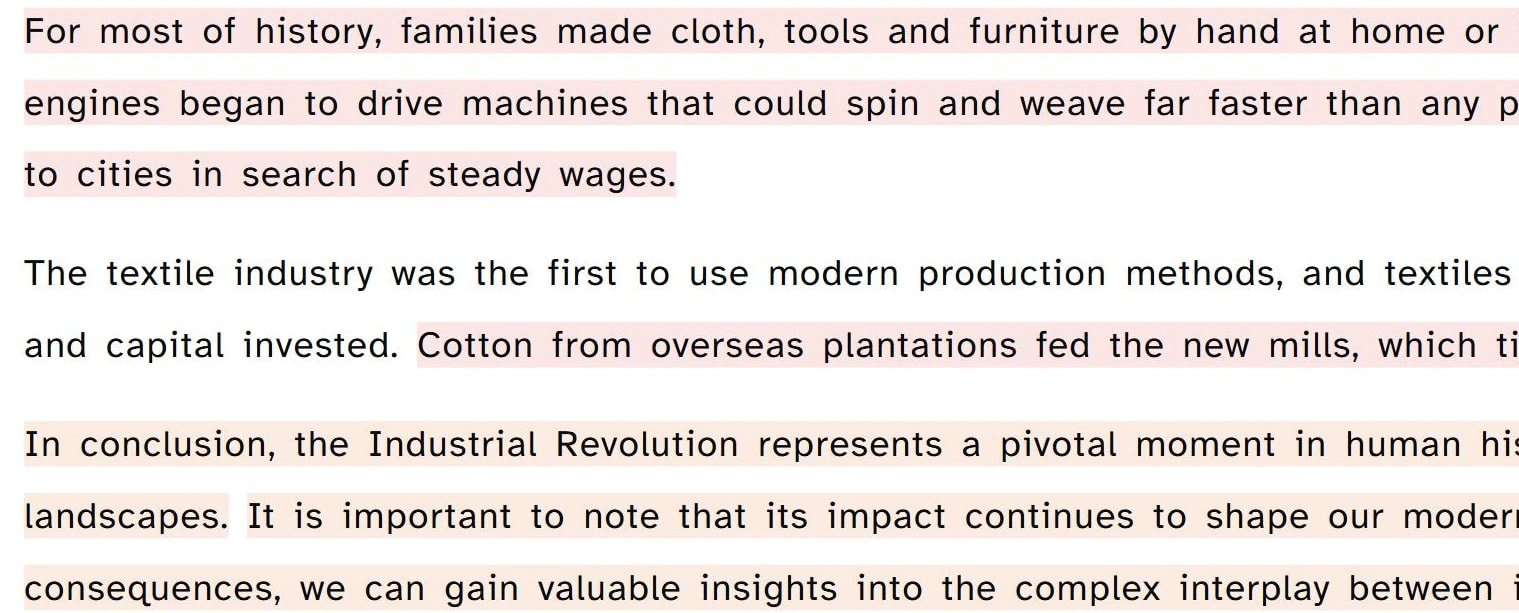
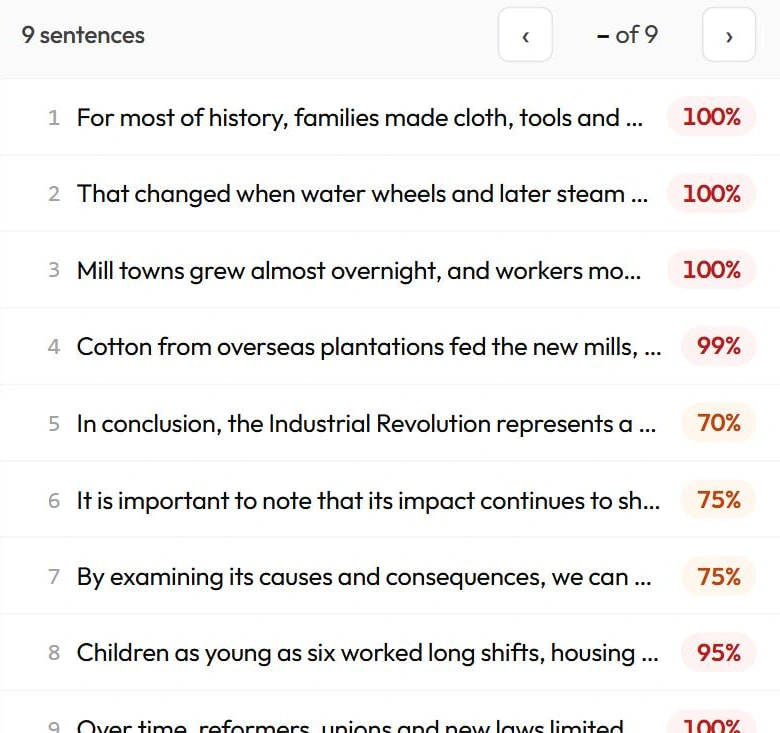
Not a vague single number. Every sentence is scored and color-coded with a confidence rating, so you know exactly which passages to act on and which to verify.
Private by design
Your text is processed in real time and never shared or used to train AI. Free scans are not retained. Your writing stays yours.
What Our AI Detector Analyzes
AI text reads the way it does for measurable reasons. Click a signal to explore it — or let them cycle.
Sentence-level highlighting
Every sentence scored and color-coded green, amber, or red — so the AI signal shows up exactly where it is.
High accuracy, low false positives
Thresholds are calibrated to avoid flagging genuinely human writing, because a false accusation has real consequences.
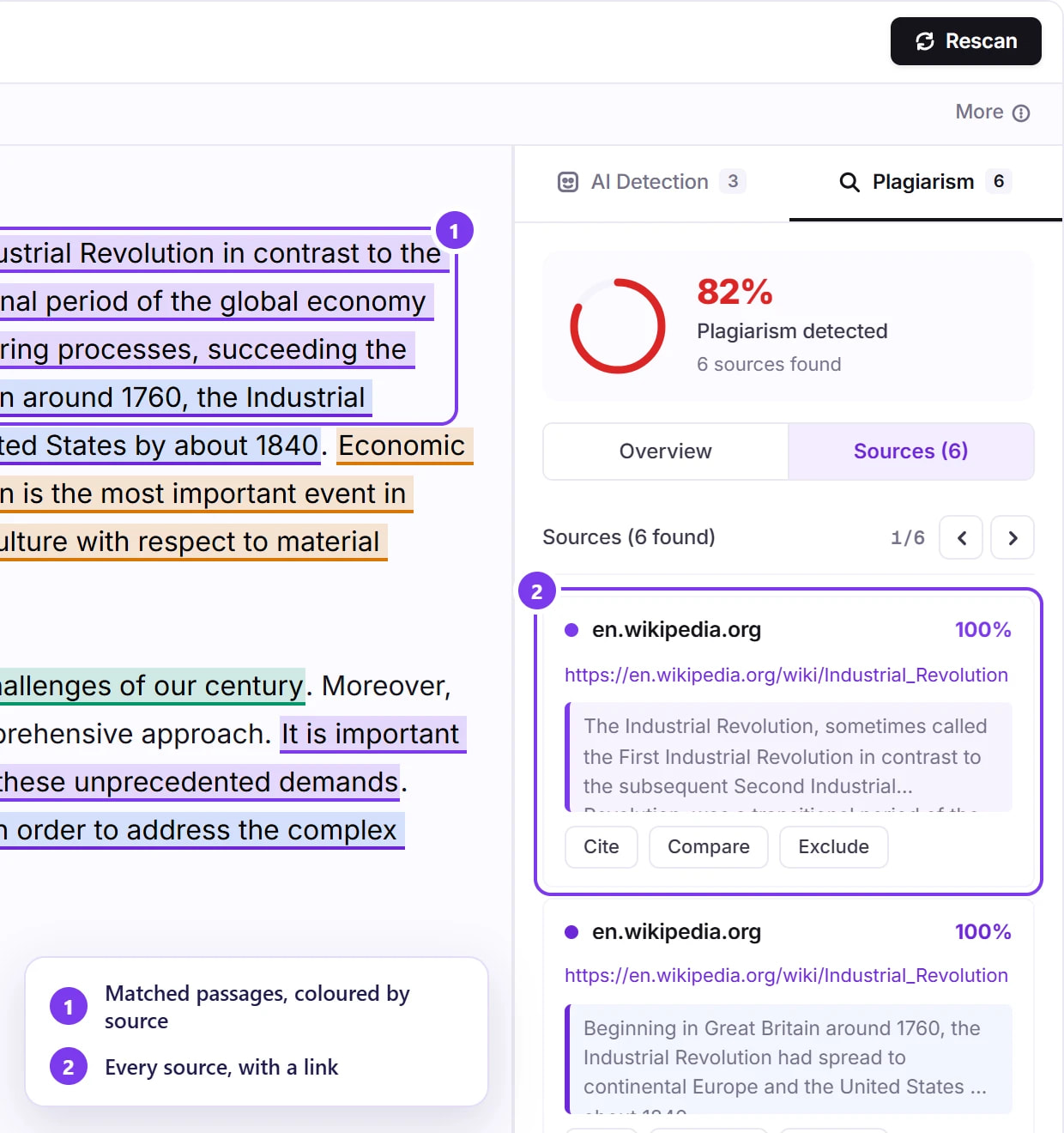
Combined AI + plagiarism
Run both checks in a single scan and get one unified originality report instead of juggling two tools.
Bulk document scanning
Upload a full class set or a batch of articles and get an individual report for each, stored in your folder.
API access for teams
Integrate detection into your LMS, CMS, or review workflow — submissions scanned the moment they upload.
Private by design
Documents are processed in real time and never shared or used to train AI. Your content stays yours.
Inside Your AI Detection Report
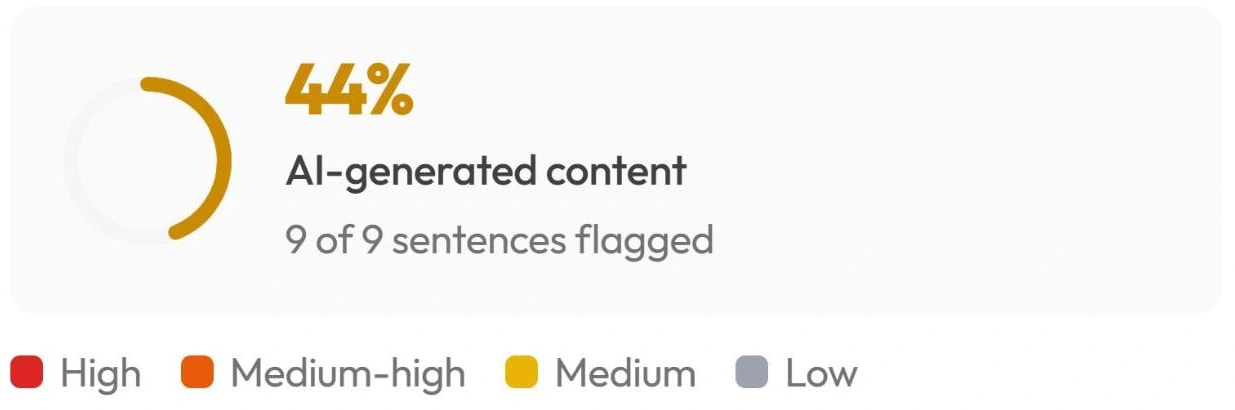
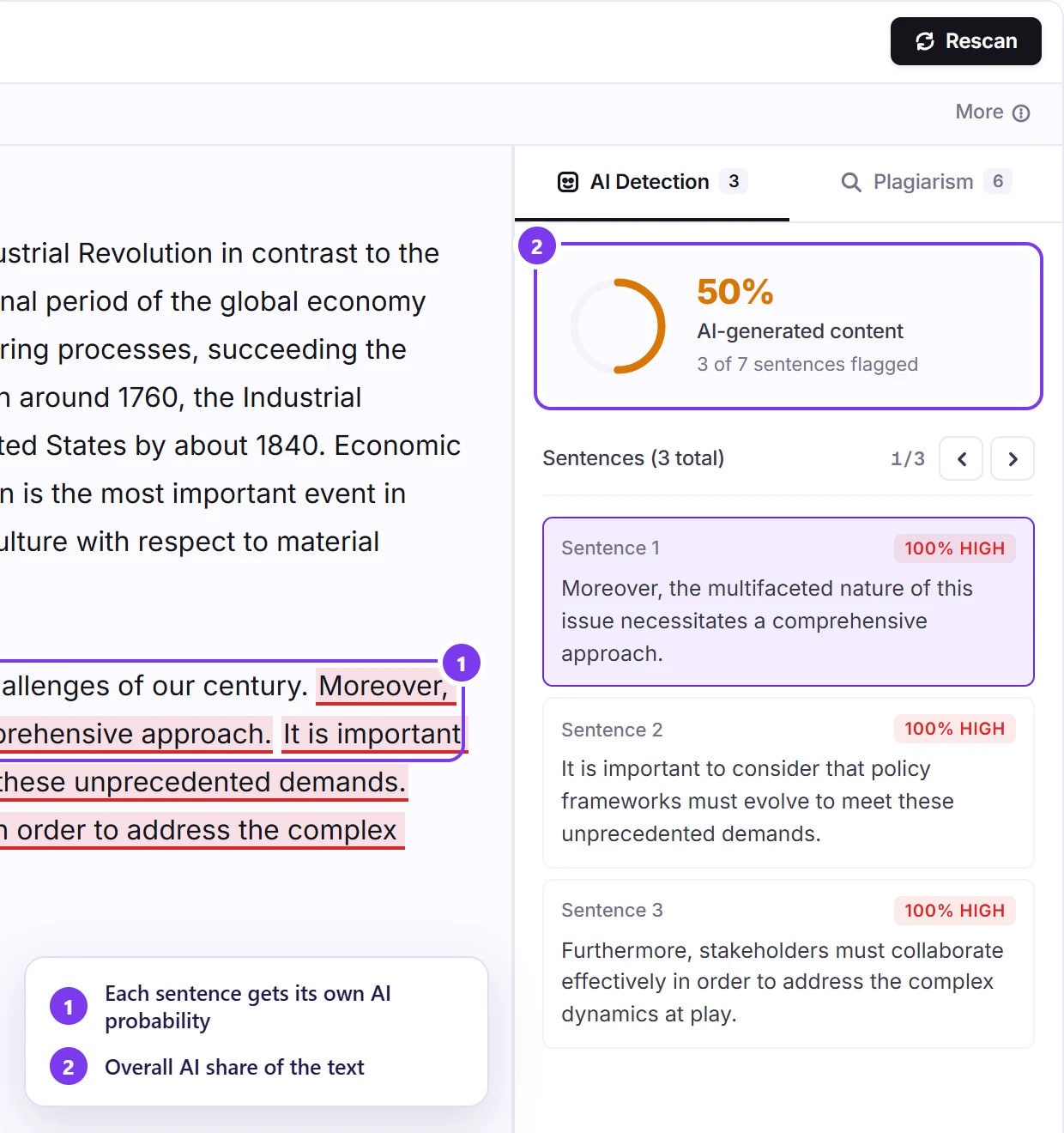
Overall AI score at a glance
A single percentage shows how much of your text looks AI-generated. Color-coded so you know in one second whether to publish or rewrite.
Sentence-level AI highlights
Every flagged sentence is color-coded by AI confidence. Click any sentence to see why it was flagged: predictable phrasing, statistical patterns, structural tells.
Confidence rating per flag
We do not just say AI or human. You get a confidence rating: high, medium, or low. This matters because no AI detector is 100% accurate. Confidence ratings tell you which flags to take seriously and which to double-check.
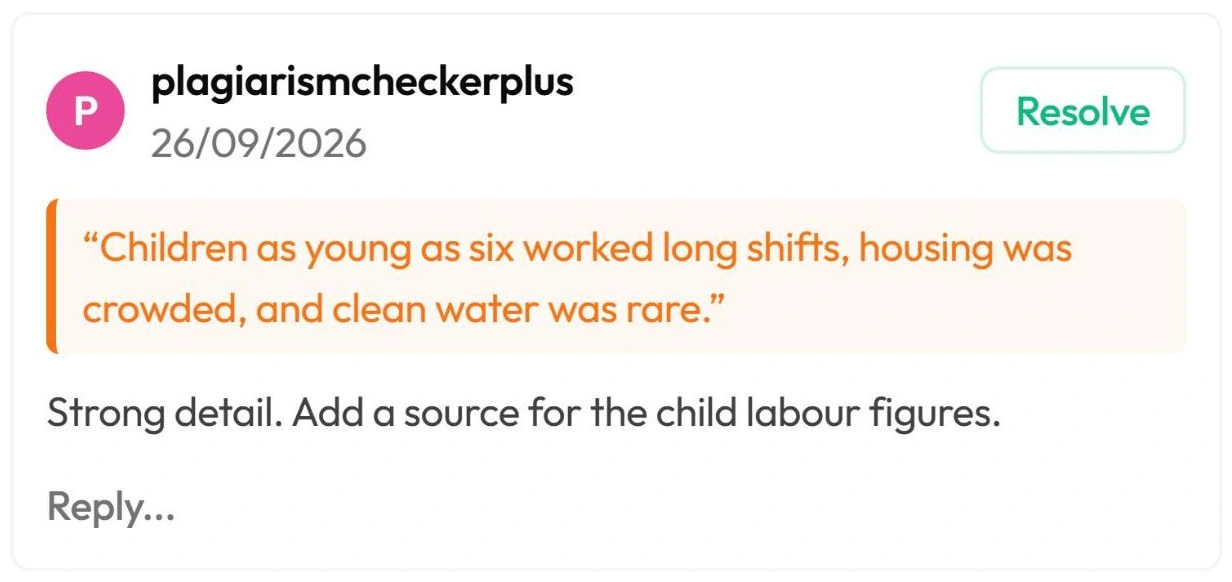
Edit and rescan in one click
Fix flagged sentences in the same window, then rescan. No copy-pasting. No losing your work.
Downloadable PDF report
Export a clean report for a professor, editor, or client. Use it as proof when you need it.
Why You Need an AI Detector
A year ago, you could spot ChatGPT writing at a glance. Now it sounds like a human. Editors, teachers, and recruiters are getting work submitted that may or may not be original, and asking the obvious question: is this AI? Guessing is no longer safe. Checking is fast.
AI-generated text is everywhere now
Google penalizes sites for scaled content abuse
Schools and clients want proof your work is yours
A standard plagiarism check will not catch AI
What Our AI Detector Spots
AI writing is not one thing. Different models leave different fingerprints. The detector is trained on output from the major language models so it can flag them all in one pass.
ChatGPT (GPT-4o, GPT-5)
The most common source of AI text on the internet. We track patterns from every public GPT release, including the latest models.
Claude (Anthropic)
Claude has a different writing style than ChatGPT: calmer, more hedged, more nuanced. The detector is tuned to recognize Claude output specifically, not just generic AI.
Gemini (Google)
Gemini text has its own structural tells — particular cadence, phrasing patterns, and hedging vocabulary. We score for them.
Llama, Mistral & open-source
Open-source models are popular with developers building wrappers and content farms. They are also harder to detect because output varies more. Our detector covers them too.
Mixed & lightly edited AI
A common pattern: someone writes a rough draft with AI, then edits it. The detector flags partial AI even when a human has cleaned it up. Each sentence is scored on its own.
Humanized AI (paraphrased to dodge)
Humanizer tools rewrite AI text to sound less robotic. We catch the patterns they leave behind. Both the original AI structure and the humanizer's reshuffling show up in the scan.
Built for the Way You Work
AI Detection at Scale
Universities, publishing houses, and large content operations need infrastructure to match the volume. Our institutional tier is built for it.
Admin dashboard & user management
Manage users, monitor usage, review flagged documents, and export reports from one control panel — no technical setup required.
Internal database cross-referencing
Combine AI detection with institutional plagiarism checking against your own uploaded private library of past submissions and research.
LMS integration via API
Connect to Moodle, Canvas, Blackboard, or any LMS. Submissions are scanned at the point of upload, with results delivered to instructors automatically.
Compliance-grade privacy
No retention beyond the analysis session. For institutions under FERPA, GDPR, or similar regimes, this is not optional — and we do not treat it as one.
Bulk processing
Handle high volumes without degrading in speed or accuracy — 500 end-of-term submissions or a quarterly content audit.
Department-level oversight
Coordinators and department heads control access, monitor usage, and review reports across courses and teams.
Detection is the first step to an honest conversation.
AI detection does not replace human judgment, and it should never be the sole basis for an academic-integrity decision. What it does is identify content that warrants a closer look — and give that judgment something to stand on.
How Do AI Detectors Work?
Detectors reverse the logic of AI generation: if models produce the most probable next word, then highly probable text is a signal of machine authorship.
Token probability
AI text leans on statistically expected vocabulary. Human writing is messier and more idiosyncratic.
Sentence-length variance
Humans vary their rhythm naturally. AI writing tends to be more metrically uniform.
Semantic coherence
AI writing is locally coherent but globally template-like. Detectors look for that predictable macro-structure.
Stylistic consistency
Human writing has voice shifts and quirks. Single-prompt AI output is stylistically flat in ways classifiers catch.
None of these signals is reliable alone. The most accurate systems use ensemble models — multiple classifiers weighing signals against each other — to return a calibrated probability, not a binary verdict.
Check for AI Wherever You Work
No installation, no setup. Run a check right in your browser, add the extension to check as you browse, or wire detection straight into your own stack.
Web app — no install
Use the full AI detector in any browser, on any device. Paste your text and scan in seconds.
Open the web checkerChrome extension
Select any text on any web page and run an AI check in one click, without switching tabs.
Request early accessAPI for teams
Plug the AI detector into your CMS, LMS, or QA workflow and scan submissions automatically.
Request API access