DeepMatch — contextual plagiarism detection
Two independent models. A multi-source index of 60B+ pages. A report that explains every flag. No black box, no inflated numbers — just honest detection.
Three ideas you will not find in free checkers
We read meaning, not words
Most checkers compare strings. We turn every sentence into a semantic vector — a 768-dimensional fingerprint that captures meaning, syntax, and topic. Two sentences with no shared words can still be a match if they mean the same thing.
→ Same word, different meaning. We compare meaning, not strings.
Reworded text still gets caught
Swapping a few synonyms used to be enough to fool plagiarism checkers. Our matcher computes similarity at the level of meaning, then verifies with a second-pass alignment. Paraphrased passages and patchwork rewrites surface in the same report.
Every match is weighted in context
A flat percentage hides the truth. Our originality score weights each match by type, length, citation status, and how common the phrasing is. A cited quotation barely moves the needle. A verbatim paragraph without a citation moves it a lot.
→ Each match is weighted in context. A cited phrase ≠ stolen idea.
From paste to report, step by step
Text preparation
Your text is normalized — case, punctuation, whitespace, and Unicode are cleaned. Sentences are segmented with a tokenizer trained on academic writing, so a citation inside a sentence does not split it.
Semantic fingerprinting
A transformer-based encoder turns every sentence into a 768-dim vector. Fingerprints capture meaning, syntax, and topic, which is what makes paraphrase detection possible.
Source matching
Vectors are compared against our index of web pages, academic publications, and prior submissions. Candidates are ranked by similarity, then verified with a second-pass exact / near-exact alignment.
AI scoring
In parallel, every sentence is scored by an independent AI-detection model that reads perplexity, burstiness, and stylometric signatures from major generators.
Conditional scoring
Matches are deduplicated and weighted in context. Citation status, match type, and phrase commonness all factor in before the final originality score is computed.
Report assembly
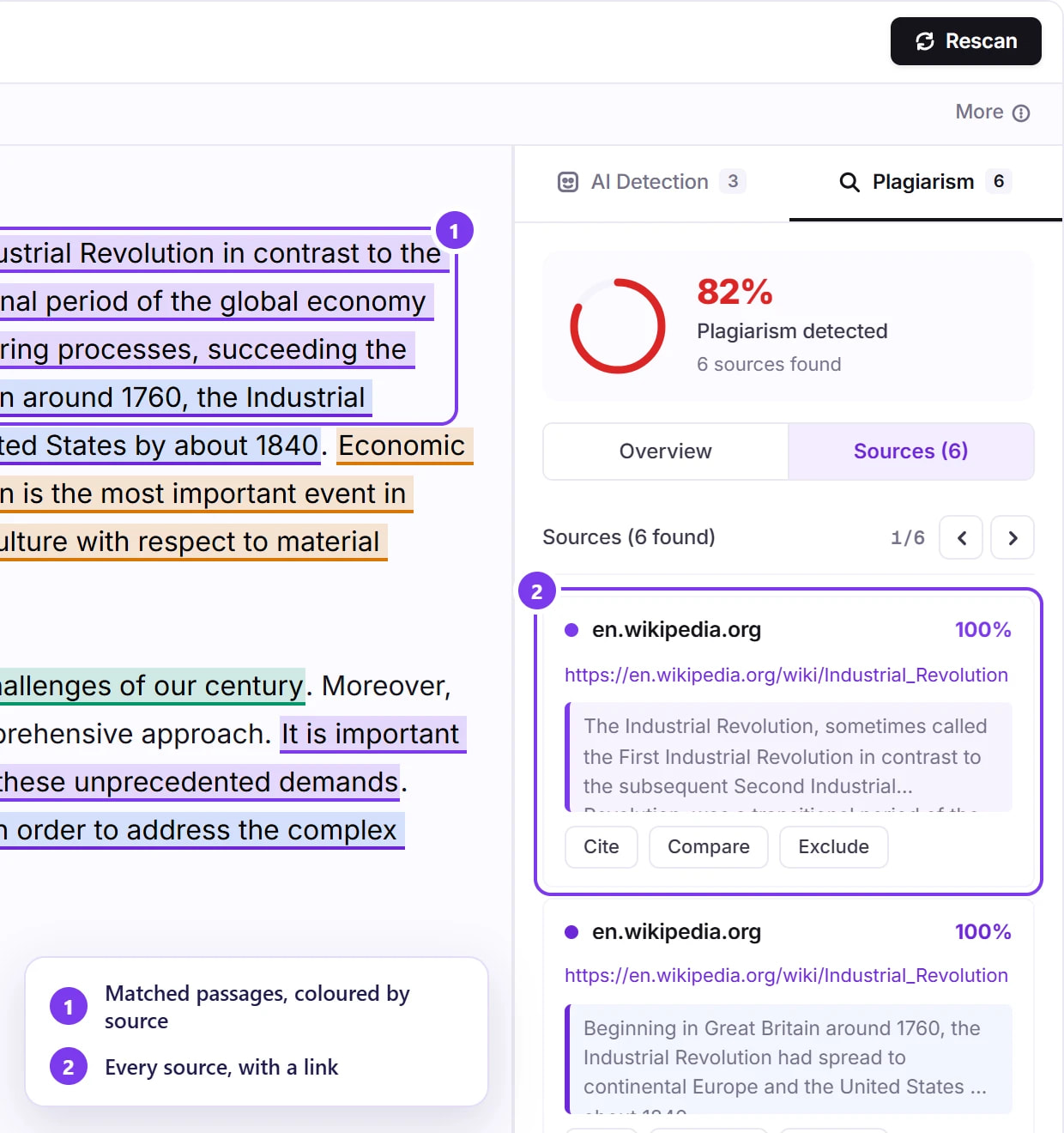
You get a sentence-level, color-graded report. Click any flagged sentence to see the source, the match confidence, and what to do about it.
Six source layers, one verdict
Free checkers usually scan the open web and stop. We add five more layers, because most plagiarism does not live where it is easy to find.
- 60B+ pages
Open web
Billions of indexed pages refreshed continuously. Blogs, news, encyclopedias, course pages, forums.
- 110M+ articles
Academic publications
Journal articles, conference papers, theses, and dissertations from major open-access and licensed repositories.
- 15M+ titles
Books & reference
Public-domain texts, Project Gutenberg, and licensed reference titles. Where partial-match plagiarism often hides.
- Opt-in
Prior submissions
A private institutional store of previously submitted work — only used when an institution has opted in.
- 14 languages
Cross-language
Aligned corpora across 14 languages. Suspect passages are mapped to a common space to catch translated plagiarism.
- 40+ years
News archives
Major news archives going back decades. Useful for current-events essays and journalism programs.
- 60B+web pages indexed
- 14languages supported
- 99.2%verbatim recall
- 1.8sper 1k words
Figures reflect Plagiarism Checker Plus internal benchmarks on our own evaluation sets and may vary with document type and language.
An independent model, trained on what generators actually produce
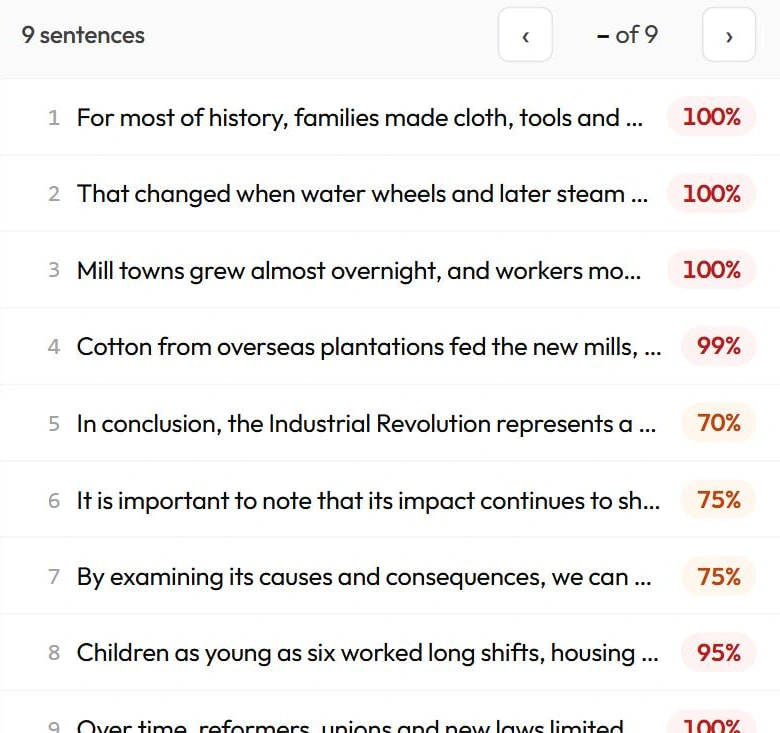
The AI detector is a separate model from the plagiarism pipeline. It scores each sentence on perplexity, burstiness, and stylometric signatures we have observed in GPT-4o, Claude, Gemini, Llama, and a long tail of fine-tuned variants.
- Retrained regularly as new models appear
- A confidence score for each sentence, not a yes/no
- Because a yes/no on a single sentence is almost always wrong
Your text is not training data
Not training data
We never use your submissions to train generative AI models. Detection models are trained on licensed and public corpora only.
Free scans are ephemeral
Free-tier text is processed in memory and discarded the moment your result returns. Nothing is written to long-term storage.
Account scans are yours
Account submissions are stored privately under your account so you can revisit reports. Delete any report in one click.
Encrypted everywhere
TLS in transit, AES-256 at rest, role-based access controls, audit logs. Sensitive endpoints are rate-limited and monitored.
See DeepMatch on your own text
Free, no signup, sentence-level results in under two seconds.