For a student, a plagiarism check is simple: find anything to fix before submission. For a teacher it is harder. You are making a judgment about someone’s work that can affect their grade, their progression or their confidence. Using a checker well means understanding what it measures, what it cannot tell you, and how to respond consistently and fairly.
What plagiarism checkers actually measure
A checker measures textual similarity, and that is all it measures. Knowing where that line sits is the difference between using a report fairly and misusing it.
What it measures
- How much of the text matches language found elsewhere
- Matches against web pages, academic journals and published content
- Matches against previously submitted papers in its database
- The specific source each flagged passage came from
What it does not measure
- Whether the copying was deliberate or accidental
- Whether a missing citation was forgotten or hidden
- Whether a close paraphrase was lazy or simply inexperienced
- Intent. That judgment is always yours.
What a similarity score tells you (and what it doesn’t)
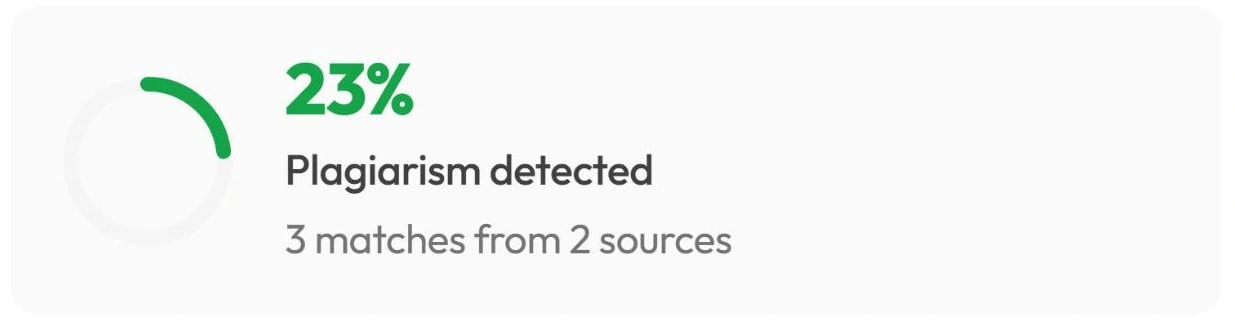
The percentage is the share of the text that matches language found in other sources. It does not, by itself, tell you whether plagiarism happened. Students tend to panic at any number above zero or relax too quickly at anything under 15%. Neither reaction is quite right.
A high score can still be legitimate
- Properly quoted and attributed material
- Standard technical terminology shared across sources
- A references or bibliography section that matches other documents
- A title, a name or an institution that appears in other submitted papers
A low score can still hide plagiarism
- Close paraphrasing that does not match word for word
- A source that simply is not in the checker’s database
What matters is the sentence-level detail: which passages are flagged, what source they match, and whether they are properly attributed. When you can see the exact sentence that triggered a match and compare it side by side with the source, you can make a real decision about it.
The types of plagiarism you will see in a report
Not all plagiarism looks the same. Recognising the different forms helps you respond in proportion. For a fuller explanation with examples, see what is plagiarism.
Direct copying
Text pasted from a source without quotation marks or a citation. Checkers detect this most reliably. Among students making any effort it is fairly uncommon, and when it appears it tends to cluster in introductions and background sections, where students feel least confident in their own voice.
Close paraphrasing
Restructuring a passage while keeping most of its vocabulary and meaning. This causes the most honest disagreement between teachers and students, because the line is genuinely unclear. The real questions are whether the student understood the idea well enough to express it independently, and whether they cited it. A paraphrase with a citation is usually fine; without one it is always a problem.
Mosaic plagiarism
Patchwriting: passages from several sources woven together with connecting sentences and presented as original. Individual pieces may not trigger exact matches, but the paper is still derived from sources rather than the student’s own thinking. It can be hard to tell from weak writing, so it needs reading, not just a score. It is often a sign the student cannot yet synthesise sources on their own.
Self-plagiarism
Resubmitting previously submitted work, or large parts of it, without disclosure. Many students are genuinely surprised this is an issue, so it is worth addressing explicitly in course materials. Compliance follows when students understand why the rule exists.
Accidental plagiarism
A missing citation, forgotten quotation marks or a phrase absorbed from reading. It is common, usually inadvertent, and still plagiarism under most institutional definitions. Whether it is a learning opportunity or a formal violation depends on severity, the student’s history and your policy.
How to interpret a plagiarism report fairly
Reading a report carefully before drawing conclusions is one of the most important things you can do to make sure your response is appropriate.
1. Check what is actually being flagged
Read the flagged sentences before forming a view. Standard academic phrasing, properly cited quotes, course-specific terminology, headers and bibliography entries are false positives from an integrity standpoint. Set them aside first.
2. Look at the matched source
A match against a paper the student cited correctly is different from a match against a paper-mill site. A match against another student’s earlier submission is different from a match against a news article. The source is often as informative as the match itself.
3. Compare with the student’s other work
Writing that suddenly improves, a voice that sounds different, vocabulary out of step with earlier work: these are signals a checker cannot see but an experienced teacher can. A high score that is consistent with the student’s previous work may simply call for citation guidance.
4. Avoid the threshold trap
A fixed trigger such as “anything over 20%” works against fair assessment. A well-researched paper with many properly attributed sources can legitimately score higher than one that avoided sources altogether. The percentage needs context to mean anything.
Using detection across different assignment types
Not every assignment carries the same plagiarism risk, so your checking can be calibrated to match.
Research papers and essays
The highest-risk type: heavy source engagement, higher scores and more complex reports. Read flagged sections carefully and weigh the share of quoted or closely paraphrased material against the sections where the student writes analytically in their own voice.
Group projects
The report often cannot show which student wrote a flagged passage, so the conversation has to cover who wrote which sections. Asking for individual contribution statements makes students accountable for specific parts and shifts the incentive in the right direction.
Literature reviews and annotated bibliographies
Extensive source engagement means naturally higher similarity than a reflective essay. Adjust your expectations before reading the report, and focus on the sections where the student should be synthesising or analysing rather than summarising.
Short responses and reflections
Lower risk: there is less room to hide borrowed content, and students usually write from personal experience. A full review of every short response is rarely the best use of your time; save detailed review for higher-stakes submissions.