The short answer
Teachers check for AI in two ways at once. They run submissions through an AI detector, which estimates how likely each passage is to be machine-written, and they look at evidence around the work: drafts and version history, how the writing compares with the student’s earlier work, and whether the student can explain it. No single method is proof. A careful teacher treats a detector score as a reason to look closer, not as a verdict.
Six ways teachers check for AI
1. AI detectors
An AI detector analyses statistical patterns in the text, such as how predictable the word choices are and how uniform the sentence rhythm is, and returns a likelihood that it was generated by a model like ChatGPT, Claude or Gemini. Many schools provide one through their learning platform or a licensed tool, and teachers also use standalone checkers.
The most useful detectors score each sentence rather than giving one number for the whole essay. That shows where AI-like text is concentrated, which matters when a student used AI for one section, or when only a couple of formal sentences are flagged.
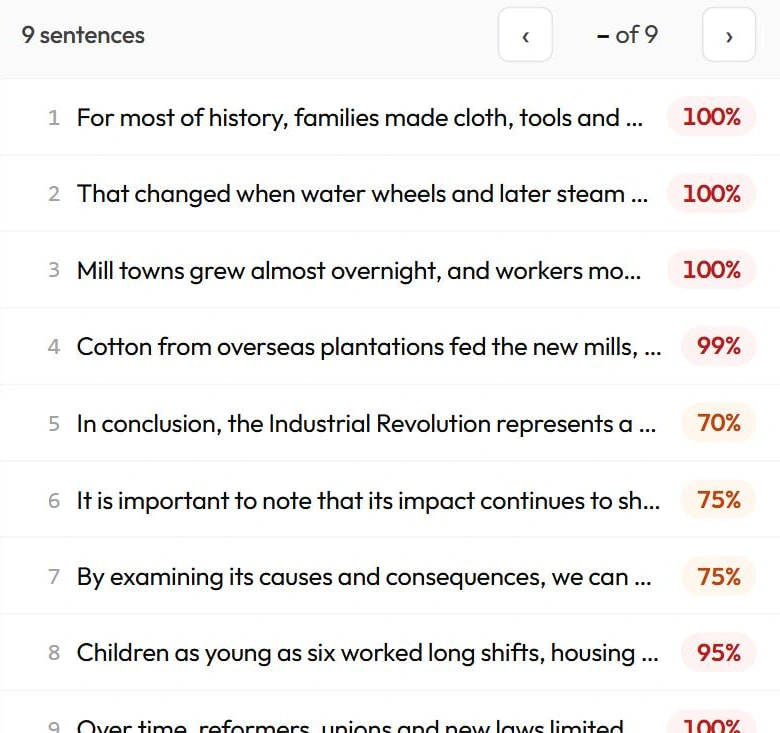
For how the scoring works, see how AI detectors work.
2. Plagiarism checkers (which mostly miss AI)
A plagiarism checker compares text against published sources. AI output is usually new text that does not exist anywhere else, so a plagiarism check often comes back clean. Teachers still run one, because AI tools sometimes reproduce familiar phrasing and, more often, invent citations that do not exist. A reference list full of sources that cannot be found is a strong reason to ask questions.
3. Drafts and version history
Writing leaves a trail. Google Docs and Microsoft Word both keep version history, showing when text was added and how it changed. Gradual drafting, deletions and rewrites look very different from a finished essay that appears in one paste. Some teachers ask for outlines, notes or drafts at checkpoints, which makes the process visible from the start.
4. Comparing with earlier writing
Teachers who know a student’s writing notice sudden changes: a jump in vocabulary, a different voice, or an essay that is fluent but oddly generic. In-class writing samples give a baseline that was produced without access to AI.
5. A follow-up conversation
Asking a student to talk through their essay is one of the most reliable checks available. A student who wrote the work can usually explain their argument, why they chose a source and what they would change. This works best as a genuine conversation, not an interrogation. Our guide on talking to a student about plagiarism covers how to run it.
6. Reading for the tell-tale signs
Teachers also read for patterns common in AI text: generic claims with no specific examples, a tidy five-part structure that answers a slightly different question, confident statements that are factually wrong, and quotations or statistics that cannot be traced. None of these proves AI use on its own; plenty of students write generically. Together, they tell a teacher where to look.
Can teachers detect ChatGPT?
Often, yes, especially when a whole essay is pasted from ChatGPT with little editing. Detectors pick up the statistical smoothness of unedited AI text, and teachers pick up the mismatch with a student’s usual work.
It gets harder when:
- the student heavily rewrites the AI draft in their own words;
- AI was used for ideas or an outline rather than the text itself;
- the text is short, so there is little for a detector to measure;
- “humanizer” tools have rewritten the output, which can lower a score without removing every trace.
In other words, detection is best at finding the cases that matter most for integrity, wholesale AI-written work, and weakest at the grey areas that policies are still working out.
Why an AI score is a likelihood, not proof
Every AI detector can be wrong in both directions. It can miss AI text that has been edited, and it can flag human writing, especially short passages, very formal or formulaic prose, and writing by people working in a second language. Detector makers generally say the same thing: their output is an indicator, not evidence of misconduct on its own.
That is also why sentence-level results are more useful than a single percentage. “Three sentences in the conclusion scored high” leads to a very different conversation than “this essay is 40% AI.”
For teachers: a fair process
- Set the rules first. Say in the assignment brief what AI use is allowed, if any, and how students should disclose it.
- Build in process evidence. Ask for an outline or a draft, or use version history, so you have more than the final text to go on.
- Check, then read. Use a detector to decide which submissions and passages deserve a closer read, not to decide the outcome.
- Talk before you conclude. Ask the student about their process with the evidence in front of you.
- Follow policy and record it. Keep notes of what you saw and what the student said, and use your institution’s process for anything formal.
Assignment design helps as much as detection. Tasks that ask students to connect course material to their own experience, respond to a class discussion, or reflect on how their draft changed are harder to hand straight to a chatbot, and they produce the process evidence you need anyway.
Plagiarism Checker Plus gives teachers a plagiarism check and a sentence-level AI check in one report, with folders for each class. See the plagiarism and AI checker for teachers.
For students: how to protect yourself
If you write your own work, the best protection is being able to show your process. That is useful whether or not your teacher ever asks.
- Write in a document with version history, rather than drafting elsewhere and pasting the final text in.
- Keep your notes, outline and sources. They show how your argument developed.
- Disclose any AI use your course allows, and cite AI output you include. See how to cite ChatGPT.
- Run your own check. An AI detector shows which sentences might be flagged, so you are not surprised. If your own writing scores high, keep your drafts ready rather than rewriting good sentences to game a score.
If you are flagged and you did not use AI, stay calm, ask to see what was flagged, and offer your version history and notes. A conversation about your process is usually the fastest way to resolve it.