Florida adopts binding AI rules for schools, with parent opt-in
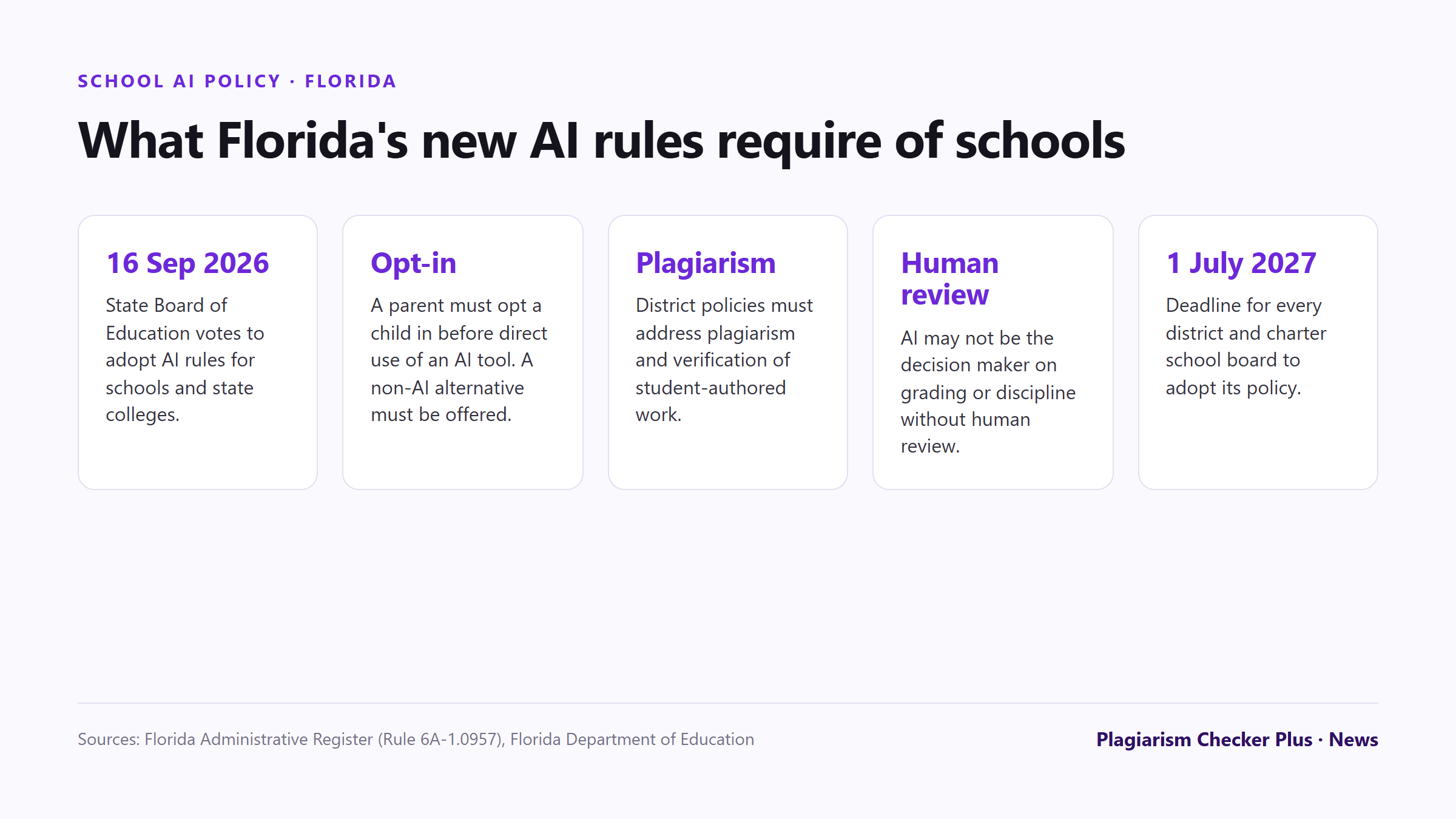
Florida's State Board of Education voted on 16 September 2026 to adopt rules on artificial intelligence in the state's public schools and its 28 state colleges. The school rule does not set one statewide classroom policy. It tells every school district and charter school board to write its own by 1 July 2027 and lists what that policy must contain. The list includes telling parents which AI tools are approved, letting them choose whether their child uses a tool directly, and addressing plagiarism and the verification of work a student says is their own. A separate rule tells state colleges to ban AI on graded work unless the instructor allows it.
Summary
- The board met at Polk State College in Winter Haven. FOX 35 Orlando reported that the vote was unanimous.
- Under the school rule, a child uses an approved AI tool directly only if a parent opts them in. Families who do not opt in must be offered a comparable non-AI alternative.
- District policies must also cover academic integrity, extra review of tools for the youngest pupils, teacher training and limits on what vendors do with student data.
Key takeaways
- These are rules that districts and colleges must follow. The Florida Department of Education contrasted them with the guidance many other states have issued.
- The academic integrity clause names plagiarism, permitted classroom use and verification of student-authored work. It leaves the detail to each district.
- AI may not be the decision maker on grading or discipline without human review, under an amendment the board made on the day of the vote.
What the board adopted
There are two rules. The first is an amendment to Rule 6A-1.0957, Florida's existing internet safety rule for school districts and charter schools. The second is a new rule, 6A-14.0719, for the Florida College System, which is the state's network of public colleges and is separate from its state universities. The Florida Department of Education announced the vote on 16 September.
The text of both rules is in the Florida Administrative Register, the state's official record of rulemaking. The proposed school rule was published on 26 August 2026 and the proposed college rule on 25 August. A notice of change published on 18 September records what the board added to the school rule. This article is based on those three documents.
| Schools (Rule 6A-1.0957) | State colleges (Rule 6A-14.0719) | |
|---|---|---|
| Who must act | Each district school board and charter school governing board | The board of trustees of each Florida College System institution |
| What they must do | Amend their internet safety policy to cover AI instructional tools | Adopt one or more policies on the use and limits of AI |
| Deadline in the rule text | 1 July 2027 | None stated |
| Parents | Notice of each approved tool, and an opt-in before a child uses a tool directly | Parents of enrolled minors are told if their child will directly use an AI instructional tool |
| Academic integrity | Policy must address plagiarism, permitted use and verification of student-authored work | No AI on a graded assignment or assessment unless the instructor explicitly permits it |
The school rule applies to what it calls an AI instructional tool: software using generative AI, or AI that acts with little human oversight, that a school makes available to a student for instruction, tutoring, practice, feedback or assignments. Generative AI is the kind that produces text, images or other content on request. The definition leaves out AI systems that do not interact with students, and systems used to analyse, classify, predict or detect on the basis of existing data.
What changes for parents and pupils
When a district approves an AI instructional tool, its policy must require a notice to parents in plain, non-technical language. The notice has to name the application, the grade levels and subjects it will be used in, and how students will interact with it, including whether it gives automated feedback. It must also explain how a parent can object to the tool's content.
If a student will use the tool directly, the rule requires that parents be given the option to opt their child in. The notice must also describe a non-AI alternative that is, in the rule's words, "substantively comparable in instructional quality and access" for children whose parents do not opt in. Some reports in August, including one from CBS Miami, described the proposal as letting parents opt out. The text in the register is an opt-in: the default is that the child does not use the tool.
- Youngest pupils: tools proposed for Voluntary Prekindergarten through grade 5 must go through an additional review to check that content is age- and developmentally appropriate.
- No companion AI: districts may not deploy AI that is designed, marketed or configured to meet a student's social or emotional needs, to simulate friendship or an emotional relationship, or to use human-like design features to keep a student interacting.
- No hidden profiling: tools must not subject students to undisclosed behaviour monitoring, social scoring or psychological profiling.
- Public list: each district must keep a publicly accessible list of approved AI instructional tools.
- Records: tools must keep records of student interactions for at least 30 days so that parents can ask to see them.
- Data: approved tools may not sell or monetise student data or use it to train commercial AI models. Districts must prioritise vendors that store and process student data in the United States.
What the rules say about plagiarism and grading
For schools, the academic integrity requirement is one sentence. District policies must ensure academic integrity in the use of AI instructional tools by addressing "student plagiarism, permissible classroom usage, verification of student authored work" and, where appropriate, by letting students demonstrate mastery. The rule gives three examples of what that can include: drafts, a student's reflection on their AI use, and showing mastery without AI.
The rule does not say how a district should verify that a student wrote something. It does not mention AI detection software, and it does not set penalties. Those choices are left to each district's policy.
The notice of change adds a limit that bears on how any suspicion is handled. Policies must ensure that AI is "never used as a decision maker absent human review" for any use. The examples listed are grading, evaluations, promotions, discipline, threat assessment, counselling referrals, referrals for Exceptional Student Education, and communications.
The college rule is more direct. Each college's policies must prohibit students from using AI to work on a graded assignment or assessment unless the instructor of that course or programme explicitly permits it. Colleges must also list their approved AI tools and adopt a definition or framework for AI literacy.
What the board added on the day
The notice of change shows three additions to the school rule as first proposed. Besides the human review clause, the board added a definition of autonomous or agentic AI, meaning a system that can set goals, take multi-step decisions and carry out actions with minimal or no human oversight. A tool of that kind may be used in any grade only under the direct supervision of an adult. It must keep a complete log of its activity, and school staff must be able to suspend or disable its autonomous functions immediately without help from the vendor.
The third addition requires districts to tell the Department of Education if an approved AI tool shows unexpected autonomous behaviour or causes a safety or security incident, including unauthorised access to data.
Other requirements were in the August text and remain. Teachers and administrators must be trained on AI risks, limitations and safety. Districts must review whether each tool improves student outcomes, and must report the tools they use to the department, with grade levels, subjects, frequency of use and length of student interaction.
| Date (2026) | What happened | Source |
|---|---|---|
| 27 May | Notice of rule development for the college rule is published. | Florida Administrative Register |
| 21 July | Notice of rule development for the school rule is published. | Florida Administrative Register |
| 25 and 26 August | The proposed text of the college rule and then the school rule is published. | Florida Administrative Register |
| 16 September | The State Board of Education votes at Polk State College in Winter Haven. | Florida Department of Education |
| 18 September | The notice of change to the school rule is published. | Florida Administrative Register |
What officials said, and what is not yet known
Education Commissioner Henry Mack told the board, as reported by the News Service of Florida and carried by WGCU: "Artificial intelligence is already in the classroom, and the rules before you today are about keeping Florida in front, rather than reacting." He described the approach as neither banning AI nor allowing unfettered access. In the department's press release, Governor Ron DeSantis said: "Florida will not outsource childhood to a chatbot."
The department called the rules "one of the most comprehensive, parent-centered AI frameworks in the country". That is the department's own description. We have not seen an independent comparison with other states.
The same press release said the commissioner had directed the department to update Florida's K-12 computer science standards and its Digital Classrooms Plan, which covers how districts evaluate educational technology.
- Effective date: when we checked the Florida Administrative Register on 4 October 2026, it did not yet show an effective date for either rule. The school rule sets 1 July 2027 as the deadline for district policies, and the News Service of Florida reported that the policies are for the 2027-28 school year.
- Final college text: the register shows the college rule as proposed in August. It lists no notice of change for that rule, and we could not confirm from the register whether the board altered it.
- Reaction: the news reports we read did not include responses from school districts, teachers' organisations or parent groups.
- Scope of supervision: some news reports said students may not use AI unsupervised. The rule text we read ties the direct supervision requirement to autonomous or agentic tools.
What this means for students and teachers
- Students in Florida schools: nothing changes at once. Your district has until 1 July 2027 to adopt its policy. Until then, the rule that applies to an assignment is the one your teacher and school already set.
- Students in Florida state colleges: the college rule's starting point is that AI is not allowed on graded work unless the instructor says so explicitly. If a syllabus is silent, ask, and keep the answer.
- Students anywhere: the rule names drafts and a reflection on AI use as ways to show work is your own. Keeping drafts and notes is useful whatever your school's policy says.
- Teachers: the rule requires training on AI risks and limitations, and bars AI from deciding grading or discipline without human review. A flag from any automated system would need a person to review it before a decision.
- School leaders outside Florida: the rule is a detailed checklist of what a district AI policy can cover, from parent notices to vendor data terms. The exact wording is in the register notices linked above.
Sources
- Florida Department of Education, Florida Sets National Standard for Responsible AI in Classrooms, From VPK Through College, press release, 16 September 2026.
- State Board of Education, Notice of Proposed Rule 6A-1.0957, Internet Safety Policy, Florida Administrative Register, Vol. 52 No. 166, 26 August 2026.
- State Board of Education, Notice of Change, Rule 6A-1.0957, Florida Administrative Register, Vol. 52 No. 182, 18 September 2026.
- State Board of Education, Notice of Proposed Rule 6A-14.0719, Artificial Intelligence (A.I.) Policies in Florida College System Institutions, Florida Administrative Register, Vol. 52 No. 165, 25 August 2026.
- Ana Goñi-Lessan, News Service of Florida, State board approves artificial intelligence guidelines for K-12 Schools, colleges, WGCU, 17 September 2026.
- FOX 35 Digital Staff, Florida approves AI classroom rules requiring parental consent, new student safeguards, FOX 35 Orlando, 16 September 2026.
- CBS Miami Team, Florida moves to regulate AI in public colleges and K-12 schools as state lawsuit targets OpenAI over violence, CBS Miami, 26 August 2026 (report on the proposal before the vote).
FAQ
Did Florida ban AI in schools?
No. The State Board of Education voted on 16 September 2026 to require each school district and charter school board to adopt a policy on AI instructional tools by 1 July 2027. The rule prohibits some kinds of AI, such as tools designed to simulate friendship or an emotional relationship with a student, and sets conditions for the rest.
Do Florida parents have to consent before a child uses AI at school?
Under the rule, district policies must notify parents when an AI instructional tool is approved. If the student will use the tool directly, parents must be given the option to opt their child in, and must be told about a comparable non-AI alternative if they do not.
What does the Florida rule say about plagiarism?
District policies must ensure academic integrity in the use of AI instructional tools by addressing student plagiarism, permissible classroom usage and verification of student-authored work. Where appropriate, students may demonstrate mastery through drafts, a reflection on their AI use, or work done without AI. The rule does not prescribe a method of verification.
Can AI grade or discipline students under the Florida rule?
Not on its own. An amendment recorded in the notice of change published on 18 September 2026 says AI must never be used as a decision maker without human review. Grading, evaluations, promotions and discipline are among the examples listed.
What do Florida's state colleges have to do?
Under Rule 6A-14.0719 as proposed, each Florida College System institution must adopt AI policies. They must prohibit students from using AI on a graded assignment or assessment unless the instructor explicitly permits it, and require that parents of enrolled minors are told if their child will directly use an AI instructional tool.
When do the Florida AI rules take effect?
The school rule gives districts until 1 July 2027 to adopt their policies. When we checked on 4 October 2026, the Florida Administrative Register did not yet show an effective date for either rule.
What happens next
The vote sets requirements for district and college policies. It does not write those policies. What a Florida student is allowed to do with AI on an assignment will depend on what each district adopts before July 2027 and what each college instructor permits. We will update this article when the register shows the rules' effective dates, or if the final text differs from the notices cited here.
Is using AI plagiarism?
A plain guide to when AI help counts as plagiarism, how school rules differ, and how to disclose what you used.