New York City pauses student-facing generative AI through 8th grade for the 2026-27 school year
The largest school district in the United States has started the school year with a pause on generative AI for its younger students. On 2 September 2026, Mayor Zohran Mamdani and Schools Chancellor Kamar Samuels announced a one-year moratorium on student-facing generative AI from 2-K through 8th grade, together with new screen time limits and a small set of supervised pilots in high schools. This article sets out what the city has published, how the first reports described it, and what it does and does not say about schoolwork.
Summary
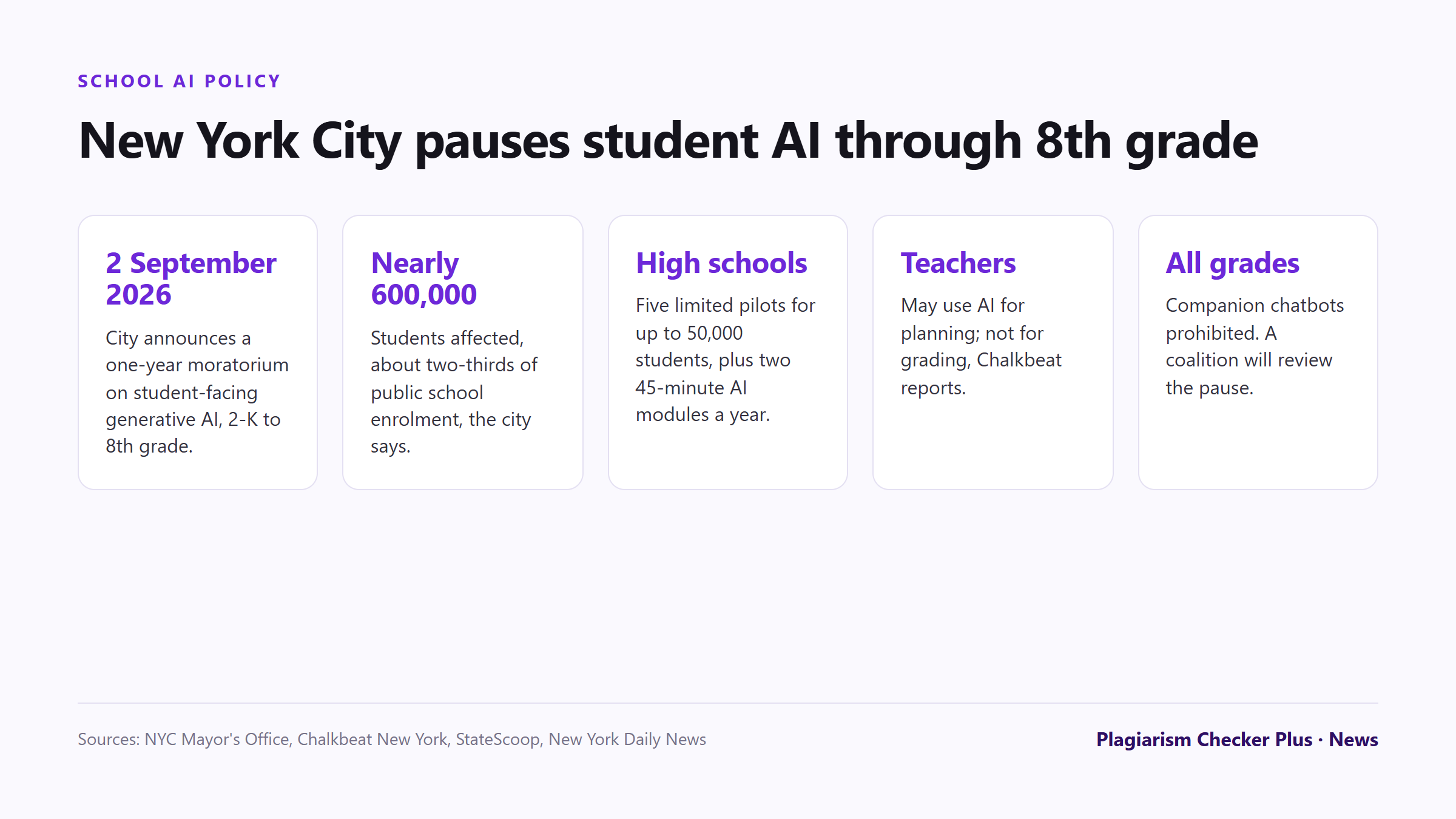
- On 2 September 2026 New York City announced a one-year moratorium on student-facing generative AI for children in 2-K through 8th grade, effective in the 2026-27 school year.
- The city says the decision affects nearly 600,000 public school students, about two-thirds of total enrolment. Companion chatbots are prohibited in every grade.
- High schools get two 45-minute AI modules a year and five limited pilots for up to 50,000 students. Teachers may still use AI for planning, but not for grading, Chalkbeat reports.
Key takeaways
- This is a pause with a review, not a permanent ban: it lasts one school year and a coalition will assess it.
- The rules cover what schools provide in class. The mayor's announcement does not mention cheating, academic integrity or AI detection tools.
- Critics come from both directions: some say the exceptions are too wide, others say younger pupils could lose useful tools.
What was announced
The mayor's office announcement, dated 2 September 2026, sets a one-year moratorium on student-facing generative AI for children in 2-K through 8th grade, effective in the 2026-27 school year. The city says the decision, together with the screen time policy, will affect nearly 600,000 public school students, or two-thirds of the system's enrolment.
Chalkbeat New York reported the plan the same day, describing the banned tools as student-facing products such as chatbots and AI tutors. It gave the first day of school as 10 September.
The policy replaces an earlier approach. According to Chalkbeat, guidelines issued in March 2026 drew a strong backlash: thousands of people signed a petition, and more than half of City Council members signed a letter. The September policy is stricter for younger children.
The rules by grade
| Group | Generative AI | Screen time on individual devices |
|---|---|---|
| 2-K to 2nd grade | No student-facing generative AI for 2026-27 | Restricted. Chalkbeat reports no individual devices, although classroom smart boards are allowed |
| 3rd to 5th grade | No student-facing generative AI for 2026-27 | Recommended cap of 30 minutes a day |
| 6th to 8th grade | No student-facing generative AI for 2026-27 | Recommended cap of 45 minutes a day |
| High school | Not covered by the moratorium. Two 45-minute AI modules a year, plus five limited pilots for a maximum of 50,000 students, with no more than five pilot classes per school | Chalkbeat reports that recommendations vary by subject |
| All grades | Companion chatbots prohibited | - |
The figures in the table come from the mayor's office announcement unless Chalkbeat is named. The announcement says the two high school modules will cover what AI is and is not, bias, risks, ethics and the effect on careers. StateScoop reports that the five pilots use vetted tools: Quill, Edia, Brisk Teaching, Playlab and Intel AI-Ready Schools.
- Exceptions: the city says exceptions will be granted for assistive technology used by students with disabilities, for multilingual learners, and for students in career readiness courses such as computer science.
- Teachers: staff may keep using AI for instructional planning and operational tasks, provided the tools meet the school system's safety standards, according to the announcement.
- Limits on staff use: Chalkbeat reports that teachers will not be allowed to use AI for grading, behaviour monitoring, counselling or developing special education plans.
- Review: a new Technology in Schools Coalition of students, educators, parent leaders, elected officials, advocates, union partners and experts will assess the moratorium and the pilots.
How people reacted
The city presents the policy as protecting how children learn. In the announcement, Mamdani says children need teachers and human connection to learn and grow, and Samuels describes the rules as guardrails. StateScoop reports that Jim Steyer, chief executive of Common Sense Media, endorsed the policy.
Others were less sure, according to a New York Daily News report carried by the News Tribune on 4 September. A parent in the AI Moratorium Coalition told the paper: "There are a lot of holes in the policy". Michael Mulgrew, president of the United Federation of Teachers, questioned how the city will make sure the products it buys follow the new rules.
The same report quotes a high school student activist who wanted the pause to go further: "We can't just stop at middle school". From the other direction, Richard Buery Jr., chief executive of the anti-poverty organisation Robin Hood, said he feared the city was rejecting uses that could help younger children.
Enforcement is the open question. Chalkbeat reported on 2 September that it was unclear how the Education Department planned to enforce the policy.
What this means for teachers, students and parents
The points below are our reading of the reported facts, not official advice. Schools in New York City should follow what the Education Department sends them.
- Teachers in 2-K to 8th grade: check whether any classroom software you use includes a student-facing generative AI feature, and ask your school how it is being handled. The union's concern, as reported, is that this checking should not be left to individual schools.
- Teachers in every grade: planning with AI is still allowed if the tool meets the system's safety standards. Grading with AI is not, according to Chalkbeat.
- High school students: you are not covered by the pause, but school-provided AI is limited to the modules and a small number of supervised pilot classes. Ask your teacher what is allowed before using AI on an assignment.
- Parents: the screen time figures for 3rd to 8th grade are recommended caps. If your child has a disability or is a multilingual learner, the exceptions may apply, so ask the school.
- School leaders elsewhere: the structure may be more useful than the headline. It sets different rules by age, separates staff use from student use, limits pilots in size and builds in a review.
Sources
- NYC Mayor's Office, Mayor Mamdani and Chancellor Samuels Put Students First with Nation's Broadest Generative AI Moratorium in Schools, nyc.gov, 2 September 2026.
- Amy Zimmer and Alex Zimmerman, NYC to ban student AI tools in 2-K through 8th grade and limit classroom screen time, Chalkbeat New York, 2 September 2026.
- Keely Quinlan, NYC schools ban student use of generative AI in classrooms through middle school, StateScoop, 2 September 2026.
- Cayla Bamberger, NYC to ban AI in preschool through eighth grade this year, but AI skeptics fear 'exemptions', New York Daily News (via News Tribune), 4 September 2026.
FAQ
Did New York City ban AI in schools?
Partly. On 2 September 2026 the city announced a one-year moratorium on student-facing generative AI for children in 2-K through 8th grade, effective in the 2026-27 school year. High school students are not covered by the moratorium, and teachers may still use AI for planning and operational tasks.
Can New York City high school students use AI at school?
Only in limited ways. The city says high schoolers will take two 45-minute AI modules a year, and five limited pilots will be offered to a maximum of 50,000 students, with no more than five pilot classes per high school. Companion chatbots are prohibited in all grades.
Can New York City teachers use AI for grading?
No, according to Chalkbeat New York, which reports that teachers will not be allowed to use AI for grading, behaviour monitoring, counselling or developing special education plans. The city says teachers may use AI for instructional planning and operational tasks if the tools meet its safety standards.
How long does the New York City school AI moratorium last?
One year. The mayor's office describes it as a one-year moratorium effective in the 2026-27 school year. A Technology in Schools Coalition will assess its impact and the high school pilots.
What happens next
The moratorium covers the 2026-27 school year. During that time the city says a new Technology in Schools Coalition will assess the pause and the high school pilots and publish recommendations, which should shape what happens after the year ends. We will update this article when the city publishes those recommendations or changes the rules.
Is using AI plagiarism?
A plain guide to when AI help on schoolwork is allowed, when it is not, and how to ask your teacher.