Ofqual warns students that hidden AI use in coursework could cost them a whole GCSE or A level
Ofqual, the regulator for qualifications in England, is starting a campaign aimed at secondary school students during coursework season. Its message is that using AI in coursework and passing the work off as your own will not be tolerated. In comments reported by PA Media on 18 November 2026, chief regulator Sir Ian Bauckham said students who do not disclose AI use could lose an entire GCSE or A level. He also said unsupervised coursework needs a rethink, and that exam halls face a separate risk from AI-enabled wearable devices.
Summary
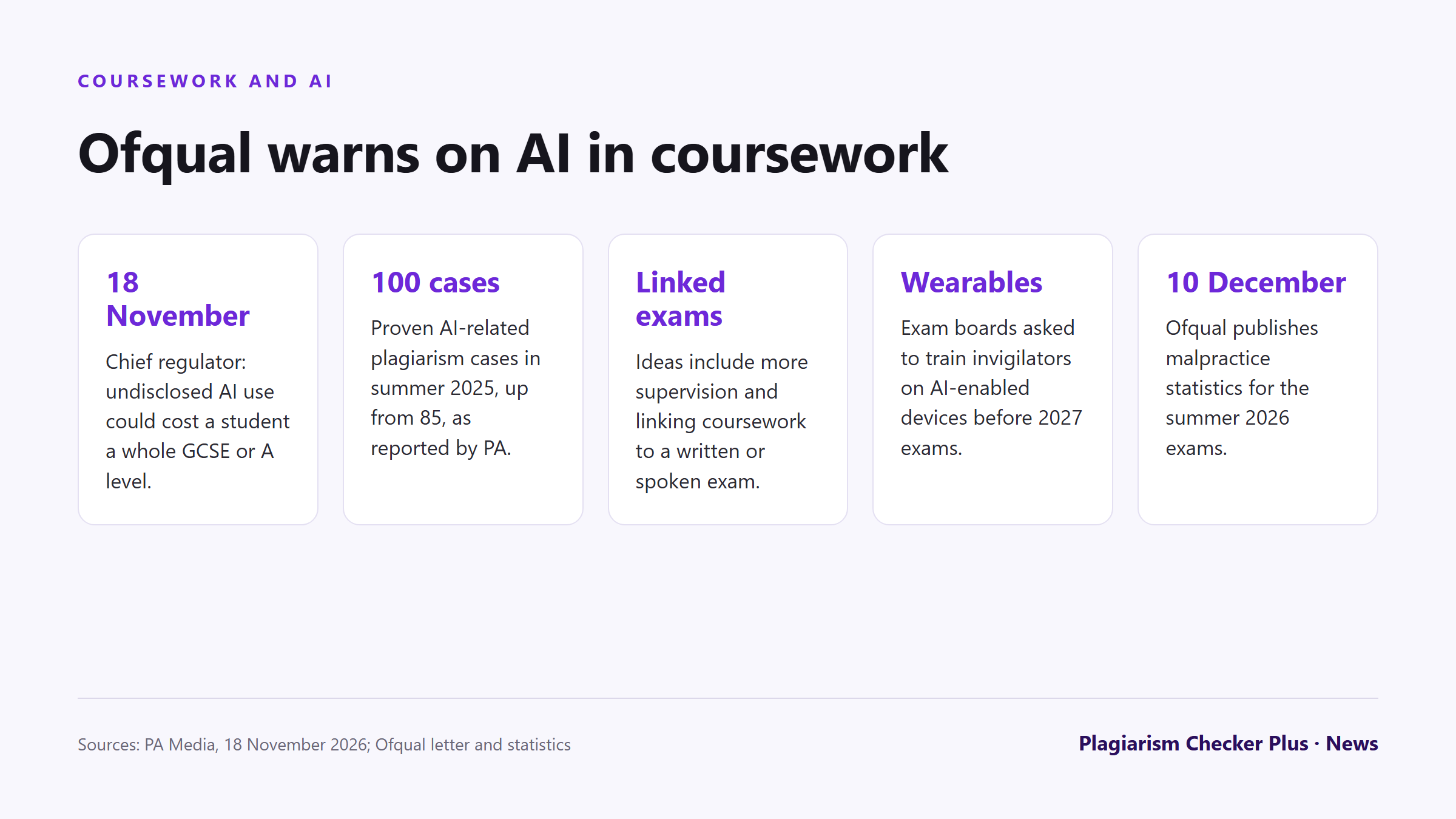
- Sir Ian Bauckham told PA Media that undisclosed AI use in coursework could lead to the loss of a whole qualification, which he described as potentially life-altering.
- PA reports that Ofqual recorded 100 proven cases of AI-related plagiarism in GCSE, AS and A level in summer 2025, up from 85 the year before, and that these made up 75% of all student plagiarism cases.
- Ofqual is considering more supervision of coursework and formally linking it to a written or spoken exam. It has also asked exam boards to train invigilators on wearable devices before the 2027 exams.
Key takeaways
- Nothing has changed in the rules yet. The campaign restates existing sanctions, and the coursework reforms are options Ofqual says it is looking at.
- The subjects named as most exposed are those with unsupervised written coursework, such as A level English and history.
- Bauckham said teachers' knowledge of a student's earlier work is the strongest defence against AI cheating, not a detection tool.
What Ofqual said
The comments were reported by PA Media education correspondent Eleanor Busby on 18 November 2026 (published here by The Irish News). Bauckham spoke to PA, and made further remarks on wearable technology in a speech at the Schools and Academies Show in Birmingham.
- The penalty. Students who use AI in coursework without declaring it could lose the whole qualification, not just marks for one piece of work. Bauckham called the consequences "life-altering".
- Detection is getting harder. He said AI is getting better at hiding its traces, and that teachers' knowledge of a student's earlier work is the most powerful defence.
- Coursework needs rethinking. He said both the conditions under which coursework is done and the way it is designed need a radical rethink, and that unsupervised extended essays with no linked assessment are unlikely to have a long future.
- Wearables in exams. He warned that students can cheat in supervised exams with wearable technology and micro-devices, said it is unacceptable for retailers to market products for exam cheating, and said he has written to exam boards asking them to train invigilators on this risk before the 2027 exams.
The numbers behind the warning
| Figure | What it shows | Source |
|---|---|---|
| 100 cases | Proven AI-related plagiarism cases in GCSE, AS and A level in England, summer 2025, up from 85 the year before. They made up 75% of student plagiarism cases, up from 55.4%. | PA Media, citing Ofqual |
| 5,025 cases | Student malpractice cases with a penalty in summer 2025, down 2.5% from 5,155 in 2024. | Ofqual statistics |
| 2,225 cases | Cases involving phones or other devices in summer 2025, 44.3% of student cases and the most common offence. | Ofqual statistics |
| 1,125 cases | Cases in 2025 in which students lost an entire GCSE or A level. | Ofqual letter to exam boards, 2 March 2026 |
| 70% and 83% | Shares of more than 4,500 teachers surveyed by Teacher Tapp for Ofqual who said unsupervised written coursework should not count towards final grades (70%), and that it should have more supervision or other controls (83%). | PA Media |
What could change for coursework
PA reports that Ofqual wants to strengthen assessment design in subjects with unsupervised written coursework, naming A level English and history. The options it describes are:
- More supervision of non-exam assessment.
- More weight on showing authorship, including referencing sources.
- Formally linking coursework to a written or spoken exam, so students can show that the work is theirs and that they understand it.
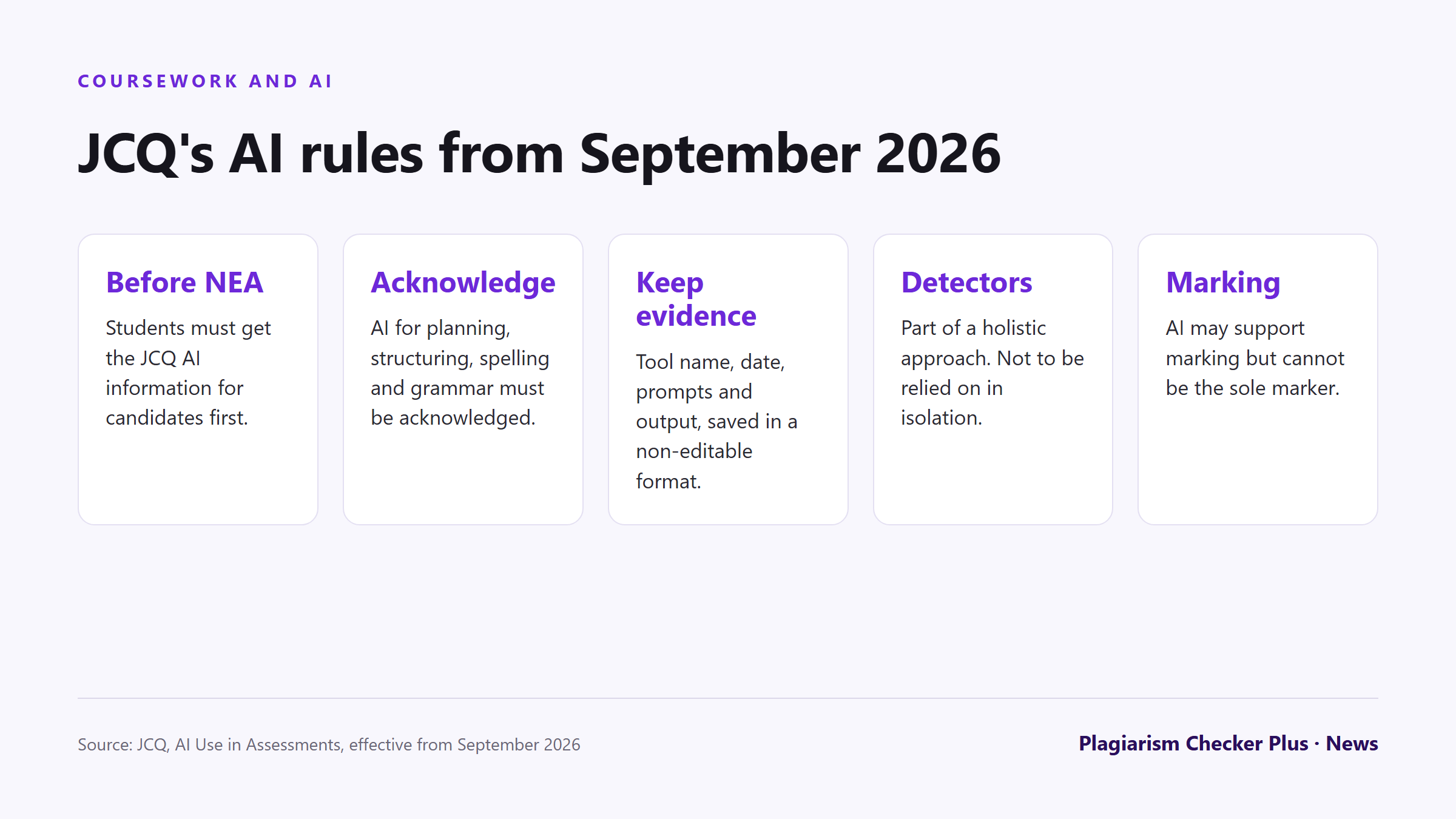
The campaign builds on earlier steps. In a letter to exam board chief executives dated 2 March 2026, Bauckham asked boards to improve awareness of what counts as AI misuse, strengthen deterrence, detection and prevention, and take a more rigorous approach to how students and teachers authenticate work. Ofqual's blog post on talking to students about AI in coursework followed a week later. The exam boards' own rules for this year are set out in the JCQ guidance, which we covered in JCQ's AI rules from September 2026.
PA also reports that education minister Josh MacAlister said smart glasses should not be allowed in schools and that he will advise headteachers on wearable technology.
What this means for students and teachers
- Students: if your coursework rules allow some AI use, declare it exactly as your school asks. The JCQ guidance expects a record of the tool, the prompts and the output. Undeclared use is the problem Ofqual is targeting.
- Students: keep your notes, drafts and version history. If your authorship is ever questioned, a record of how the work developed is the strongest evidence you have. Our guide on how to prove you didn't use AI explains what helps.
- Students: expect to talk about your coursework. If Ofqual's linked-exam idea goes ahead, explaining your own work will become part of the assessment.
- Teachers: the regulator's own emphasis is on knowing your students' work. An AI detector score is a likelihood, not proof, and should be weighed alongside earlier work, drafts and a conversation with the student.
- Exam officers: prepare for invigilator training on AI-enabled wearables before the 2027 exam series.
Sources
- Eleanor Busby, PA Media, Pupils who use AI to complete coursework face 'life-altering' penalties – Ofqual, via The Irish News, 18 November 2026.
- Ofqual, Letter to exam board chief executives from Sir Ian Bauckham (PDF), 2 March 2026.
- Ofqual, Malpractice in GCSE, AS and A level: summer 2025 exam series, official statistics, 11 December 2025.
- Ofqual, Malpractice in GCSE, AS and A level: summer 2026 exam series, release announcement, due 10 December 2026.
- Ofqual blog, Talking to students about AI in coursework: why the conversation matters, 9 March 2026.
FAQ
Can you lose your GCSE or A level for using AI in coursework?
Yes, in serious cases. Ofqual's chief regulator has warned that undisclosed AI use in coursework can lead to the loss of the whole qualification. Ofqual's March 2026 letter says 1,125 students lost an entire GCSE or A level for malpractice in 2025, across all types of malpractice.
Is AI banned in GCSE and A level coursework?
Not entirely. Exam board rules, set out in JCQ guidance, allow some uses of AI if they are acknowledged and recorded. Ofqual's warning is about AI use that is not disclosed and work that is passed off as the student's own.
Is Ofqual scrapping coursework?
No decision has been announced. Ofqual says it is looking at more supervision, more emphasis on authorship and formally linking coursework to a written or spoken exam, especially in subjects with unsupervised written coursework such as A level English and history.
How many students were caught using AI in GCSE and A level coursework?
PA Media reports that Ofqual recorded 100 proven cases of AI-related plagiarism in summer 2025, up from 85 the previous year. Ofqual publishes its summer 2026 malpractice statistics on 10 December 2026.
What happens next
For now the rules are the same, but the message is sharper and the direction is clear: more supervision, more proof of authorship and less room for unsupervised essays. The summer 2026 malpractice statistics, due on 10 December, will show whether proven AI cases are still rising. We will update this article when they are published.
AI checking for teachers
How teachers can use an AI check as one piece of evidence alongside drafts and a student's earlier work, and what a score does not show.