JCQ's 2026-27 AI rules: unacknowledged grammar help now listed as misuse
The Joint Council for Qualifications (JCQ), which represents the main UK exam boards, has updated its guidance on AI in assessments for the 2026-27 year. The document, AI Use in Assessments: Your role in protecting the integrity of qualifications, is effective from September 2026. It applies mainly to non-examination assessment (NEA) and coursework in general qualifications such as GCSEs and A levels, and in vocational and technical qualifications. The new edition widens the definition of AI misuse, sets out what evidence students must keep, and adds detailed advice for teachers on investigating suspected misuse, including where AI detection tools fit.
Summary
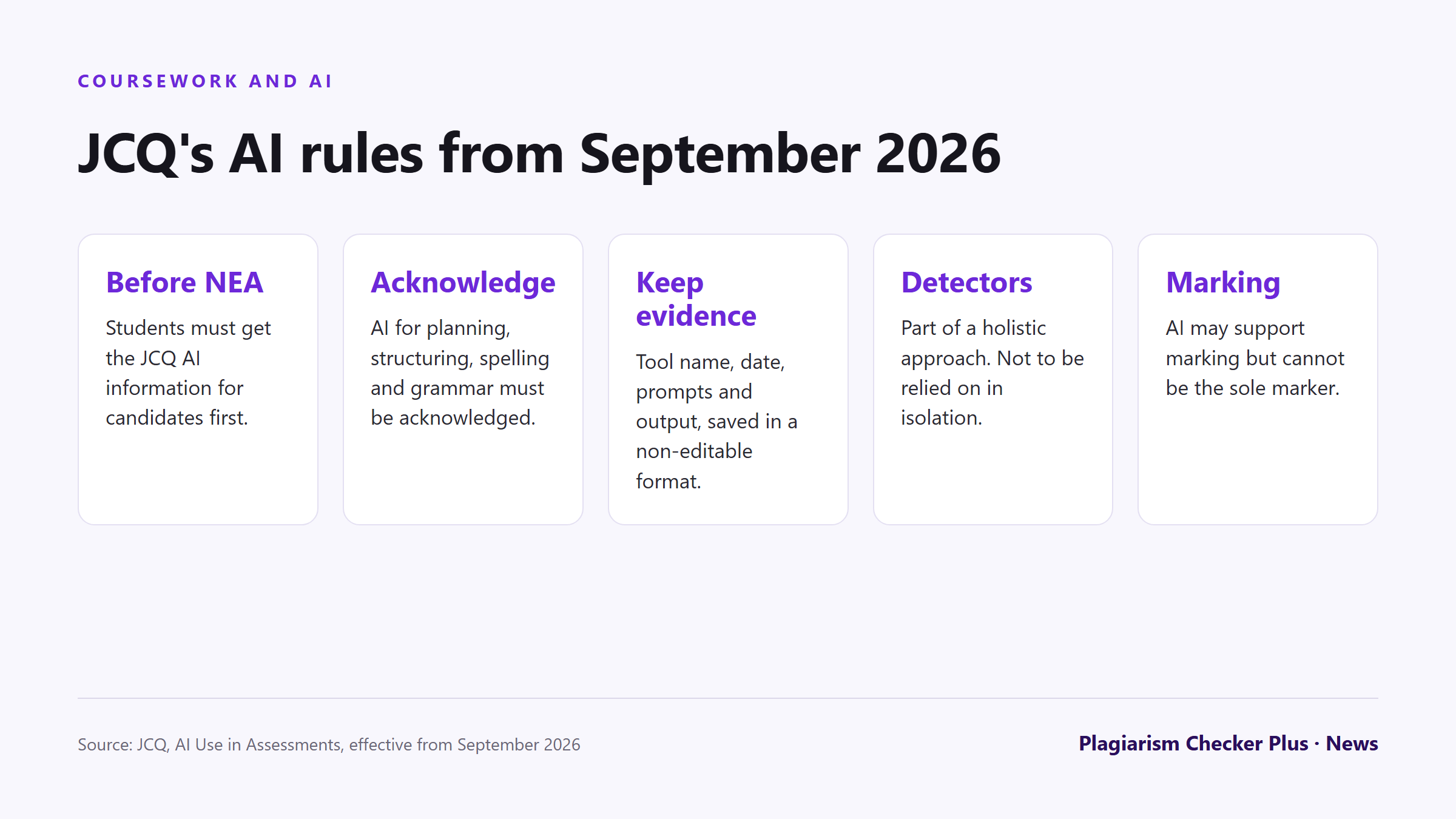
- Failing to acknowledge AI used for planning, structuring, guidance, or spelling, punctuation and grammar is now listed as AI misuse. So is using translation tools to turn work written in another language into English.
- Students must name the AI tool and the date, keep their prompts and the AI output in a non-editable format such as a screenshot, and explain how they used it.
- AI detection tools may be part of the evidence, but JCQ says they can produce false positives and false negatives and must form part of a holistic approach.
Key takeaways
- The guidance does not ban AI in coursework. It says acknowledged AI use is permitted, but students cannot be credited for work that is not their own.
- AI misuse counts as malpractice. The possible sanctions for the related offences include disqualification and being barred from qualifications for a number of years.
- Teachers get new investigation methods, including talking students through their work and comparing it with likely AI output, alongside cautions about detectors.
What changed
The updated guidance opens with a table of changes since the previous version. Most exams are taken under supervision without internet access, so JCQ says the guidance is mainly about assessments where internet access is allowed during research or production. That means NEA, coursework and internal assessments.
| Area | What the September 2026 guidance says |
|---|---|
| Before coursework starts | Students must be given the JCQ document Information for Candidates: AI (Artificial Intelligence and Assessments) before they begin NEA work. |
| What counts as misuse | Examples now include not acknowledging AI used for planning, structuring or guidance, not acknowledging AI used for spelling, punctuation and grammar, and translating work produced in another language into English. |
| Evidence students keep | Prompts and AI-generated content in a non-editable format, such as a screenshot, plus a brief explanation of use. If AI tools change a student's work directly, the original must be kept too. |
| Exam rooms | Centres must restrict access to online AI tools on devices used in exams, and stay alert to concealed or wearable technology such as smart glasses and watches. |
| Marking | AI tools may support marking where the centre permits it, but cannot be the sole marker. A human assessor must review the whole piece of work and remains responsible for the mark. |
| Parents and carers | New guidance on involving parents and carers in preventing AI misuse. |
How students must acknowledge AI
Where AI has been used as a source of information or guidance, the acknowledgement must give the name of the AI tool and the date the content was generated. The guidance gives examples in this format, including a writing assistant inside Microsoft Word. Students must keep a copy of the prompts and the AI output, explain briefly how they used it, and submit this with their work.
If that evidence is missing and a teacher suspects AI use, the teacher must follow the centre's malpractice policy and assure themselves the work is the student's own. The guidance says students who cannot show they have independently met the marking criteria will not be rewarded for that work.
Where AI detectors fit
The guidance names Pangram, Copyleaks and Turnitin AI writing detection as examples of tools that estimate the likelihood that text was produced by AI. It says they may be used as part of the evidence when authenticating work, and that the list is not an endorsement.
- Accuracy varies with the AI tool used, the mix of AI and human text, the prompt and other factors, including a student's English language competency.
- The tools can produce both false positives and false negatives, and give lower scores for AI text that students have later amended.
- Detection must form part of a holistic approach, and all available information must be considered. JCQ says teachers are generally best placed to judge authenticity because they know their students' usual work.
- The guidance also describes stylometric tools, which compare work with a student's known writing, and watermark checks. It notes that the absence of a watermark is not proof that AI was not used.
Other methods are set out in a new appendix. Teachers can work out a likely prompt from the task and compare the AI response with the student's work. They can also talk the student through the work and earlier versions, or read out part of a sentence and ask the student to complete it. The guidance says no single feature of writing is conclusive.
How suspected misuse is handled
- Concerns raised before a student signs the declaration of authenticity are dealt with under the centre's own procedures and do not need to be referred to the exam board.
- After the declaration is signed, suspected malpractice is reported to the awarding organisation on the JCQ/M1 form.
- When gathering information, centres must tell the student about the allegation and the evidence, and let them give a statement.
- The exam board investigates reported cases and decides the outcome.
What this means for students and teachers
- Students: read the AI information sheet your school gives you before starting coursework, and ask if anything is unclear.
- Students: if you use any AI tool, including for grammar or planning, write down the tool and date, and save your prompts and the output as screenshots.
- Students: keep your drafts, notes and version history. JCQ lists these as evidence of authenticity.
- Teachers: a detector result is a likelihood, not proof. JCQ expects it to be weighed with your knowledge of the student and other evidence.
- Teachers: check that your centre's malpractice policy covers every qualification with coursework, and that it has been reviewed this year.
Sources
- Joint Council for Qualifications, AI Use in Assessments: Your role in protecting the integrity of qualifications, effective from September 2026.
- Joint Council for Qualifications, Preventing AI Misuse in Assessments: a summary for teachers, effective from September 2026.
FAQ
Can students use AI in GCSE and A level coursework?
JCQ says AI use is permitted when it is properly acknowledged and referenced, subject to the rules for each assessment. Students cannot be credited for work that is not their own, and unacknowledged use that makes work not their own is malpractice.
Do students have to acknowledge Grammarly or other grammar tools?
The September 2026 guidance lists failing to appropriately acknowledge AI tools used for spelling, punctuation and grammar as an example of AI misuse. Students should check their centre's rules and acknowledge such tools.
Does JCQ allow AI detectors to be used as evidence?
Yes, as part of the evidence. The guidance says detection tools can produce false positives and false negatives, so their use must form part of a holistic approach that considers all available information.
What evidence of AI use must students keep?
The name of the AI tool and the date, a copy of the prompts and the AI-generated content in a non-editable format such as a screenshot, a brief explanation of how it was used and, where AI changed the work directly, the original version.
What happens next
The 2026-27 guidance moves the focus from catching AI use to documenting it. Students who keep a clear record of what they did are better protected, and teachers are told to rely on their knowledge of the student and on conversations as much as on any tool. JCQ says it will update the document as AI and detection tools change.
How to cite ChatGPT
How to acknowledge and reference AI tools in your work, with examples.