Los Angeles Unified blocks student generative AI on district devices
Los Angeles Unified School District, the second-largest school system in the United States, has stopped students in every grade from using generative AI on district devices. The change became public on 2 September 2026 at the first meeting of the school board's Generative AI Ad Hoc Committee, where it surprised the board members themselves. The district says the restriction is in place while it reviews how the tools are used in teaching and what safeguards are needed. This article sets out what the district has said, how local reporters described the meeting, and what has not been settled.
Summary
- A district statement dated 2 September 2026 says that since the beginning of the 2026-27 school year its practice has been to restrict student access to generative AI platforms while it reviews instructional use and safeguards.
- The block applies to district-owned devices and to all grades. Until this year, students aged 13 and older could use approved AI tools after completing digital citizenship instruction.
- Senior administrators made the change on their own authority, the Los Angeles Times reports. A board committee is due to bring policy recommendations to the full board at the end of the school year.
Key takeaways
- This is an administrative practice during a review, not a policy voted by the school board. The district statement gives no end date.
- It covers district devices only. Board members said at the meeting that they cannot regulate what students do on their personal devices.
- Teachers keep access to generative AI for their own work, according to the district.
What the district said
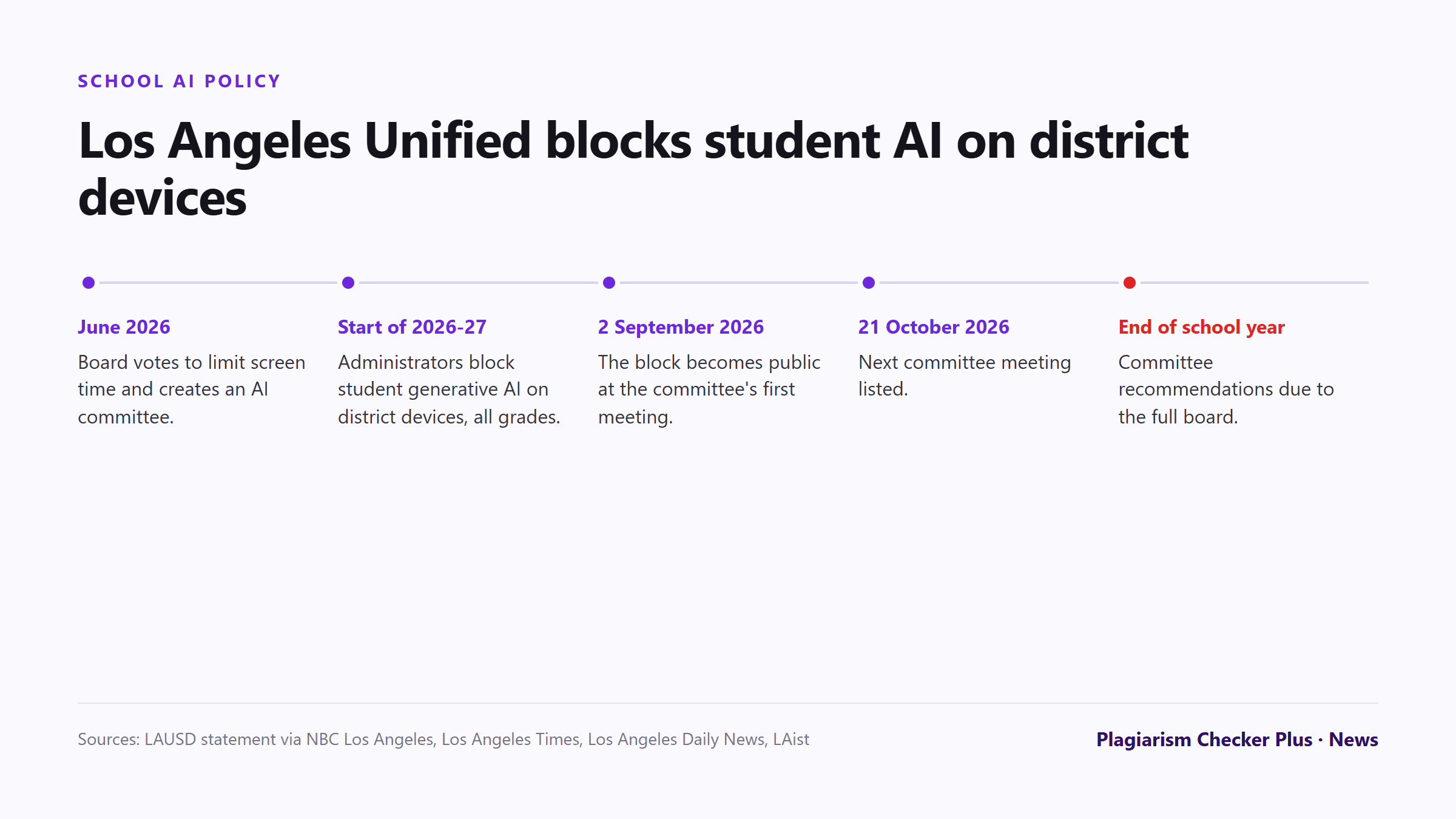
The district's position is set out in a statement that NBC Los Angeles published in full on 2 September 2026. It says the Generative AI Ad Hoc Committee held its first meeting that day and will bring policy recommendations to the board at the end of the school year. It then describes the change: "Since the beginning of the 2026-2027 school year, the District practice has been to restrict student access to generative AI platforms while the District reviews instructional use and safeguards."
The statement also describes the rule that applied before. Students aged 13 and older who had completed required Digital Citizenship instruction and acknowledged the district's Responsible Use Policy could access approved generative AI tools. That access has now been removed, so the restriction covers every grade.
Kelly Gonez, the board member who chairs the committee, summed it up at the meeting, according to NBC Los Angeles: "Currently, there is no access to generative AI for any student."
How the change came to light
The restriction was not announced when it began. According to a Los Angeles Times report by Howard Blume, republished by Education Week on 3 September, it came to light at the committee's first meeting. Senior administrators had put it in place on their own authority, in the spirit of the school board's unanimous vote in June to limit student screen time.
The same report says Gonez told the meeting that, even as a board member, she had expected the district to be operating under the previous year's policy. Board member Nick Melvoin said the change "didn't really come from the board", and NBC Los Angeles quotes him saying of the restriction: "I don't think it's well publicized".
The committee itself was created in June, when the board adopted the screen time limits, LAist reported on 1 September. Its members are Gonez, Melvoin and Tanya Ortiz Franklin. LAist lists five more meetings: 21 October and 9 December 2026, and 20 January, 3 March and 7 April 2027.
What is blocked and what is not
| Question | What has been reported | Source |
|---|---|---|
| Which students? | All grades. Students aged 13 and older previously had access to approved tools | District statement |
| Which devices? | District-owned devices | Los Angeles Times |
| Which tools? | Standalone AI services and AI features built into Google Workspace applications | District spokesperson, quoted by the Los Angeles Daily News |
| How is it enforced? | The district's firewall and Lightspeed web-filtering software block categories of content, including AI | Douglas Le, interim chief information officer, at the meeting |
| Personal devices? | Not covered. Restrictions can follow a student who is logged into a district account | Board members and Le |
| Teachers? | Still have access for their own work, such as planning and developing lessons | District, quoted by the Los Angeles Daily News |
Most of the technical detail comes from a Los Angeles Daily News report by Teresa Liu, carried by Government Technology on 4 September. A web filter is software that stops a device from reaching certain sites or types of site. Le told the committee that this method lets the district block new sites and apps that fall into a restricted category. He also said some sites can be miscategorised or contain embedded content, which makes it hard to give a complete list of what is allowed and what is blocked.
On staff use, the Daily News reports the district as saying that teachers receive training on using the technology for instructional planning, developing lessons and resources, and adapting teaching to different students. The training stresses professional judgment, student data privacy and checking AI-generated material.
How people reacted
Parent campaigners welcomed the news. Lila Byock, a district parent and founder of the group Schools Beyond Screens, told the Daily News that her organisation had been calling for a temporary moratorium, and that she arrived at the meeting expecting to repeat that demand. She wants the restriction kept for all grades: "We have to remember that teenagers are also children".
Melvoin raised two objections. The first was process, since the board had not approved the change. The second was fairness: students with their own computers or phones can keep using generative AI at home, while classmates who rely on district devices cannot. He told the Los Angeles Times, as reported by Straight Arrow News: "High school is where I would have more teacher discretion, with guardrails".
Stephen Aguilar, an associate professor of education at the University of Southern California who studies educational technology, made a similar point to the Daily News. He said restrictive policies can be appropriate in some circumstances, but a broad restriction "can encourage sort of an equity gap" in access to AI platforms. He also said older students need chances to learn how to assess AI-generated material.
How this differs from New York City
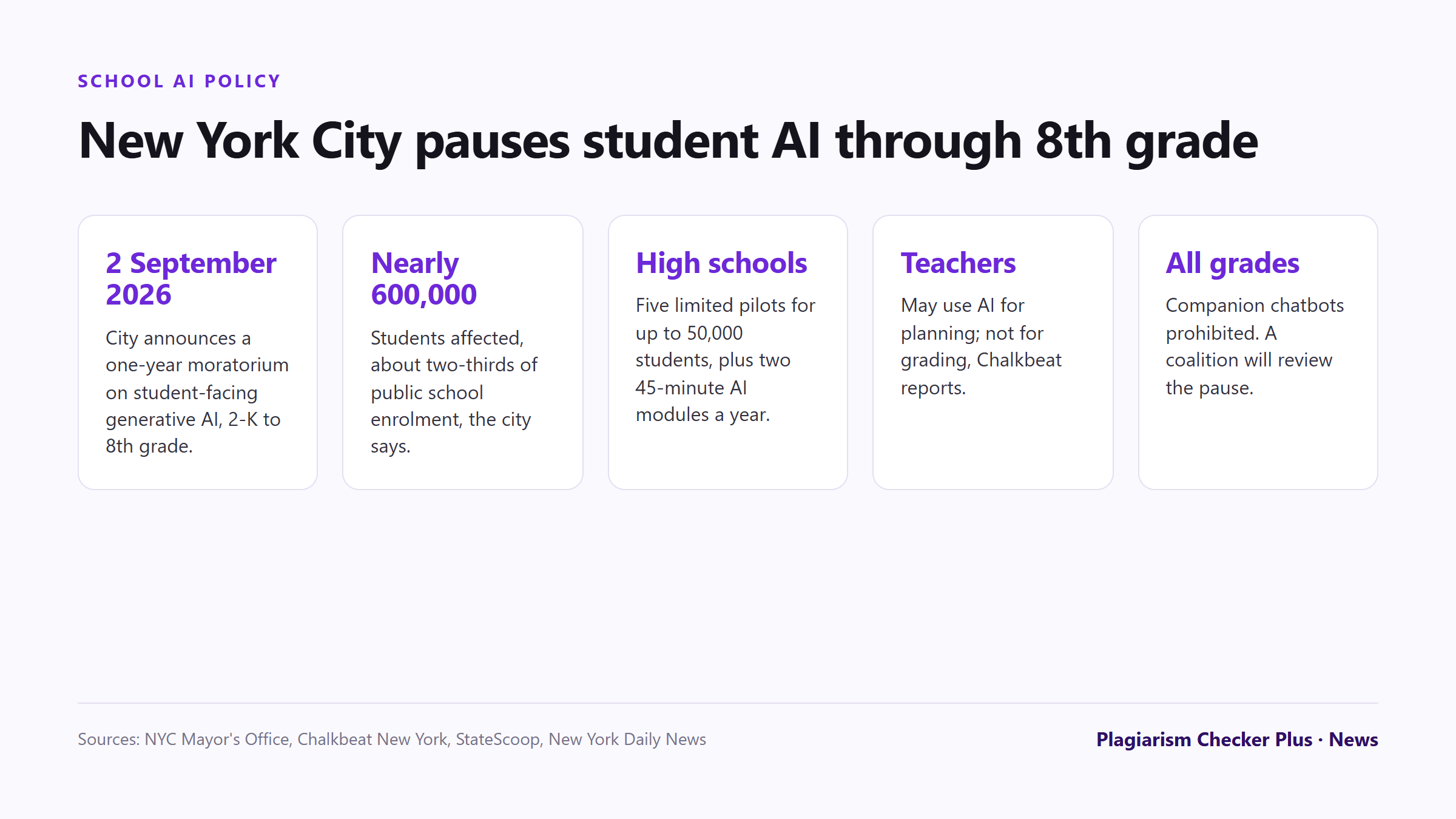
The news came on the same day that New York City announced a one-year moratorium on student-facing generative AI from 2-K to 8th grade, which we covered in a separate article. The two are often reported together, but they are different kinds of decision.
- Who decided: New York's policy was announced by the mayor and the schools chancellor. In Los Angeles, administrators made the change and board members learned of it at a committee meeting.
- Which grades: New York's moratorium stops at 8th grade and allows limited supervised use in high schools. The Los Angeles restriction covers all grades.
- How it is defined: the Los Angeles restriction is described in terms of district devices and web filtering. The district statement calls it a practice during a review and does not give an end date.
What is not known
- How long it lasts. Several reports call it a moratorium for the 2026-27 school year. The district statement says only that access is restricted while the review continues and that recommendations are due at the end of the school year.
- Whether the board will vote on it. The reports we read do not say that the board has approved, or been asked to approve, the current restriction.
- Exactly which tools are blocked. Le said a complete list is difficult to provide because of how the filter categorises sites.
- Rules for personal devices. The Los Angeles Times reports that the district has no policy yet on student use of AI on personal devices.
- Schoolwork and misconduct. The district statement does not mention cheating, academic integrity or AI detection tools. Whether using AI at home on an assignment breaks a rule is a separate question that the statement does not answer.
What this means for students, teachers and parents
The points below are our reading of the reported facts, not official advice. Families and staff in Los Angeles should follow what the district and their school tell them.
- Students: a block on school devices is not the same as a rule about your homework. Ask each teacher what AI use is allowed on each assignment, and do not assume that a tool being reachable at home means it is permitted.
- Students: if you are logged into your district account on your own device, the district's restrictions can still apply, according to Le.
- Teachers: you still have access for planning. If you set work that used to involve an approved AI tool in class, check with your school whether it can still be done.
- Parents: if your child relies on a district device at home, they now have less access to these tools than classmates with their own devices. That is the fairness concern raised at the meeting.
- People who want a say: the committee's next meeting is listed for 21 October 2026. LAist reported that the first meeting was open to the public, with registration for public comment.
Sources
- Los Angeles Unified School District statement of 2 September 2026, published in full in Karma Dickerson and Karla Rendon, Generative AI banned on LAUSD-issued devices for students, NBC Los Angeles, 2 September 2026.
- Howard Blume, LAUSD Adopts Moratorium on Student AI Use, Another Big Move to Limit Tech Use, Los Angeles Times (via Education Week), 3 September 2026.
- Teresa Liu, LAUSD Temporarily Bans Generative AI on School-Issued Devices, Los Angeles Daily News (via Government Technology), 4 September 2026.
- Mariana Dale, How will LAUSD students use AI? Here's how you can help decide, LAist, 1 September 2026.
- Shea Taylor, LA's ban on AI for all students follows limits on screen time, Straight Arrow News, 4 September 2026.
- Anna Merod, LAUSD restricts all students from using AI tools, K-12 Dive, 3 September 2026.
FAQ
Did Los Angeles Unified ban AI for students?
On district devices, yes for now. A district statement dated 2 September 2026 says that since the beginning of the 2026-27 school year its practice has been to restrict student access to generative AI platforms while it reviews instructional use and safeguards. The restriction applies to all grades.
Can LAUSD students still use AI on their own devices?
The restriction applies to district-owned devices, and board members said they cannot regulate what students do on personal devices. The district's interim chief information officer said restrictions can follow students who are logged into their district account. Whether AI may be used on a particular assignment is a separate question for the teacher.
Can LAUSD teachers still use AI?
Yes. According to the district, as reported by the Los Angeles Daily News, teachers continue to have access to generative AI for their own work, including instructional planning and developing lessons.
How long will the LAUSD restriction last?
That is not confirmed. The district statement gives no end date. It says the Generative AI Ad Hoc Committee will bring policy recommendations to the board at the end of the school year.
How is the Los Angeles restriction different from New York City's?
New York City announced a one-year moratorium on student-facing generative AI from 2-K to 8th grade, with limited supervised use in high schools. Los Angeles has blocked access on district devices for all grades, through a change made by administrators that the school board had not voted on.
What happens next
The restriction is in force, but its status is provisional: it was introduced by administrators, it has no stated end date, and the committee that is meant to write the long-term rules has only met once. The next meeting is listed for 21 October 2026, and recommendations are due to the board at the end of the school year. We will update this article when the district publishes a written policy or the board votes.
Is using AI plagiarism?
A plain guide to when AI help on schoolwork is allowed, when it is not, and how to ask your teacher.