Students are taking AI cheating accusations to lawyers and courts
Some students accused of using AI to cheat are paying lawyers to contest the finding, and a small number have sued their universities. On 2 October 2026 FOX 26 Houston reported that a University of Houston-Downtown senior had a failing grade overturned by a committee of deans. A day later the Financial Times published a report on students turning to lawyers over AI misconduct accusations. This article sets out what published sources say about five disputes in the United States, the status of each as those sources give it, and what the courts looked at. In the cases decided so far, judges have examined whether the university followed a fair procedure. They have not ruled on whether AI detectors work.
Summary
- A New York court annulled an AI misconduct finding against an Adelphi University student and ordered his record expunged, because the university did not follow its own procedures.
- A federal court in Minnesota dismissed a student's due process claims in October 2025 after finding he had notice, an advocate, a hearing and an appeal.
- Federal lawsuits against Yale and the University of Michigan are continuing. Neither has been decided on its merits, and the allegations in them have not been tested at trial.
Key takeaways
- The two decided cases turned on procedure: one university skipped steps in its own rules and lost, another followed a full hearing process and won.
- There is no national count of AI misconduct accusations or of students who hire lawyers. The figures available come from law firms that take these cases.
- Most disputes end inside the university. The Houston-Downtown student won on his third internal appeal, and the report of his case mentions no lawyer and no court.
What prompted the coverage
FOX 26 Houston reported on 2 October 2026 that Mark Pieterson, a senior studying business management at the University of Houston-Downtown, had been given an F in a Music Appreciation course. According to the report, his professor said he had submitted journal entries and discussion posts that were determined to be copied and pasted from AI. Pieterson denied it. He told the station: "To be honest, I was shocked."
FOX 26 reports that his first appeal, to the professor, was denied, and that the chair of the Arts and Communication department also ruled against him. A student discipline committee made up of four deans then reversed the decision. The station quotes the committee as citing "concerns regarding the reliability and consistency of the evidence used to support the original finding". The report does not say what tool or method was used to reach the original finding, does not include a statement from the university, and does not mention a lawyer.
On 3 October the Financial Times published an article headlined "Students turn to lawyers to fight AI misconduct accusations". The article is behind a paywall and we were not able to read it, so we do not report its details here. A briefing published by ETC Journal the same day summarises it as saying that lawyers report rising caseloads, that one student spent more than £3,000 clearing her name, and that some universities now treat minor unauthorised AI use as poor academic practice instead of formal misconduct. That is a second-hand summary and should be read as one.
Five disputes and where each stands
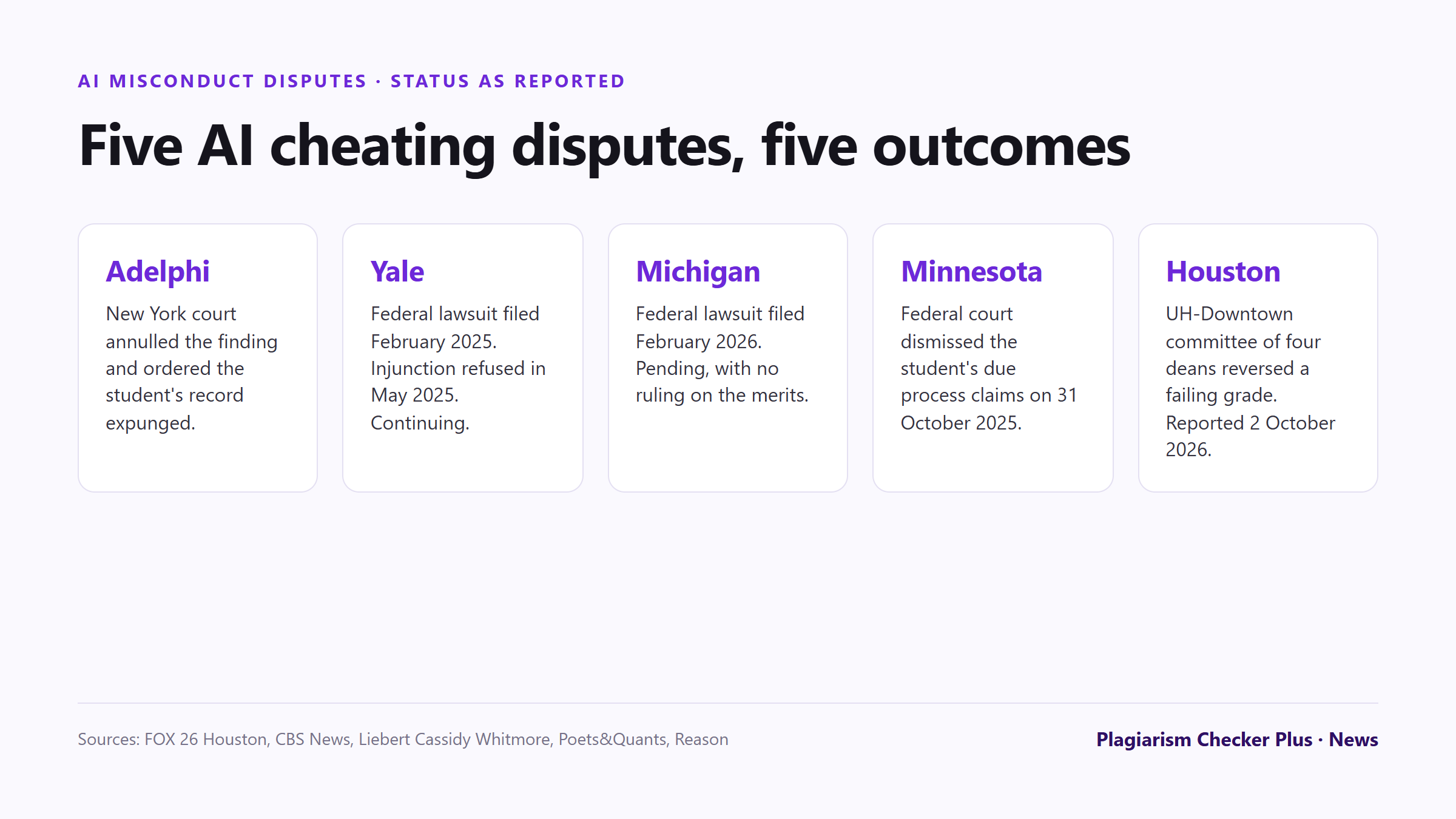
The table lists only disputes in which a published source names the university. The status column gives the position as the cited source reported it on the date shown. Later developments may not be reflected.
| Institution | Forum | Status as reported |
|---|---|---|
| Adelphi University, New York | New York Supreme Court (a trial-level state court) | Decided for the student. The finding was annulled and the record ordered expunged (law firm summary, 26 February 2026) |
| Yale School of Management | US District Court, District of Connecticut | Continuing. A request to be reinstated while the case runs was refused on 5 May 2025. Not close to trial as of 4 August 2026 |
| University of Michigan | US District Court, Eastern District of Michigan | Pending. The judge refused the student's request to sue under a pseudonym on 28 July 2026. No ruling on the merits reported |
| University of Minnesota | US District Court, District of Minnesota | Due process claims dismissed without prejudice on 31 October 2025 |
| University of Houston-Downtown | Internal appeal only | Failing grade reversed by a committee of four deans (reported 2 October 2026) |
The two decided cases, and why they went different ways
Adelphi. Orion Newby, then a first-year student at Adelphi University, was accused of using AI on an essay. According to a summary of the decision by the law firm Liebert Cassidy Whitmore, the essay had received a 100% score from Turnitin's AI detection, Newby denied the allegation and supplied detection results that pointed the other way, and the university's academic integrity officer both found him responsible and denied his appeal. The case, Matter of Newby v. Adelphi University, was brought as an Article 78 petition, which is the New York procedure for asking a court to review a decision by an institution.
The court found the determination and the appeal denial were "without valid basis and devoid of reason". The same summary says the court found that Adelphi had not followed its own procedures: it did not provide an advisor or a meaningful hearing, and the same administrator handled the original finding and the appeal. The court annulled the finding, rescinded the sanction and ordered the record expunged. CBS News New York reported Adelphi's response on 9 February 2026: "We are evaluating the court's decision and will proceed accordingly." EdScoop, citing Newsday, reported that the family spent more than $100,000 on the case.
Minnesota. Haishan Yang, a doctoral student, was expelled from the University of Minnesota after the university concluded he had used ChatGPT in an eight-hour qualifying exam in August 2024 where AI tools were prohibited. He sued in federal court. According to a second Liebert Cassidy Whitmore summary, the court in Haishan Yang v. Neprash dismissed his due process claims on 31 October 2025. It found that he had received detailed notice of the allegations, representation by an advocate, a full opportunity to present evidence and a review on appeal. The claims were dismissed without prejudice, which means the dismissal does not by itself bar them from being brought again.
The two continuing cases
Yale. A student on the executive MBA programme at the Yale School of Management sued in February 2025 after receiving a one-year suspension and a failing grade in one course. The New Haven Register reported that the lawsuit alleges discrimination on the basis of national origin, an attempt to coerce a false confession, and a denial of due process, and that Yale did not respond to its request for comment. The suit was filed under a pseudonym. Poets&Quants reported that Judge Sarah Russell refused anonymity on 31 March 2025, after which the plaintiff was identified as Thierry Rignol, and that on 5 May 2025 she refused a preliminary injunction, an order that would have returned him to the programme while the case continued.
The two sides give different accounts. Rignol alleges that the detection tool used on his exam is unreliable for non-native English speakers and that he was denied access to key evidence. Poets&Quants reports Yale's position as being that he did not provide the original file of his exam for months after it was first requested. None of this has been decided. eDiscovery Today reported on 4 August 2026 that the case had reached a third amended complaint with 13 counts and was not close to trial.
Michigan. A University of Michigan student sued in February 2026 in the US District Court for the Eastern District of Michigan. CBS News Detroit reported that she alleges an instructor accused her three times of using AI to write papers in one course, on the basis of judgments about her writing style, and that traits linked to her generalised anxiety disorder and obsessive-compulsive disorder were treated as evidence of misconduct. The claims are brought under the Americans with Disabilities Act and the Rehabilitation Act. The university told CBS it had no comment on the lawsuit.
The only ruling reported so far concerns her name. Eugene Volokh, writing on The Volokh Conspiracy blog at Reason, reported on 29 July 2026 that Judge Laurie Michelson had denied the request to proceed as Jane Doe the day before. That ruling says nothing about whether her claims will succeed. We have not named her because the reports we read do not.
What lawyers say, and the limits of that evidence
There is no national count of students accused of AI misconduct, or of how many hire a lawyer. A Mashable report from May 2026, which we read in a republished copy, makes that point itself. It reports Thomas Terrill, director of the National Education Defense Practice Group at LLF National Law Firm, as saying the firm has as many as 250 clients at any one time on AI-related academic integrity matters. The report puts the cost of representation at thousands of dollars, rising to tens of thousands when a case goes to court.
In the United Kingdom, two staff at Alpha Academic Appeals, a firm that represents students, wrote in Times Higher Education in May 2026 about a survey they ran of 12 lawyers who work on university misconduct cases. They report that 83% disagreed that procedures are reliable enough to protect wrongly accused students, and 92% disagreed that decision-makers are adequately trained. The survey covers academic misconduct in general, not only AI.
What this means for students and universities
Due process, in this setting, means the steps an institution must follow before it punishes someone: telling the student what the allegation is, showing the evidence, giving a chance to answer, and having someone different hear the appeal. The points below follow from the cases above. They are not legal advice.
- Students: read your institution's academic misconduct procedure as soon as you are accused. In the Adelphi case the court's decision rested on steps the university's own rules required.
- Students: keep drafts, notes and version history. The Yale dispute, as Yale describes it, partly concerns how long it took to produce an original file.
- Students: use every internal appeal. The Houston-Downtown student lost twice before a committee of deans reversed the grade.
- Students: court is slow and expensive. The Yale case was filed in February 2025 and was not close to trial 18 months later.
- Universities: an appeal heard by the person who made the original decision was one of the failings the Adelphi court identified.
- Universities: the Minnesota decision shows that a process with written notice, an advocate, a hearing and a separate appeal was upheld.
Sources
- Randy Wallace, Senior at UH Downtown prevails after being accused of handing in assignments that were AI generated, FOX 26 Houston, 2 October 2026.
- Briefing 10/3/26: 'students are hiring lawyers', ETC Journal, 3 October 2026 (summarises a Financial Times article of the same date that we could not read).
- Liebert Cassidy Whitmore, Court rules that university must expunge record for student accused of AI violation due to lack of fair process, 26 February 2026 (Matter of Newby v. Adelphi University, 2026 NY Slip Op 26021).
- Jennifer McLogan, Adelphi student Orion Newby sues over AI plagiarism accusation and wins, CBS News New York, 9 February 2026.
- Student accused of AI plagiarism wins lawsuit against Adelphi University, EdScoop, 10 February 2026.
- Liebert Cassidy Whitmore, Federal court upholds university's disciplinary process in AI misconduct case, 3 December 2025 (Haishan Yang v. Neprash, D. Minn., 31 October 2025).
- Brian Zahn, Yale student suing over accusation of improper AI use, New Haven Register via Government Technology, 10 March 2025.
- Kristy Bleizeffer, Judge denies injunction in Yale EMBA student's AI-linked suspension, Poets&Quants for Execs, 7 May 2025.
- Doug Austin, The Yale AI-cheating dispute that turned into a big lawsuit, eDiscovery Today, 4 August 2026.
- Nick Lentz, University of Michigan student accused of using AI sues for disability discrimination, CBS News Detroit, updated 16 February 2026.
- Eugene Volokh, U. Michigan student sues alleging wrongful discipline for unauthorized AI use, but can't sue as a Jane Doe, The Volokh Conspiracy at Reason, 29 July 2026.
- AI cheating accusations: The students hiring lawyers to defend themselves, Mashable, May 2026, read as republished by WDC News 6 on 24 May 2026.
- Alex Fairbairn and Daniel Sokol, UK universities' academic misconduct procedures are not fair, Times Higher Education, 27 May 2026.
FAQ
Can a student sue a university over an AI cheating accusation?
Some have. Published reports describe lawsuits against Adelphi University, Yale, the University of Michigan and the University of Minnesota. The claims vary and include failure to follow the university's own procedures, denial of due process and discrimination. Whether a claim is available depends on the country, the state and whether the institution is public or private.
Has any student won an AI cheating case in court?
Yes. In Matter of Newby v. Adelphi University a New York court annulled the finding against the student and ordered his record expunged. According to a law firm summary of the decision, the court found the university had not followed its own procedures.
Have courts ruled that AI detectors are unreliable?
Not in the decisions described here. The Adelphi and Minnesota rulings turned on whether the student received a fair process. Arguments about detector reliability are part of the continuing Yale lawsuit, which has not been decided.
What does due process mean in an academic misconduct case?
It means the steps an institution has to follow before imposing a penalty: clear notice of the allegation, access to the evidence, a chance to respond, and an appeal heard by someone other than the original decision-maker. The exact requirements depend on the institution's rules and the law that applies to it.
How many students have hired lawyers over AI accusations?
Nobody knows. There is no national count. One US law firm told Mashable in May 2026 that it has as many as 250 clients at any one time on AI-related academic integrity matters, which is one firm's figure and not a measure of the whole.
What happens next
The Yale and Michigan lawsuits are undecided, and the Financial Times report that prompted this week's coverage is one we could not read in full. What the decided cases show is narrower than the headlines suggest: courts have so far asked whether a university followed a fair procedure, and have answered differently depending on what the university did. We will update this article when either pending case produces a ruling on the merits.
How teachers check for AI writing
A plain guide to the methods teachers use, what a detector score does and does not show, and what counts as supporting evidence.