73% of faculty have had an AI integrity case: what the survey shows
On 30 September 2026 the philosophy news site Daily Nous published a post titled Overwhelming Cheating, asking what professors should do when there is more AI-enabled cheating in a course than they can realistically report. The post and its comment thread are full of individual accounts. The statistic most often attached to this debate is that 73% of college faculty have personally dealt with an academic integrity issue involving AI. That figure is sometimes credited to Inside Higher Ed, which reported it. The survey itself was run by the American Association of Colleges and Universities (AAC&U) and Elon University, was fielded in late 2025, and describes itself as non-scientific. This article sets out what it measured and what it did not.
Summary
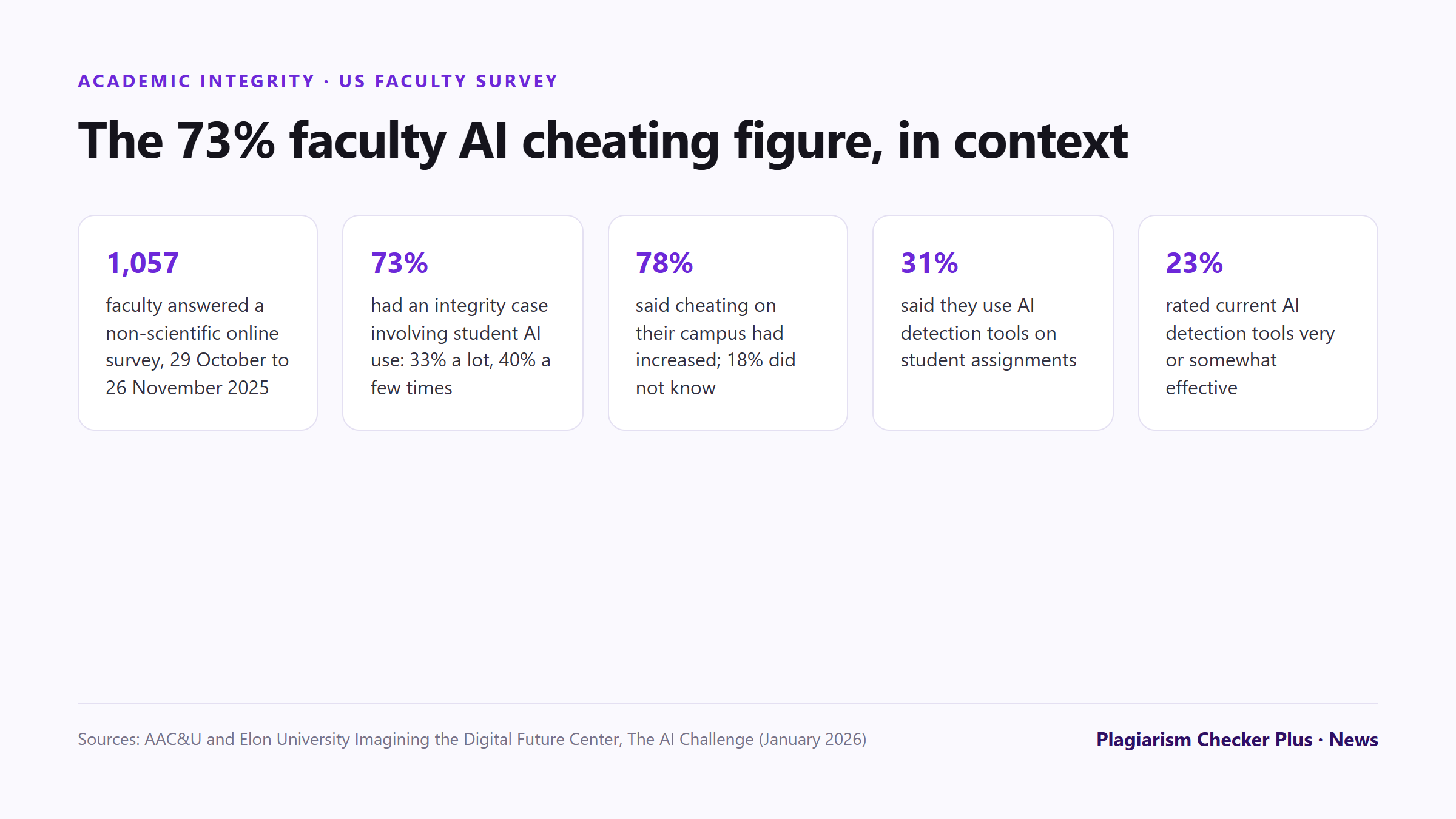
- The 73% figure comes from an AAC&U and Elon University online survey of 1,057 US faculty, fielded from 29 October to 26 November 2025 and published on 21 January 2026.
- The survey's own methodology note says it is non-scientific and that its results are not generalizable to all college faculty.
- The question asked whether faculty had had integrity cases involving student use of generative AI. It did not ask how many students cheated, and it cannot be read as a cheating rate.
Key takeaways
- The 73% is the sum of 33% who answered "Yes, a lot" and 40% who answered "Yes, a few times". A further 27% said no.
- In the same survey, 31% of respondents said they use AI detection tools and 23% rated such tools very or somewhat effective.
- Cheating rates quoted by professors in blog comments, including figures of about 60% and about 90%, are personal accounts from single classrooms and are not survey data.
What set off the discussion
Overwhelming Cheating was written by Justin Weinberg and published on Daily Nous on 30 September 2026. Weinberg wrote that he had heard from many professors about what he called rampant AI-enabled cheating, and he reproduced an account from an instructor of an online course.
That account first appeared on 25 September 2026 as a guest post on the Teaching Philosophically newsletter, which is run by Justin Kalef. Kalef says the author is a friend who asked to be published under a pseudonym. The author describes a five-week online summer course in which 24 students enrolled. Seven dropped on the first day after being told there would be live oral exams over Zoom. Four of the remaining 17 handed in little or nothing. Of the 13 who were left, the author says 10 were reported for using AI to cheat, and 3 of those were reported again for continuing. The author's conclusion: "of the original 24 students, only 3 did the work required in the course, and did so honestly." The author also says the reports took more than 30 hours.
This is one unnamed instructor's description of one course. It has not been independently confirmed, and the author notes that an online course may attract students who intend to cheat.
Weinberg's post is less about how much cheating there is than about what to do with it. He asks whether professors should use the official reporting route given the time each case takes, what a university is likely to do in response, and whether confidentiality weakens any deterrent effect. He also asks: "Is this a collective action problem?" His suggestion is that university-wide measures may only follow if many professors report, while each individual professor has little reason to think their own reports will make a difference.
Where the 73% figure comes from
The Daily Nous post does not cite a survey. The 73% figure that circulates alongside discussions like this one comes from The AI Challenge: How College Faculty Assess the Present and Future of Higher Education in the Age of AI, a report by C. Edward Watson of AAC&U and Lee Rainie of Elon University's Imagining the Digital Future Center. Elon University announced the results on 21 January 2026.
Inside Higher Ed reported on the survey the same day and attributed it to AAC&U and Elon University. We found no Inside Higher Ed survey of its own that produced this figure.
| Detail | What the survey documents say |
|---|---|
| Who ran it | Elon University's Imagining the Digital Future Center and AAC&U |
| When | 29 October to 26 November 2025 |
| How | Online, through the survey platform Qualtrics |
| Who was asked | A list of college and university faculty members developed by AAC&U and Elon University |
| Responses | 1,057 |
| Representative? | No. The methodology note calls the survey "non-scientific" and says the data "are not generalizable for the entire population of college faculty members" |
The methodology and topline document also gives a profile of who answered. The largest subject group was arts and humanities, at 37% of respondents, followed by social sciences at 18%. Full professors made up 39%, and non-tenured instructors, a group that includes adjuncts and lecturers, made up 26%.
What the question asked
The 73% comes from one question. Its wording in the topline document is: "Have you had academic integrity cases in your courses that involved student usage of Generative AI tools?" A second question asked: "Has cheating increased on your campus since Generative AI tools have become widely available?"
| Question | Answer | Share |
|---|---|---|
| Had academic integrity cases involving student use of generative AI | Yes, a lot | 33% |
| Yes, a few times | 40% | |
| No | 27% | |
| Has cheating increased on your campus | Yes, it has increased a lot | 57% |
| Yes, it has increased a little | 21% | |
| Cheating levels have not changed | 5% | |
| Don't know | 18% |
So 73% is 33% plus 40%, and the 78% figure quoted for rising cheating is 57% plus 21%. The report notes that numbers may not add up to 100% because of rounding.
What the survey does and does not show
- It is not a cheating rate. The question asks faculty whether they have had cases. It says nothing about what share of students use AI dishonestly. A professor with one case in three years and a professor with dozens each term can both be in the 73%.
- It does not describe all faculty. The respondents came from a list built by the two organisations, and the report says the results cannot be generalised. The true share among all US faculty could be higher or lower.
- It does not define a case. The survey did not say what counts as an academic integrity case, so the answers may cover formal reports, informal conversations and suspicions that were never confirmed.
- The campus-wide figure is a perception. The 78% reflects what faculty believe has happened to cheating on their campus. Nearly one in five answered that they did not know.
- It is about a year old. The answers were collected in October and November 2025.
The same survey shows that faculty do not agree on what cheating with AI is. Asked about a student who gets a detailed outline from AI and then writes the paper from it, 52% called it cheating, 29% called it legitimate and 18% were not sure. For a student who uses AI to brainstorm and refine project ideas, 64% called it legitimate and 22% called it cheating. For a student who has AI write a first draft and then edits it, 76% called it cheating. A case in one professor's course might not be a case in another's.
What the survey says about detection and proof
The Daily Nous discussion is about the cost of proving and reporting cheating. The survey has figures on that side of the problem too. An AI detection tool is software that estimates whether a piece of text was written by an AI system.
| Finding | Share of respondents |
|---|---|
| Use AI detection tools on student assignments | 31% |
| Say their university provides a subscription to a detection tool | 34% |
| Rate current detection tools very or somewhat effective | 23% |
| Rate them not very or not at all effective | 55% |
| Rate themselves very or somewhat effective at recognising AI-generated content | 66% |
| Rate their colleagues very or somewhat effective at it | 46% |
The report also prints a few written answers to an optional question about how faculty had handled cases. One respondent said it had been made clear that AI use cannot be proven and that the administration would not pursue such cases. Another said they assign a zero and ask the student to redo the work. A third described treating a case as a teaching moment and allowing a resubmission. These are individual answers chosen for the report, and the report does not say how common each approach was.
What professors said in the comments
The Daily Nous post had 38 comments when we read it on 4 October 2026. Several include numbers. They are accounts from individual classrooms, posted in a comment thread, and should be read that way.
- Thomas Nadelhoffer, who says he is a full professor at the College of Charleston teaching remotely, wrote that he gives his students an anonymous survey each term. He says roughly 30% admitted in 2023 to having knowingly cheated on written work using AI, and that the figure was nearly 60% in spring 2026. These are self-reports from one professor's courses, which he says usually have 100 to 120 students. He has not published the results.
- A commenter posting as a community college philosophy professor estimated that around 90% of their students were very likely using AI on exams. The comment does not name the institution, and the estimate rests on the commenter's own method of spotting AI use.
- A commenter posting as Michel wrote that an instructor who follows the official procedure and reports dozens of students a semester gets called to a meeting with the dean.
- Gary Bartlett wrote that he has stopped trying to police AI use because it is too much work. He says he allows AI on out-of-class work and requires students to show they can think and write for themselves in class without devices. If they cannot, the in-class grade determines the course grade.
People who choose to comment on a post about overwhelming cheating are likely to be those with the strongest experiences of it. None of these accounts tells us how common such experiences are across colleges.
What this means for students and teachers
- Students: professors in this survey disagreed about whether outlining, feedback and brainstorming with AI count as cheating. Ask each instructor what is allowed on each assignment, and get the answer in writing if you can.
- Students: keep your notes, drafts and version history. Several of the approaches professors describe, including oral exams and short interviews about an essay, test whether you can explain your own work.
- Teachers: when you quote the 73% figure, give its source and its limits. It counts faculty who have had a case. It is not the share of students who cheat.
- Teachers: most respondents doubted detection tools. A detector score is a reason to look more closely and talk to the student. It is not proof.
- Departments: the question raised on Daily Nous is whether reporting is worth an individual's time. That depends on how long the process takes and what happens after a report, which are things an institution can change.
Sources
- C. Edward Watson and Lee Rainie, The AI Challenge: How College Faculty Assess the Present and Future of Higher Education in the Age of AI, AAC&U and Elon University's Imagining the Digital Future Center, 21 January 2026 (full report, PDF).
- Elon University Imagining the Digital Future Center and AAC&U, survey methodology and topline findings, survey fielded 29 October to 26 November 2025 (PDF).
- Elon University, Elon/AAC&U national survey: 95% of college faculty fear student overreliance on AI, 21 January 2026.
- Emma Whitford, Survey: Faculty Say AI Is Impactful, but Not In a Good Way, Inside Higher Ed, 21 January 2026.
- Justin Weinberg, Overwhelming Cheating, Daily Nous, 30 September 2026 (post and comments).
- And Then There Were Three, a pseudonymous guest post published by Justin Kalef, Teaching Philosophically, 25 September 2026.
FAQ
Where does the claim that 73% of faculty have dealt with AI cheating come from?
It comes from a survey by the American Association of Colleges and Universities and Elon University's Imagining the Digital Future Center, published on 21 January 2026. Inside Higher Ed reported on the survey but did not conduct it.
What exactly did the survey ask?
It asked: "Have you had academic integrity cases in your courses that involved student usage of Generative AI tools?" 33% answered yes, a lot, 40% answered yes, a few times, and 27% answered no.
Does the survey show that 73% of students cheat with AI?
No. It counts faculty who say they have had at least some cases. It does not measure how many students were involved or what share of students use AI dishonestly.
Is the survey representative of all college faculty?
No. The survey's methodology note describes it as a non-scientific online survey of 1,057 people from a list developed by the two organisations, and says the data are not generalizable to all college faculty.
Are the cheating rates professors quote online reliable?
They are personal accounts. Figures in the Daily Nous comment thread, such as one professor's report that nearly 60% of his students admitted to AI cheating in an anonymous class survey, describe single classrooms and have not been published or independently checked.
What happens next
The survey and the blog thread point the same way, but neither measures how much cheating there is. The survey records that about three in four of the faculty who responded had handled at least one AI-related integrity case by late 2025. The thread records how heavy that work feels to some of the people doing it. We have not found a newer representative survey of faculty on this question, and we will update this article if one is published.
How teachers check for AI writing
A plain guide to the methods teachers use, what a detector score does and does not show, and what counts as supporting evidence.