Dartmouth lets professors use the Pangram AI detector on student work, with conditions
On 29 September 2026, Dartmouth College's interim dean of the faculty of Arts and Sciences, John Carey, emailed undergraduate faculty a set of guidelines on using AI detection in teaching. They allow professors to run student writing through one named detector, Pangram, and set conditions on how that can be done. The student newspaper The Dartmouth reported the guidelines on 1 October. They arrive eight days after the same newspaper used the same detector on the published writing of Dartmouth's own provost.
Summary
- On 29 September 2026 Dartmouth's interim dean of the faculty of Arts and Sciences sent undergraduate faculty seven guidelines on AI detection, The Dartmouth reports.
- Pangram is the only detector authorised. Faculty must tell students if they may use it, remove identifying details from work before submitting it, and talk to the student before a result affects a grade.
- The guidelines rest partly on a University of Chicago working paper that tested four detectors on 1,992 passages from six genres, none of which was student coursework.
Key takeaways
- Use of the detector is optional for Dartmouth faculty, and the guidelines say the disciplinary committee will look at information beyond a detector result.
- Pangram's own technical report says a detector should not be the only evidence in an academic integrity case.
- The conditions Dartmouth attached (notice, de-identification, a conversation first) are a checklist other institutions can compare their own practice against.
The safeguards attached
Most of the seven points are conditions rather than permissions. This table summarises them as The Dartmouth reports them.
| Area | What the guidelines say |
|---|---|
| Which tool | Pangram only. |
| Notice to students | Faculty must tell students the course policy on AI, including whether a detector may be used and whether its results could affect grades. |
| Privacy | Student work must be de-identified before it is submitted to a detector, in line with the Family Educational Rights and Privacy Act (FERPA). |
| Before a penalty | Faculty must communicate with the student before using a detection result to penalise them or otherwise affect a grade. |
| Discipline | The Committee on Standards will consider a range of information beyond a detector result before finding a student responsible. |
| Cost | The College is evaluating an institutional subscription to an AI detector. No final decision has been made. |
The Dartmouth reports that a College spokesperson did not respond to its requests for comment and that the senior associate provost for learning innovation declined to comment.
The timing: Pangram and the provost
Pangram was already a familiar name on campus. Carey told The Dartmouth that work on the guidelines had begun before AI use and detection became a central topic at the College.
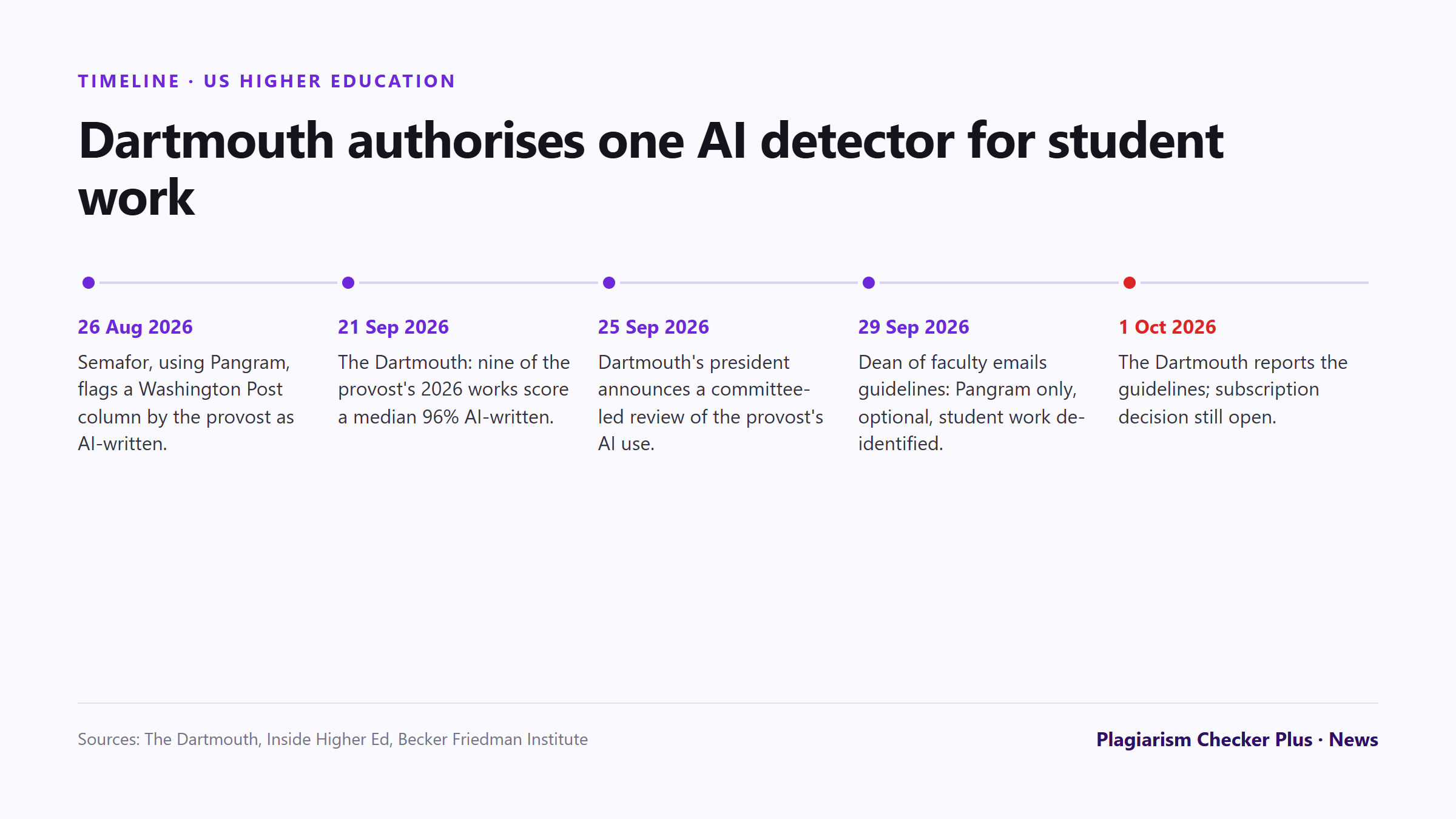
| Date (2026) | What happened | Source |
|---|---|---|
| 26 August | A Semafor investigation using Pangram flags a Washington Post opinion column by Provost Santiago Schnell as 100% AI-written. | The Dartmouth |
| 21 September | The Dartmouth reports that nine of Schnell's 2026 publications returned a median AI-written score of 96% in Pangram, while five pieces from before 2022 were scored as fully human-written. | The Dartmouth |
| 25 September | President Sian Leah Beilock announces an independent committee, led by former provost David Kotz, to review Schnell's use of AI. | The Dartmouth |
| 29 September | Carey emails the AI detection guidelines to undergraduate faculty. | The Dartmouth |
Schnell has not denied using AI. He told The Dartmouth he uses it for language refinement and copyediting, and that the ideas, research, drafts and final decisions are his own. Inside Higher Ed reports that he has since said he should always disclose AI use in his public writing. Dartmouth's chapter of the American Association of University Professors has circulated a petition for his removal, which The Dartmouth says has more than 220 signatures.
What the University of Chicago study measured
The Dartmouth describes the evidence for Pangram's reliability as an October 2025 University of Chicago audit. The underlying document is a working paper, Artificial Writing and Automated Detection, by Brian Jabarian and Alex Imas of Chicago Booth. The Becker Friedman Institute dates the working paper to August 2025 and published a research brief on it in October 2025. It is also listed as an NBER working paper.
- What was tested: three commercial detectors (Pangram, OriginalityAI and GPTZero) and one open-source baseline (RoBERTa).
- On what: 1,992 passages in six genres: news, blogs, consumer reviews, novels, restaurant reviews and résumés. Human-written text was paired with text generated by GPT-4.1, Claude Opus 4, Claude Sonnet 4 and Gemini 2.0 Flash.
- Result for Pangram: essentially zero false positives and false negatives on medium and long passages, with slightly higher error rates on short ones. It was the only detector that kept detecting AI text effectively when the false positive rate was capped at 0.5%.
- Result for the others: OriginalityAI and GPTZero formed a second tier. The open-source baseline wrongly flagged roughly 30% to 78% of human text.
Two points are worth keeping in view. The six genres do not include student essays or other coursework, so the study is not a direct test of the setting Dartmouth is applying it to. And the brief itself says the implications for writing are not obvious, because AI tools can legitimately help people develop ideas and tighten prose.
Pangram's own position is cautious on discipline. Its technical report says every AI detector has a nonzero false positive rate and discourages using its classifier as a "sole arbiter of academic integrity and plagiarism checking". Dartmouth's sixth guideline is consistent with that.
What this means for students and teachers
- Students: check each course's stated AI policy and whether it says a detector may be used. At Dartmouth the default is that generative AI is not allowed in submitted work unless the instructor permits it.
- Students: if a result is raised with you, the Dartmouth model is a conversation before any penalty. Drafts, notes and version history are the kind of additional information a committee can weigh.
- Teachers: decide before term whether you will use a detector, and say so in writing along with whether results could affect grades.
- Teachers: remove names and other identifying details before uploading student work to any outside service.
- Institutions: if you name an approved tool, be ready to say what evidence the choice rests on and how closely that evidence matches student writing.
Sources
- Jackson Hyde, Dean of faculty authorizes professors to use AI detector Pangram to review student work, The Dartmouth, 1 October 2026.
- Alex Klee and Isabela Pierry, Op-eds, academic articles by Provost Santiago Schnell flagged as 'AI-written' by 'near-zero error' AI detector Pangram, The Dartmouth, 21 September 2026.
- Haley Rodriguez and Jared Gonzalez Arce, The Dartmouth's investigation into provost's AI use prompts campus-wide conversation, The Dartmouth, 1 October 2026.
- Kathryn Palmer, Dartmouth Provost's "AI Dependency" Sparks Backlash, Inside Higher Ed, 29 September 2026.
- Dartmouth College, Guidelines on using Generative Artificial Intelligence (GenAI) for Coursework, policy page, last revised 2 September 2025.
- Becker Friedman Institute, Artificial Writing and Automated Detection, research brief on BFI Working Paper No. 2025-116 by Brian Jabarian and Alex Imas, University of Chicago, October 2025.
- Brian Jabarian and Alex Imas, Artificial Writing and Automated Detection, NBER Working Paper 34223, September 2025.
- Bradley Emi and Max Spero, Technical Report on the Pangram AI-Generated Text Classifier, arXiv, 21 February 2024 (revised 29 July 2024).
FAQ
Can Dartmouth professors use AI detectors on student work?
Yes, under guidelines sent to undergraduate faculty on 29 September 2026, as reported by The Dartmouth. Only Pangram is authorised, use is optional, and faculty must tell students whether a detector may be used and whether results could affect grades.
Can a Dartmouth student be penalised on an AI detector result alone?
The guidelines, as reported, say faculty must communicate with a student before a detection result affects a grade, and that the Committee on Standards will consider information beyond a detector result before finding a student responsible.
How accurate is Pangram according to the University of Chicago study?
The working paper by Brian Jabarian and Alex Imas found essentially zero false positives and false negatives for Pangram on medium and long passages, with slightly higher error rates on short ones. The test used 1,992 passages from six genres such as news, reviews and résumés. Student essays were not among them.
Why does student work have to be de-identified first?
The guidelines tie this to FERPA, the US law that protects students' educational records. Removing names and other identifying details means the work sent to an outside service is not linked to a named student.
What happens next
Two things are still open. The guidelines say the College is evaluating an institutional subscription to an AI detector and has not made a final decision, and they say the rules may be revised because the technology moves quickly. Separately, the committee reviewing the provost's use of AI has yet to report. We will update this article if Dartmouth publishes the guidelines or changes them.
How teachers check for AI writing
A plain guide to the methods teachers use, what a detector score does and does not show, and what counts as supporting evidence.