Turnitin adds AI writing detection in Dutch, German and Turkish, and updates its English model
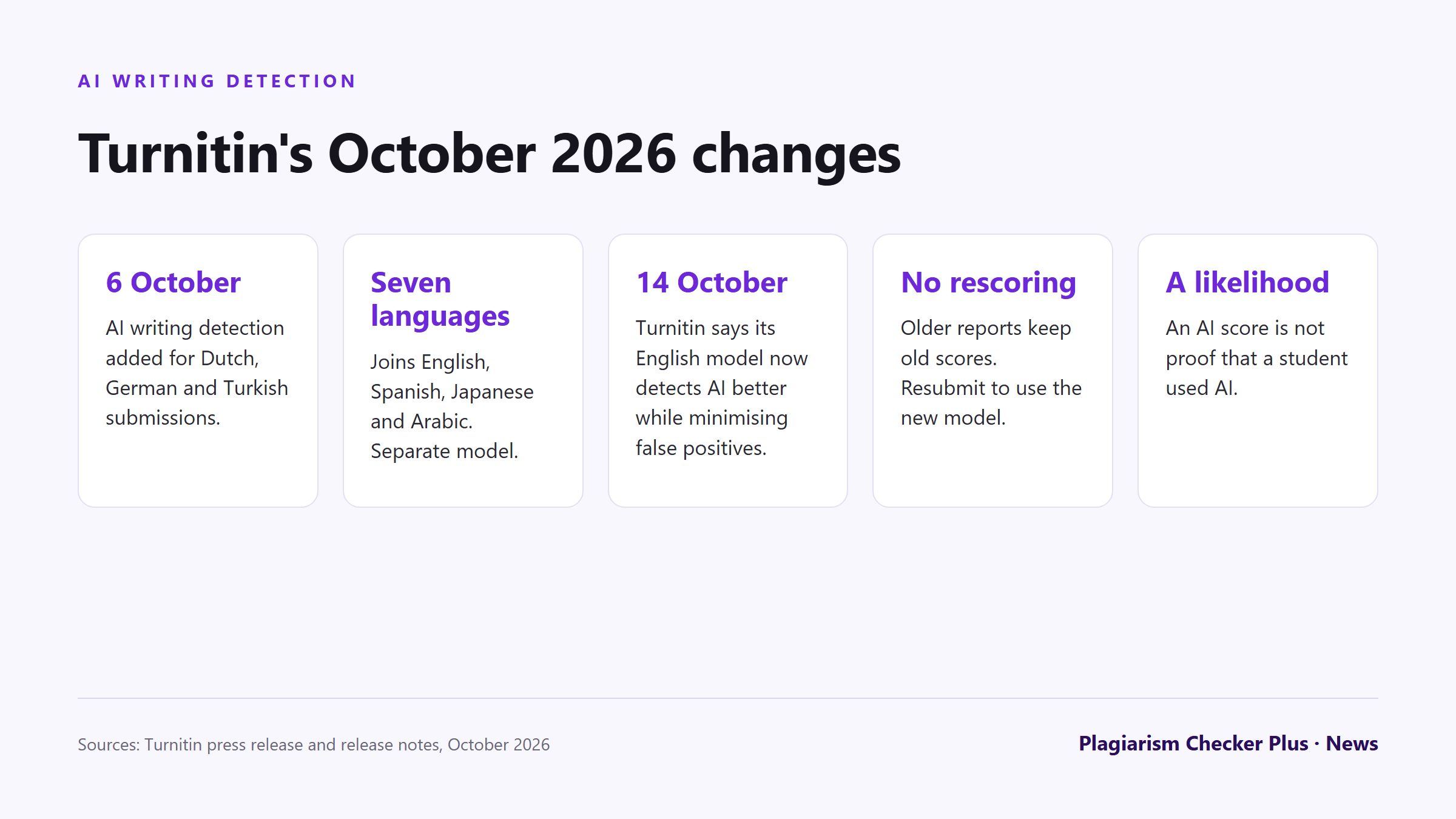
Turnitin made two changes to its AI writing detection in October 2026. On 6 October it announced that submissions written in Dutch, German and Turkish can now be checked for likely AI-generated text. On 14 October it released an update to the model it uses for English submissions. Neither change alters how the AI writing report looks. But both affect what instructors may see, and the English update means a document checked before and after 14 October may not get the same score.
Summary
- From 6 October 2026, institutions that license Turnitin's AI writing detection can get AI scores for Dutch, German and Turkish submissions, in addition to English, Spanish, Japanese and Arabic.
- On 14 October 2026 Turnitin updated its English AI writing model. It says the update improves detection while minimising false positives.
- Existing reports were not updated. A submission has to be resubmitted to get a score from the new English model.
Key takeaways
- Turnitin says the Dutch, German and Turkish model is separate from its English, Spanish, Japanese and Arabic models.
- Turnitin has not published new accuracy figures for the English update or the three new languages in the sources we reviewed.
- An AI score is a likelihood, not proof. Scores produced by different model versions should not be compared as if they were the same measurement.
Dutch, German and Turkish from 6 October
Turnitin announced the new languages in a press release dated 6 October 2026, also distributed through PR Newswire. It says the feature is available through Turnitin Originality and as an add-on for iThenticate 2.0 customers. As with the existing languages, instructors see an overall percentage of the submission that is likely to be AI-generated.
Turnitin's release notes say the model for these three languages is separate from its English, Spanish, Japanese and Arabic models. The scores only appear where the institution has licensed and switched on AI writing detection.
In the announcement, James Thorley, Turnitin's vice president for EMEA and APAC, said there is "no substitute for knowing a student's writing style".
The English model update on 14 October
Turnitin's AI writing detection model page lists an update dated 14 October 2026. It says the update improves AI detection in the English model while minimising false positives. The page does not describe the technical changes.
| Question | What Turnitin says |
|---|---|
| Do settings need to change? | No. No changes to settings are required. |
| Does the report look different? | No. There are no visual changes to the AI writing report. |
| Are old reports rescored? | No. Previously generated reports are not updated. A submission must be resubmitted to get a score from the new model. |
How this fits with sector guidance
The updates come as regulators and exam bodies stress the limits of detection. A report published in November 2026 by England's Office for Students and Advance HE says evidence suggests detection tools do not consistently and reliably identify AI use. In that report, a Turnitin spokesperson said the tool's output should be used as only one data point. We cover the report in our article on the OfS findings.
In the UK schools sector, the exam boards' updated JCQ guidance lists Turnitin among tools that may form part of the evidence, and says detection tools can produce both false positives and false negatives.
What this means for students and teachers
- Students writing in Dutch, German or Turkish: your submissions may now receive an AI score if your institution has the feature switched on. Check your course's AI policy.
- Students: keep drafts, notes and version history. If a score is questioned, evidence of how you wrote the work matters more than the number.
- Teachers: note when a submission was checked. Reports created before 14 October used the earlier English model and were not rescored.
- Teachers: treat an AI score as a likelihood, not proof. Talk to the student and look at their other work before drawing conclusions.
- Institutions: if you switch on the new languages, tell students before assessments start.
Sources
- Turnitin, Turnitin now offers AI writing detection for Turkish, German, and Dutch language submissions, press release, 6 October 2026.
- Turnitin via PR Newswire, Turnitin now offers AI writing detection for Dutch, German, and Turkish language submissions, 6 October 2026.
- Turnitin, Turnitin release notes, entry for 6 October 2026.
- Turnitin, AI writing detection model, entry for 14 October 2026.
- Office for Students and Advance HE, Making AI work for students: reflections on institutional practice, 11 November 2026.
FAQ
Which languages does Turnitin's AI writing detection support?
Following the 6 October 2026 update, Turnitin lists English, Spanish, Japanese, Arabic, Dutch, German and Turkish. Detection only runs where an institution has licensed and enabled the feature.
Did Turnitin change its AI detector in October 2026?
Yes. On 14 October 2026 Turnitin updated its English AI writing model. It says the update improves detection while minimising false positives, and that the report looks the same.
Will my old Turnitin AI score change?
No. Turnitin says the update does not retroactively change existing reports. A submission must be resubmitted to get a score from the updated model.
Is a Turnitin AI score proof that I used AI?
No. An AI score is a likelihood. In a November 2026 report by England's Office for Students, a Turnitin spokesperson said the output should be used as only one data point.
What happens next
Turnitin's October changes widen the number of students whose work can receive an AI score, and change the model behind English scores. Turnitin has not published new accuracy figures for either change in the sources we reviewed. We will update this article if it does.
Does Turnitin detect AI?
What Turnitin's AI writing report shows, what the percentage means and what it cannot tell you.