England's university regulator says secure, AI-free assessment will often work best
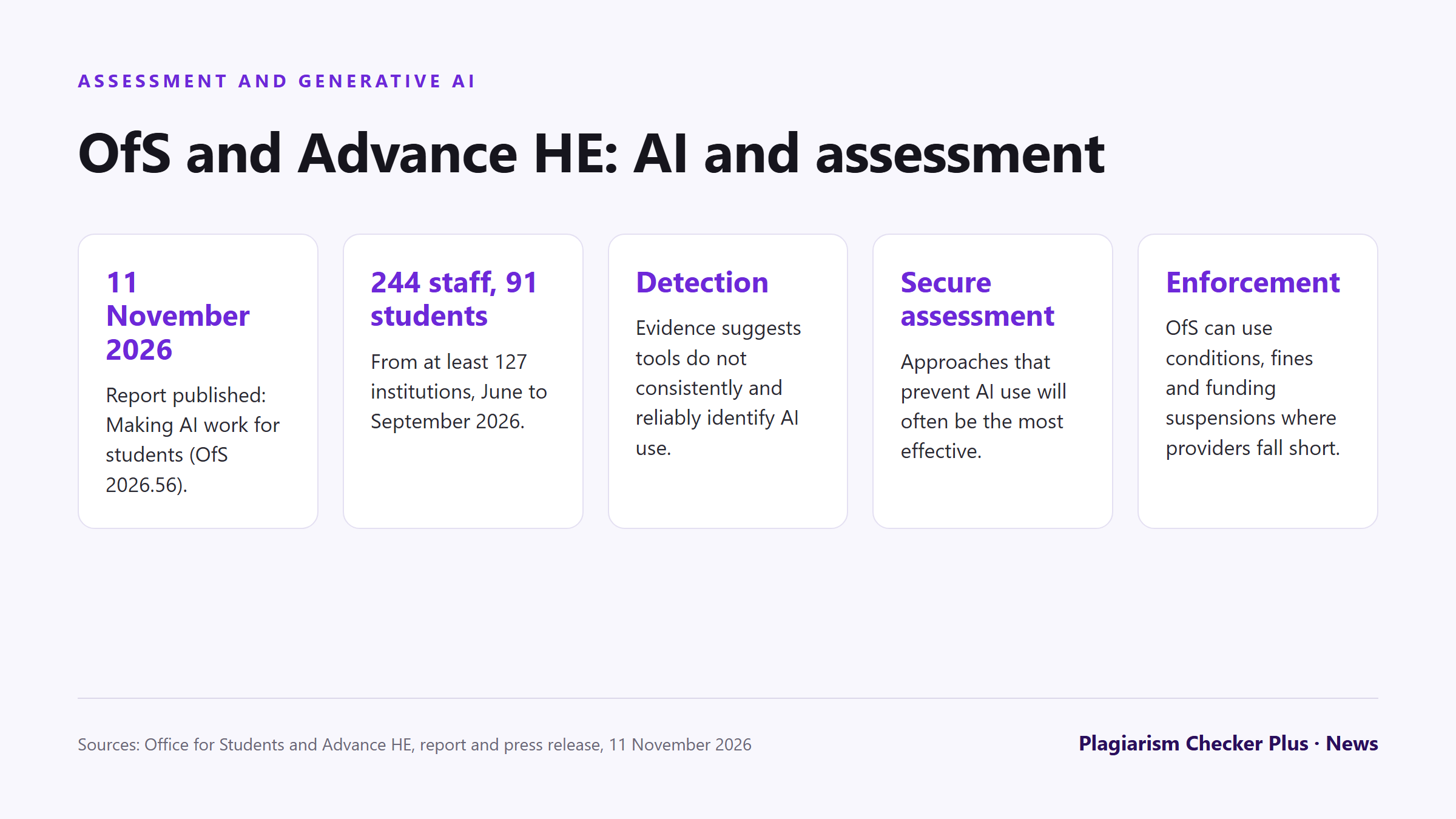
The Office for Students (OfS), the regulator for higher education in England, has published research on how universities and colleges are responding to generative AI. The report, produced with Advance HE and published on 11 November 2026, covers teaching, assessment, AI literacy and institutional strategy. Its sharpest findings are about assessment. It says many unsupervised assessments can be completed to a high standard with AI, that detection tools do not reliably identify AI use, and that secure assessments designed to prevent AI use will often be the most effective. Alongside the report, the OfS set out how it expects institutions to respond.
Summary
- The OfS and Advance HE report, Making AI work for students (OfS 2026.56), draws on the views of 244 staff and 91 students and student representatives from at least 127 institutions, gathered between June and September 2026.
- It says evidence suggests AI detection tools do not consistently and reliably identify AI use, and that it is usually not possible to establish conclusively whether a student followed an AI policy.
- The OfS says it will require assessments to validly and reliably measure students' knowledge and skills, often through secure (AI-free) assessment, and can use its enforcement powers where institutions fall short.
Key takeaways
- The report's conclusions are those of the OfS and Advance HE. The report itself says they are not new regulatory requirements.
- The regulator's press release points to its existing enforcement levers, including conditions of registration and monetary penalties, rather than new rules on AI.
- Students told researchers that detector scores cast suspicion on their work, and some said there seemed to be no route to proving their innocence after a high score.
What was published
The report is titled Making AI work for students: reflections on institutional practice. It was published on 11 November 2026 with the reference OfS 2026.56. The research was carried out jointly by the OfS and Advance HE, a sector body that works on teaching quality and leadership in higher education.
According to the full report, the team held 16 live events between June and September 2026, including seven in-person roundtables in London, Manchester and Bristol. It also collected 64 responses to online prompts and ran 22 interviews with institutions, sector groups, technology companies and graduate employers. In total, the views of 244 higher education staff and 91 students and student representatives from at least 127 institutions informed the work.
What the report found about assessment
- Unsupervised assessments are exposed. The report says a significant proportion of assessments remain in unsupervised formats, and many can be completed to a high standard using AI with limited engagement from students. Programmes assessed through remotely submitted essays were described as particularly vulnerable.
- Policies are not enough on their own. Most institutions consulted have AI policies, often 'traffic light' systems. But many students said they were unclear about what was allowed, and the report says it is usually not possible to establish conclusively whether a student has followed the policy.
- Declarations are unreliable. Many students said they would not declare AI use, even when it was allowed, because they feared it would cast suspicion on their work and lower their grade.
- Redesign is uneven. Some institutions have moved to in-person exams, presentations, vivas and practical assessments. Others assess the process of producing work at several checkpoints. Participants said many courses have not been redesigned at all.
The report also records the costs of secure formats. Staff said in-person exams and vivas are resource-intensive. Some raised concerns that closed-book exams bear little resemblance to professional work and may disadvantage some groups, such as disabled students. The report notes that wearable technology may make cheating in secure assessments more feasible.
What it says about AI detection
The report says academic research suggests humans cannot reliably identify AI-generated text. It accepts there is evidence that some newer detectors may perform better than established tools. But it says research suggests improvements in detection are often temporary, and that tools which rewrite text to avoid detection may further reduce accuracy. Its summary states that evidence suggests AI detection tools "do not consistently and reliably identify AI use".
- Many staff said their institutions still use detectors. Some institutions include detector scores as supporting evidence in misconduct cases. Some participants knew of colleagues using them informally to flag work or lower grades.
- Some institutions had stopped using detection tools because of concerns about their efficacy.
- Some institutions now hold vivas or hearings with students suspected of misconduct, to check whether they understand what they submitted.
- A Turnitin spokesperson told the researchers that the tool's output should be used as only one data point when working out how work was authored.
- Students were strongly critical of detectors. They said the tools are inaccurate and cast suspicion on work even without strong evidence.
What the OfS says it will do
In its press release, the OfS said it will require institutions to ensure their assessments validly and reliably measure students' knowledge and skills, which will often mean secure (AI-free) assessment. It said it will hold institutions to account where they fall short. The levers it listed include conditions of registration, monetary penalties, and suspending access to student support and OfS grant funding. It also said it will publish guidance and examples of effective practice, and continue its research.
Josh Fleming, the OfS director of strategy and delivery, described AI as a major opportunity but also a "generational risk" to the system as it stands. He called for far greater use of AI-free assessment. Advance HE said it will launch an AI-focused Change Academy for its members in early 2027.
The report also records the sector's view. Participants generally felt that new OfS conditions of registration on AI could be counterproductive and could constrain innovation. Some asked instead for clarity on how existing conditions apply.
What this means for students and teachers
- Students in England: expect more in-person exams, presentations and short discussions about submitted work. Being able to explain your own work is becoming part of the assessment.
- Students: keep drafts, notes and version history for coursework. If your work is questioned, a record of how it developed is more useful than any single score.
- Students: if your course allows AI, follow the declaration rules. The report shows many students hide permitted use, which makes honest declarations harder to read for everyone.
- Teachers: a detector score is a likelihood, not proof. The report and Turnitin's own comment both point to using it as one piece of evidence at most.
- Teachers: a short conversation with the student about their work is one of the checks the report describes institutions adopting.
Sources
- Office for Students, Making AI work for students: reflections on institutional practice, OfS 2026.56, 11 November 2026.
- Office for Students and Advance HE, Making AI work for students (full report, PDF), November 2026.
- Office for Students, Universities should help students develop AI skills while protecting confidence in degrees, press release, 11 November 2026.
FAQ
What did the Office for Students say about AI detectors?
The OfS and Advance HE report says evidence suggests AI detection tools do not consistently and reliably identify AI use. It notes that some institutions use detector scores as supporting evidence in misconduct cases, while others have stopped using the tools.
Is the OfS banning coursework or essays?
No. The report says secure assessments that prevent AI use will often be the most effective, and that well-designed assessments that integrate AI can also work. The OfS says it will require assessments to be valid and reliable, often through secure formats, but it has not banned any assessment type.
Who took part in the OfS AI research?
The views of 244 higher education staff and 91 students and student representatives from at least 127 institutions, gathered between June and September 2026 through events, online prompts and interviews. Participants were self-selecting.
Can the OfS penalise universities over AI and assessment?
The OfS says it will hold institutions to account where assessments fall short, using existing levers such as conditions of registration, monetary penalties and suspending access to student support and OfS grant funding. It has not announced new AI-specific conditions.
What happens next
The report does not create new rules, but it signals how the regulator will judge assessment in England. Universities that rely on unsupervised essays and detector scores are likely to face more questions. Advance HE's Change Academy starts in early 2027, and the OfS has said more guidance and research will follow. We will update this article when it does.
How teachers check for AI writing
A plain guide to the methods teachers use, what a detector score does and does not show, and what counts as supporting evidence.