Manchester now labels every assessment with one of four AI categories
Students at the University of Manchester have started the 2026-27 academic year under the university's first policy on AI in teaching and learning. The policy was approved by Senate on 22 April 2026 and has applied since 1 September. Its central rule is that every assessment must be assigned to one of four categories of AI use, and that students must be told which one. In the Faculty of Humanities, unit leads were given until 22 September to classify their assessments and post the result on the Canvas learning platform. This article sets out what the four categories mean and what else the policy changes.

Summary
- Every University of Manchester assessment must now be labelled A (AI Prohibited), B (AI Minimal), C (AI Permitted) or D (AI-Integrated), and the label must appear in the assessment brief and on Canvas.
- Students may choose not to use AI in any assessment except those in Category D.
- The policy says failure to document use of generative AI in assessed work could be a form of plagiarism under the university's Academic Malpractice Procedure.
Key takeaways
- The policy standardises how AI rules are communicated. Decisions about which category applies stay with the academics who set each assessment.
- The policy text does not mention AI detection software.
- Manchester has added a category at a time when some universities are cutting theirs. The University of Bath moved from three categories to two lanes this term.
What changed on 1 September
The AI in Teaching and Learning Policy is a seven-page document that applies to undergraduate and taught postgraduate students and to the staff who teach them. Its document control box gives the approving body as Senate, the approval date as April 2026, the implementation date as September 2026 and the next review as September 2027. It records that the policy supersedes nothing, which makes it the first of its kind at the university.
The policy describes its purpose as supporting "consistent, transparent assessment expectations" while enabling appropriate use of AI. A staff news item published on 1 June 2026 said it was developed by academic colleagues, professional services colleagues and the Students' Union, and described it as "a workable starting point - not a final answer".
| Date (2026) | What happened | Source |
|---|---|---|
| February | A working group is convened by Professor Sarah Dyer, associate vice-president for teaching excellence and innovation. | EdTech Innovation Hub |
| 22 April | Senate approves version 1.0 of the policy. | Policy document |
| 1 June | Staff are asked to categorise existing assessments and update Canvas before the start of semester. | StaffNet |
| 1 September | The policy takes effect. | Policy document |
| 22 September | Deadline in the Faculty of Humanities for unit leads to classify each assessment and tell students through Canvas. | StaffNet, Faculty of Humanities |
The four categories
The definitions below are taken from section 2.1.1 of the policy. The category decides what information an assessment brief has to contain.
| Category | What the policy says | Can a student opt out of AI? |
|---|---|---|
| A. AI Prohibited | AI is not permitted or is unable to be used in the assessment. | Not applicable |
| B. AI Minimal | AI may be used in limited ways that contribute to presentation, for example grammar, fluency and formatting, without changing the ideas, arguments or conclusions developed by the student. The brief must set out what is acceptable. | Yes |
| C. AI Permitted | AI may be used to complete the assessment. The brief must set out what is acceptable and should explain how students who do not wish to use AI can do the work. | Yes |
| D. AI-Integrated | AI use is necessary to meet the unit's intended learning outcomes. This does not mean all AI use is permitted. The brief should explain why AI is required. | No |
The line between B and C is the one most likely to cause confusion, and the university's own staff say so. In an update to the Faculty of Humanities dated 25 August 2026, Mark Carrigan, the faculty's associate dean for digital education, wrote that there is "clearly a degree of ambiguity" between the two. His suggested test is whether AI use would change what the student is saying or only how they are saying it. Category B covers the second, which he compares to the help a proofreader might offer.
Category D is expected to be rare. The June staff notice said AI-Integrated assessments would apply to "a very small minority", and that optional units using them had to be flagged before course selection opened in August so students could make an informed choice. Carrigan's update said the faculty expected only a handful, because D is the one category where students cannot opt out.
Other rules in the policy
- Declaring AI use: section 3.0.2 says that within assessed work, a student's failure to document use of generative AI "could be a form of plagiarism" contrary to the Academic Malpractice Procedure. Failure to follow an assessment brief is handled case by case and may be dealt with through marking.
- Uploading course materials: students must not upload question papers, handouts or other copyrighted resources to external AI tools.
- Lecture recordings: where a recording of a taught session is available, students may upload it to their university-provided Microsoft 365 Copilot account.
- Group work: the unit lead must state the category and explain how the group should approach and record its use of AI. Students need agreement from all group members before recording or transcribing group conversations.
- Staff: only the university-provided Microsoft 365 Copilot service may be used for student-identifiable or confidential data.
- Wellbeing: the policy says Copilot is not a suitable substitute for therapy, medical advice or academic advice.
How it compares with other models
Manchester's framework is a variation on the traffic-light systems that, in Carrigan's words, have become commonplace: prohibition (red), context-specific use (amber) and encouraged use (green). It adds a fourth category. In a post on the university's teaching and learning blog in June, Carrigan wrote that the problem with traffic lights is that most assignments end up categorised as amber, so the question of clarity is pushed elsewhere. He expects most Manchester assessments to fall into the two middle categories, and accepts that the extra category brings a risk of ambiguity of its own.
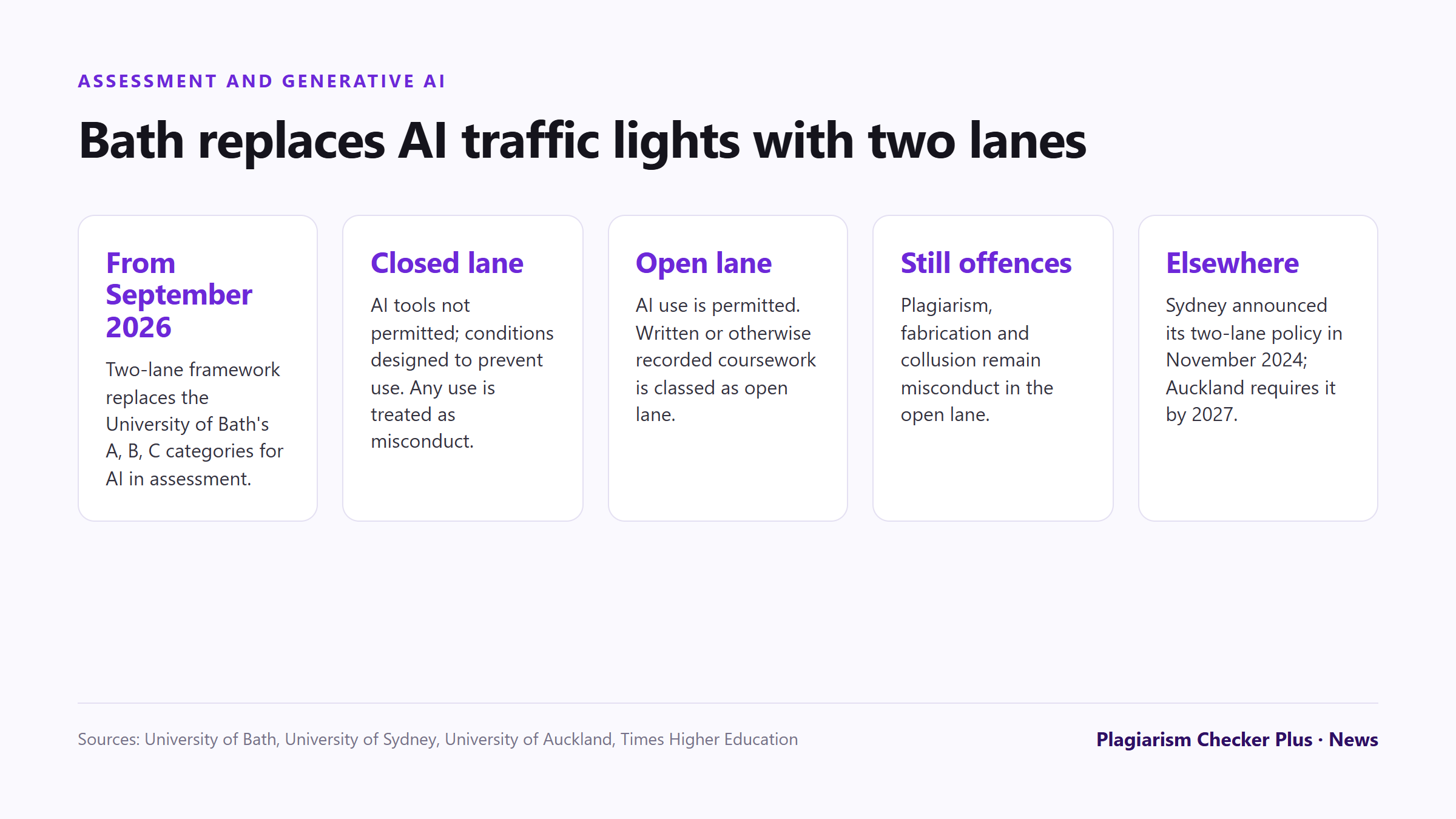
Other institutions have gone the opposite way. The University of Bath's guidance for this academic year replaces its A, B and C categories with two lanes from September 2026: a closed lane where generative AI is not permitted and the assessment is designed to prevent it, and an open lane where its use is authorised. We covered that change in our report on Bath's two-lane model.
| Feature | Manchester (from September 2026) | Bath (from September 2026) |
|---|---|---|
| Number of categories | Four | Two |
| Is there a limited-use tier? | Yes. Category B allows AI for presentation only. | No. Bath's guidance says its former types B and C both become open lane. |
| Where AI is not allowed | Category A: not permitted, or unable to be used. | Closed lane: not permitted, with assessments designed to prevent use. |
| Stated reasoning | Clear, consistent expectations, set by each discipline. | Bath's guidance says strategies built on policing AI use become less reliable over time. |
The difference matters because Categories A and B depend on students following a rule in work that may be done unsupervised. Carrigan does not present the policy as a fix. He calls AI in assessment a "wicked problem" with "only better or worse options".
What this means for students and teachers
- Manchester students: look for the category on each assessment's Canvas page and in the brief. If it is missing or unclear, ask the unit lead in writing before you start.
- Manchester students: in Categories B, C and D, record what you used AI for. The policy treats undocumented generative AI use as potential plagiarism.
- Manchester students: do not paste exam papers or handouts into outside AI tools. The policy prohibits it on intellectual property grounds.
- Students elsewhere: the same word can mean different things at different universities. 'Permitted' at Manchester still comes with a list of acceptable uses.
- Teachers: the B and C boundary needs examples. A test such as 'does it change what is said, or only how' is easier for students to apply than a category name.
Sources
- The University of Manchester, AI in Teaching and Learning Policy, version 1.0, approved by Senate 22 April 2026, effective from 1 September 2026.
- The University of Manchester, AI in Teaching and Learning Policy approved - what you need to do, StaffNet News, 1 June 2026.
- Mark Carrigan, Preparing for the new AI in Teaching and Learning Policy, StaffNet, Faculty of Humanities, 25 August 2026.
- The University of Manchester, AI in teaching and learning: what you need for the new academic year, StaffNet, 25 August 2026.
- Mark Carrigan, Building a working consensus on AI in teaching and learning, TEA: Teach, Explore, Apply (University of Manchester teaching and learning blog), 19 June 2026.
- Emma Thompson, University of Manchester adopts four-tier AI policy, EdTech Innovation Hub, 23 July 2026.
- University of Bath, The two-lane approach: frequently asked questions, Teaching Hub, accessed 4 October 2026.
FAQ
What are the University of Manchester's four AI categories?
A is AI Prohibited. B is AI Minimal, which allows AI for presentation such as grammar, fluency and formatting without changing the student's ideas. C is AI Permitted, with acceptable uses set out in the brief. D is AI-Integrated, where using AI is necessary to meet the learning outcomes.
When did Manchester's AI policy start?
It took effect on 1 September 2026, after Senate approved it on 22 April 2026. The policy document gives September 2027 as the next review date.
Can Manchester students refuse to use AI?
Yes, except in Category D. The policy says students may choose not to use AI for assessment unless the assessment has been designated as Category D, where AI use is necessary to meet the learning outcomes.
Is using AI without saying so plagiarism at Manchester?
It can be. The policy says a student's failure to document use of generative AI within assessed work could be a form of plagiarism contrary to the Academic Malpractice Procedure.
Does the policy say Manchester uses AI detectors?
No. The policy text does not mention AI detection tools at all. It deals with how AI rules are set and communicated for each assessment.
What happens next
The university has said it will review how the policy is working after the first semester, and the policy requires faculty teaching and learning committees to look at its impact at least once a semester. The first real test will be whether students find the B and C labels clear when coursework deadlines arrive. We will update this article when the university publishes the outcome of its review.
Is using AI plagiarism?
A plain guide to where AI use ends and plagiarism begins, and why the answer depends on your institution's rules.