University of Bath drops its AI traffic-light rules for a two-lane assessment model this term
The University of Bath has started the 2026-27 academic year with a new rule for generative AI in assessed work. Its three-category system, which told students whether AI was banned, optional or required in each assignment, has been replaced from September 2026 by two lanes: closed, where AI cannot be used, and open, where it is permitted. The university published the plan in February 2026 and last updated its staff guidance on 10 September 2026. The most significant consequence is that ordinary coursework can no longer be declared AI-free.
Summary
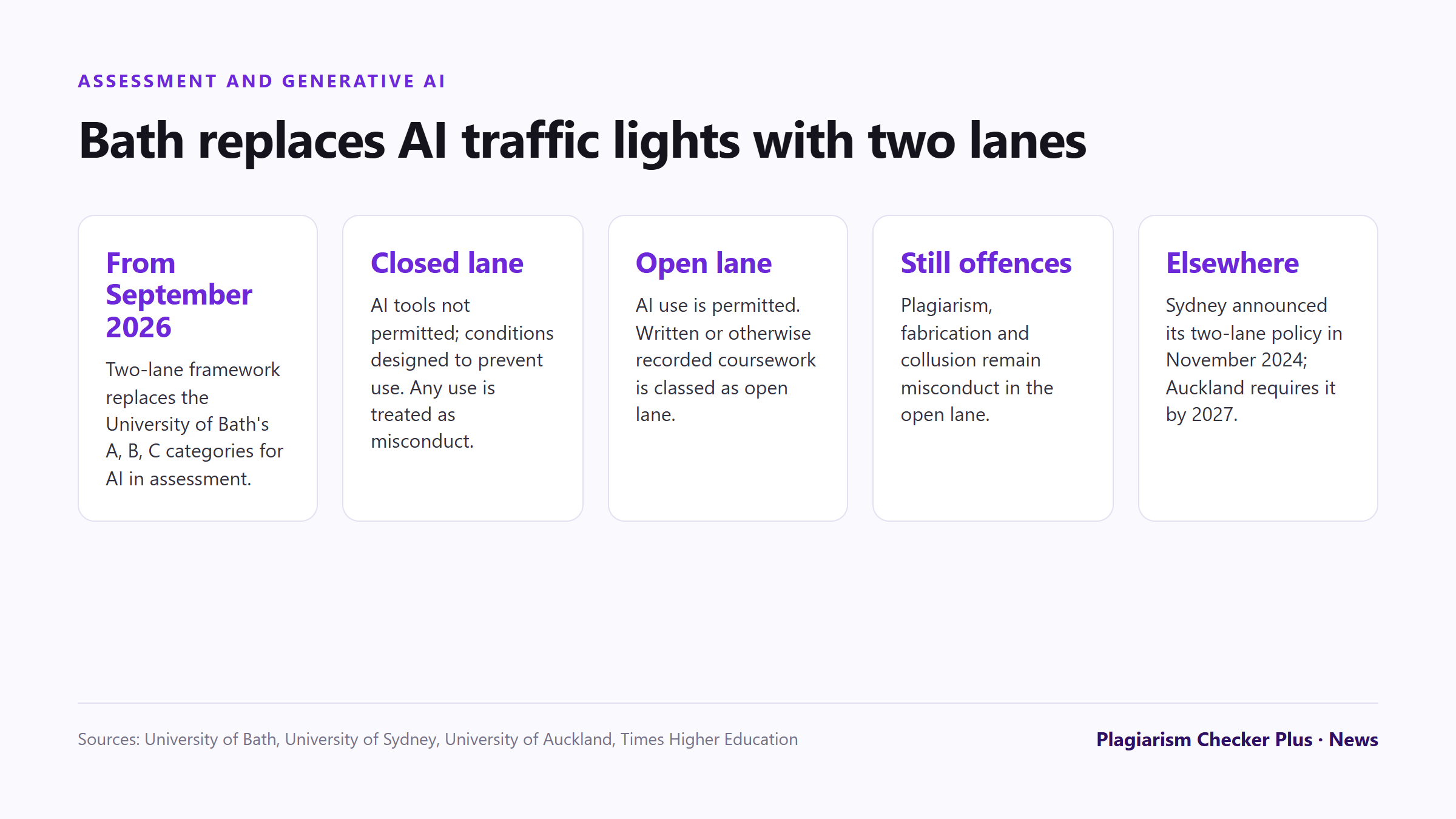
- From September 2026 the University of Bath's two-lane framework replaces the A, B, C categories it used for generative AI in assessment, according to the university's staff guidance.
- Closed-lane assessments are designed to prevent AI use; open-lane assessments permit it. Written or otherwise recorded coursework is classed as open lane.
- In a closed-lane assessment any use of generative AI is treated as academic misconduct. In the open lane, AI use alone is not an offence, but plagiarism, fabrication and collusion still are.
Key takeaways
- At Bath, a ban on AI now has to be backed by assessment conditions that actually prevent its use. An instruction not to use it is no longer enough.
- Students stay responsible for everything they submit, whichever lane the assessment is in.
- The model began at the University of Sydney and is spreading: Auckland has set a 2027 deadline and Cardiff is reported to be considering it.
What changed in September 2026
Until the end of 2025-26, Bath labelled each assessment with one of three types. Under its earlier guidance, Type A meant generative AI was not permitted, Type B allowed it as an optional assistive tool, and Type C made it an integral part of the task. That page now states that the system applies only to assessments completed before 1 September 2026.
The replacement has two categories. The university's overview of generative AI and education says every summative assessment sits in either an open lane, where students have access to AI tools and may use them, or a closed lane, where the tools are not permitted and the conditions are designed to prevent their use.
| Until 2025-26 | From September 2026 | |
|---|---|---|
| Categories | Type A (not permitted), Type B (optional assistive tool), Type C (integral to the task) | Closed lane and open lane |
| Invigilated exams and tests | Type A (AI not permitted) | Closed lane |
| Written or recorded coursework | Could be Type A, B or C | Open lane |
| Exams or tests where students could access AI tools | — | Open lane |
| AI use in a closed-lane assessment | — | Investigated as academic misconduct |
The staff FAQ gives a general rule for the switch: Type A becomes closed lane, and Types B and C become open lane. The exception matters more than the rule. Coursework that was previously Type A should now be treated as open lane, because nothing about a take-home task stops a student from using AI.
Why Bath says it is doing this
The FAQ describes the two-lane model as simpler and more sustainable than the three types, and argues that assessment strategies built on policing AI use become less reliable over time. The stated aim is to design assessments around what students should be able to demonstrate, and to build their AI literacy, instead of listing what they must not do.
The university's overview page describes the framework as deliberately minimal. Staff and students in each discipline are left to work out what effective and responsible use looks like, and the page says the aspiration is "a culture based on trust, not suspicion and policing". It also leaves room for choosing not to use AI where that can be justified educationally.
None of the three Bath pages we read mentions AI detection software, so this article makes no claim about whether or how the university uses it.
What counts as misconduct now
The rules differ by lane. In a closed-lane assessment, the overview page says any use of a generative AI tool is a breach that will be investigated as academic misconduct.
In the open lane, the FAQ says: "Misusing GenAI is not classified as misconduct in itself". It adds that misuse can still contribute to the existing offences of plagiarism, fabrication and collusion. A student who submits invented references or unacknowledged material produced with AI can therefore still face a case. The offence would be the fabrication or plagiarism.
Bath has also adjusted its academic integrity training. In an announcement dated 2 September 2026, the university said the generative AI questions in its Academic Integrity Training and Test had been changed to reflect the two-lane approach.
What this means in practice
The points below follow from Bath's published guidance. They apply to Bath. Other universities set their own rules, so check your own institution's policy.
For students
- Check the assessment brief. Staff are required to state which lane each assessment is in.
- Open lane does not mean anything goes. You remain responsible for all the work you submit, and the FAQ points students to library guidance on acknowledging and referencing AI use.
- In a closed-lane exam or test, any AI use is treated as misconduct.
- If an assessment requires AI and you object to using it, say so early. The FAQ tells staff to expect objections and to have an alternative that meets the same learning outcomes.
For teaching staff
- Update each assessment brief with its lane, and review whether the assessment still tests the intended learning outcomes.
- A coursework task cannot be made closed lane by instruction alone. If the learning outcome needs AI-free evidence, the conditions have to secure it, for example through an invigilated exam or test.
- Existing Type B guidance can be reused, with the wording changed to explain where AI may help or harm the work. The FAQ advises against lists of permitted and forbidden uses.
- Lanes are not reported centrally. Directors of Teaching oversee the updates and keep the course assessment maps.
Where the two-lane model came from
Bath's overview page says two-lane approaches originated with colleagues in the Pacific Rim. A prominent example is the University of Sydney, which announced its policy on 27 November 2024: secure, in-person assessments on one side, and open assessments that allow all available tools on the other, with the full system in place from Semester 2 2025.
The University of Auckland, which says it followed Sydney's framework, requires all courses and programmes to implement the approach in assessment design by 2027 unless a faculty specifies otherwise. Its controlled lane includes invigilated exams, interactive oral assessments and observed practical work.
In the UK, Times Higher Education reported in a feature first published on 29 June 2026 that Cardiff University is also looking to adopt two lanes and is considering more in-person, supervised assessment. The same article reports that the University of Surrey has redesigned its curriculum and assessment from September 2026.
Sources
- University of Bath, The Two-Lane Approach to Generative AI and Assessment: Frequently Asked Questions, Learning and Teaching Hub, published 26 February 2026, last updated 10 September 2026.
- University of Bath, Generative AI and Education at the University of Bath, Learning and Teaching Hub, undated, read 2 October 2026.
- University of Bath, Generative AI Assessment Categorisation (academic year 25/26), Learning and Teaching Hub, last updated 11 June 2026.
- University of Bath, The Academic Integrity Training and Test 2026/27, announcement, 2 September 2026.
- University of Sydney, University of Sydney AI assessment policy, news release, 27 November 2024.
- University of Auckland, Two-Lane Approach to assessment, TeachWell, updated 4 May 2026.
- Juliette Rowsell, Are universities returning to in-person exams to combat AI cheating?, Times Higher Education, 29 June 2026, updated 26 August 2026.
FAQ
What is the two-lane approach to AI in assessment?
It sorts assessments into two groups. In the secure or closed lane, the conditions prevent students from using generative AI, as in an invigilated exam. In the open lane, students may use AI and remain responsible for what they submit. The University of Sydney announced its version in November 2024, and the University of Bath adopted its own from September 2026.
Can University of Bath students use AI in coursework?
Under Bath's guidance for 2026-27, written or otherwise recorded coursework is classed as open lane, where generative AI use is permitted. Students remain responsible for all submitted work, and unit materials or the assessment brief should explain what effective and responsible use looks like for that task.
Is using AI still academic misconduct at Bath?
In a closed-lane assessment, yes: any use of generative AI is investigated as academic misconduct. In an open-lane assessment, using AI is not an offence on its own, but the university says misuse can contribute to plagiarism, fabrication and collusion, which are.
Which other universities use a two-lane model?
The University of Sydney has run a two-lane system since 2025. The University of Auckland requires it in assessment design by 2027. Times Higher Education reports that Cardiff University is also looking to implement it.
What happens next
Bath's guidance asks staff to use 2026-27 to reflect on how their assessment strategies should develop for 2027-28, so more redesign is likely to follow. Other universities are on the same path: the University of Auckland requires the two-lane approach in assessment design by 2027, and Times Higher Education reports that Cardiff University is also looking to adopt it. We will update this article if Bath changes its guidance.
Is using AI plagiarism?
A plain guide to where AI use ends and plagiarism begins, and why the answer depends on your institution's rules.