UK students push back on Turnitin's plan to use essays for AI development: the story so far
Who gets to use a student's essay once it has been checked for plagiarism? That question has moved from the small print to the front of UK higher education this autumn. The University of Southampton is ending its use of Turnitin, students' unions at several other universities are asking for written guarantees, and Turnitin has postponed the licence change that started the row until at least September 2027. Here is what has happened, in order, with links to the original reporting.
Summary
- In July 2026 Turnitin told universities it planned new licence terms covering the use of student submissions to improve or develop AI tools, according to student and trade press reports.
- The University of Southampton said in August it would not renew its Turnitin contract after 2026-27 and began phasing the service out.
- In September, students' unions including York's asked their universities for guarantees; Turnitin says any change will come no earlier than 1 September 2027.
Key takeaways
- Turnitin says it does not train a generative AI model on student work, but that it may use anonymised submissions to improve its detection and assessment tools.
- The dispute is about consent: students have to submit work to be graded, so they cannot easily say no to a licence.
- Any student or member of staff can ask the same four questions of any checking tool, including ours.
What happened, in order
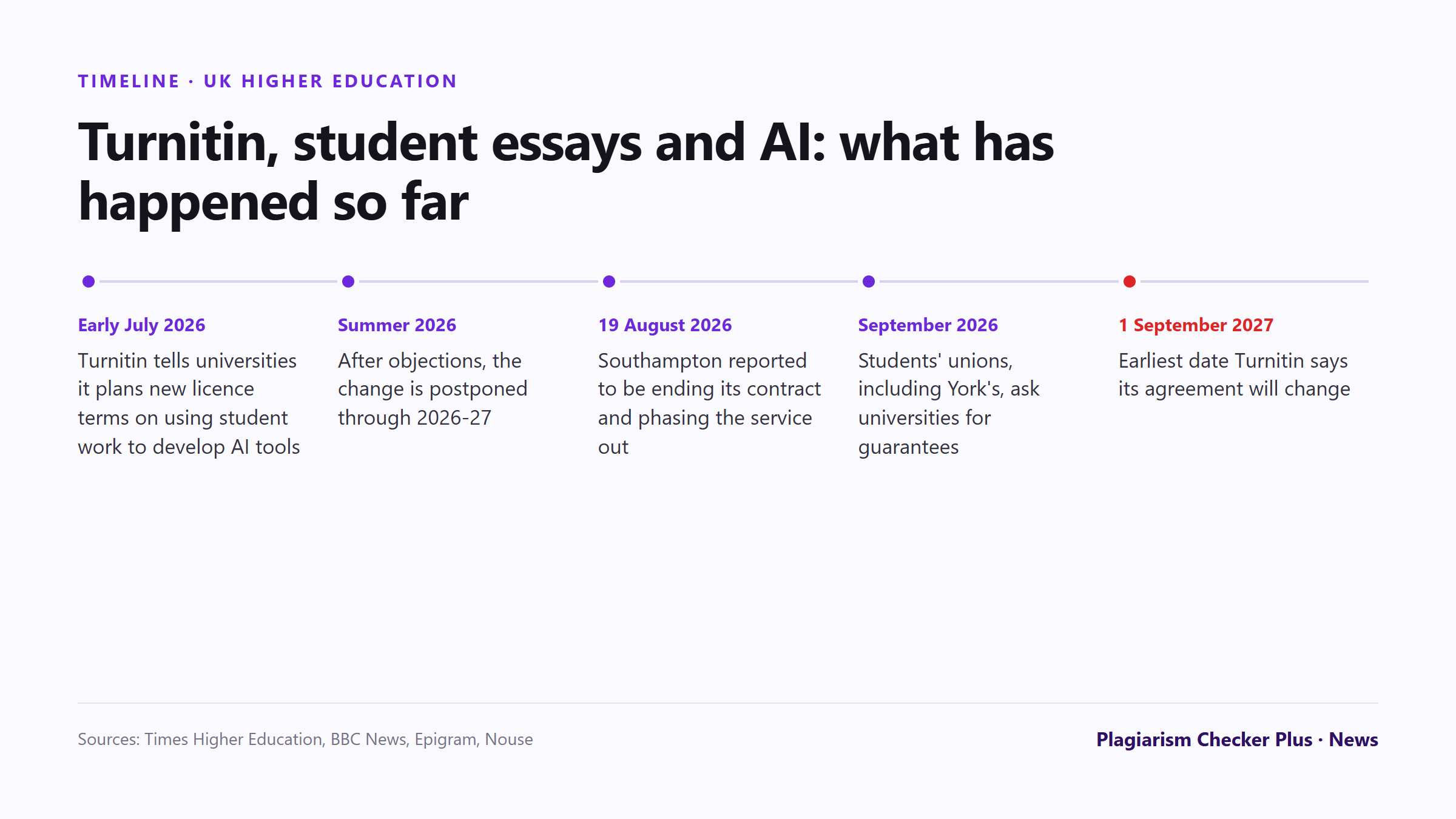
| Date | What happened | Source |
|---|---|---|
| Early July 2026 | Turnitin tells institutions it intends to update its End User License Agreement so that student submissions could be used for improving or developing AI tools and other products. | Epigram |
| Summer 2026 | After objections, Turnitin postpones the change through the 2026-27 academic year to allow time to discuss it with customers. | Epigram |
| 19 August 2026 | The University of Southampton, a Russell Group member, is reported to be ending its contract after 2026-27 and phasing Turnitin out immediately. | Times Higher Education |
| 18 September 2026 | York Students' Union says it has written to the university asking it to review its use of Turnitin. | Nouse |
| 24 September 2026 | The BBC reports students' concerns across several universities, and Turnitin's statement that its agreement will not be updated before 1 September 2027. | BBC News, via Yahoo |
The scale matters here. The BBC report cites the comparison site Uni Compare's figure that 98% of UK universities use Turnitin products, so a change to one company's terms affects students at most UK universities.
What Southampton decided
Southampton has gone further than any other UK university so far: it is ending its contract. According to Times Higher Education, it said it understood the proposed changes had been postponed, but that the company still intended to revisit them next year.
The university's own guidance for staff sets out the practical side. Courses starting on or after 14 September 2026 should not use Turnitin for assignments, and courses that began earlier should finish submissions and marking in it by 31 December 2026. In its place, staff are directed to Blackboard's assignment tool with SafeAssign originality checking. The university says it has a responsibility to protect students' data, intellectual property and academic work.
What students' unions are asking for
The unions' argument is about consent. Students have to submit work through the university's chosen system to be graded, so agreeing to a licence is not a free choice. York Students' Union officer Sam Dickinson told the BBC that students should decide how work they care about is used.
- York: the university says it has contacted Turnitin and understands there will be no change to its terms, and that its students' data will not be used to train the company's AI services (Nouse).
- Bristol: a university spokesperson said the company has never used student papers to train a generative AI model and has no plans to, and that the licence will not change during 2026-27 (Epigram).
- East Anglia and Lancaster: students' unions reported positive discussions with their universities about moving away from the service (BBC News, via Yahoo).
- Sussex: the university has entered discussions with Turnitin about the proposal (Epigram).
What Turnitin says
Turnitin's position, as reported by Times Higher Education and the BBC, has three parts. It says it does not use customer or student work to train the AI assistant in its Turnitin Clarity writing product. It says it does not train a generative AI model. And it says it may use anonymised student submissions to improve its detection and assessment tools.
Those statements are about different things, which is partly why the dispute continues. An AI-writing detector is itself a machine-learning model, so improving detection with student submissions is a use of student work in AI development, even though it is not training a chatbot. Times Higher Education also reports that the existing user agreement already gives the company a perpetual, worldwide, irrevocable licence over papers submitted from outside the EU, for providing and improving the service.
Meanwhile, in the US: more detection, with conditions
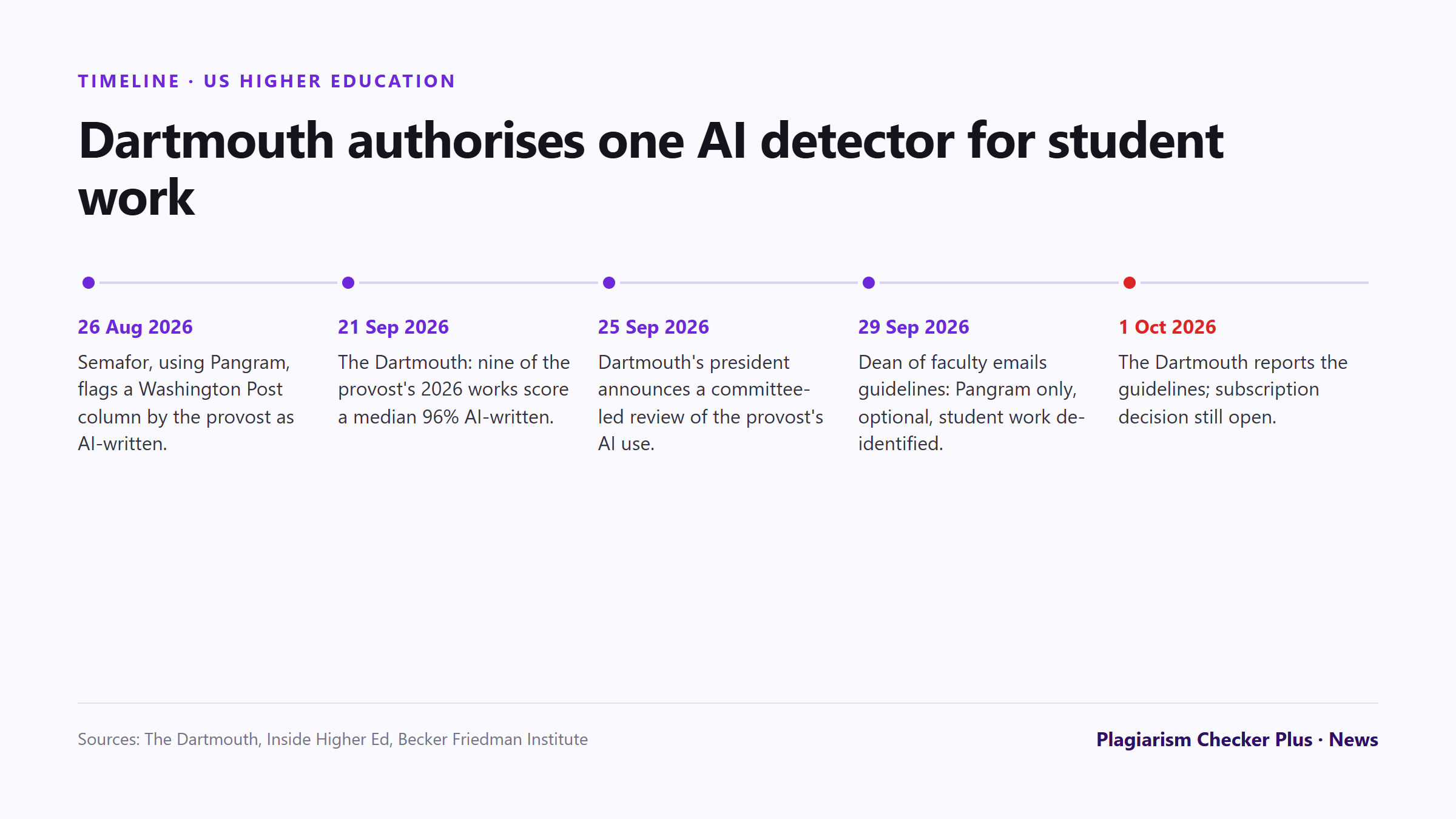
Not every institution is moving the same way. On 29 September 2026 Dartmouth's interim dean of faculty issued guidelines allowing professors to use one AI detector, Pangram, to review student work, The Dartmouth reports. The conditions are the interesting part: use is optional, student work has to be de-identified before it is submitted, faculty must tell students whether a detector may be used, and a detector result on its own is not enough for a disciplinary finding.
Read together, the two stories point the same way. Universities are no longer treating checking tools as neutral plumbing. They are asking what happens to student work once it has been uploaded, and writing the answer into policy.
Four questions to ask about any checking tool
Whichever service your institution uses, these are fair questions for a student, a lecturer or a procurement team to ask, and the answers should be in the provider's terms and privacy policy.
- Is submitted work kept? If so, for how long, and can a student or the institution have it deleted?
- Is it added to a comparison database? Some tools keep submissions so later work can be checked against them. Find out whether that is on by default and who can see the matches.
- Is it used to build or improve AI or machine-learning models? Ask about every kind of model, including detectors, not only chatbots.
- Who agreed to the licence? If students must accept terms to submit graded work, the institution should know what those terms say and what happens when they change.
Sources
- Georgia Luckhurst, Southampton dumps Turnitin over use of students' work to train AI, Times Higher Education, 19 August 2026.
- University of Southampton, Turnitin: announcement of moving away from Turnitin, staff knowledge base.
- Seb Cheer, Uni students' fears over essay-checker AI plan, BBC News (via Yahoo News), 24 September 2026.
- Ellie Howarth, The SU condemns Turnitin after concerns they may use students' work to train AI, Nouse, 24 September 2026.
- Nyx Osborne Sandford, Turnitin considers using students' submitted work to train AI tools, Epigram, 24 September 2026.
- Jackson Hyde, Dean of faculty authorizes professors to use AI detector Pangram to review student work, The Dartmouth, 1 October 2026.
FAQ
Is Turnitin using student essays to train AI?
Turnitin says it does not train a generative AI model on student work and does not use it to train the AI assistant in Turnitin Clarity. It also says it may use anonymised student submissions to improve its detection and assessment tools. The licence change that prompted the dispute has been postponed until at least 1 September 2027.
Why is the University of Southampton leaving Turnitin?
Southampton said the proposed licence changes would have allowed student submissions to be used to train AI services, and that although the changes were postponed, the company still intended to revisit them. It will not renew its contract after the 2026-27 academic year and is moving assignments to Blackboard with SafeAssign.
Can students opt out of Turnitin?
Usually not on their own. Submission through the university's chosen system is normally required for work to be graded, which is why students' unions are asking universities, rather than individual students, to negotiate the terms. Your university's academic registry or students' union can tell you the local position.
How many UK universities use Turnitin?
The BBC, citing the comparison site Uni Compare, reports that 98% of UK universities use Turnitin products.
What happens next
The next fixed point is 1 September 2027, the earliest date Turnitin says its agreement will change. Before then, expect more universities to state their position publicly, and more students' unions to ask for guarantees in writing. We will update this article when there is a material development, and the date at the top of the page will show when it was last changed.
How we handle the text you check
Read what Plagiarism Checker Plus does, and does not do, with the writing you submit.