ACS citation generator
Format ACS references from a URL, DOI or ISBN in the free web app, then check them against the ACS style rules and examples below.
- Free account required
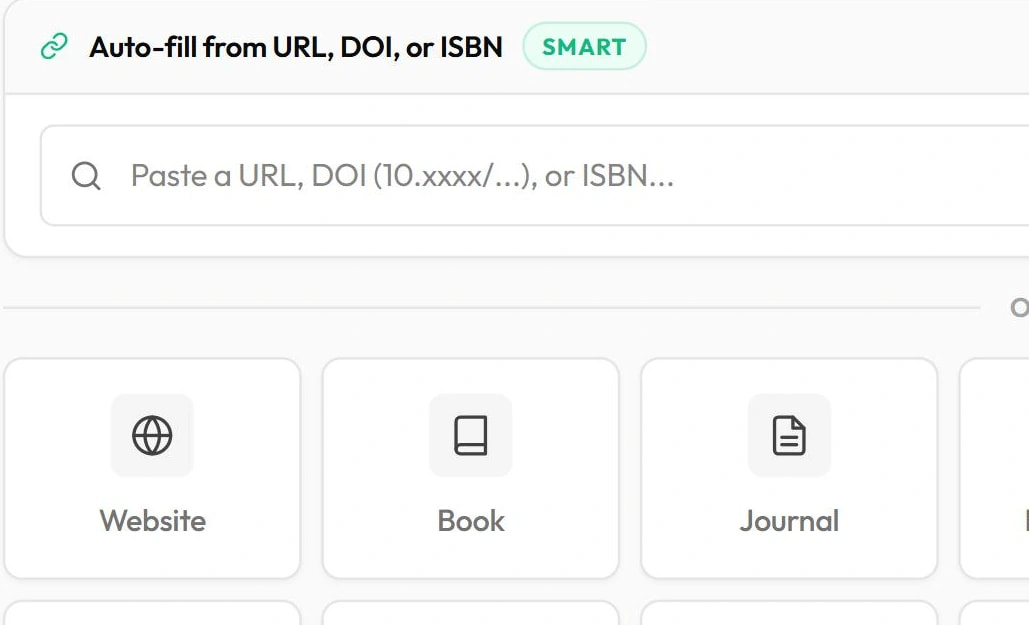
- Auto-fill from URL, DOI or ISBN
- 16 source types
How to cite in ACS style
ACS style comes from the American Chemical Society. It allows three in-text formats, and numbered superscripts are the most common.
In the text
- Superscript numbers, the most common: “… was reported previously.3”
- Italic numbers in parentheses: “… was reported previously (3).”
- Author-date: (Watson and Crick, 1953). Use it only if your instructor or journal asks for it.
- With numbers, cite sources in the order they first appear and reuse a number for later citations. Superscripts go after punctuation.
- Choose one format and use it throughout the paper.
In the reference list
- Number references in citation order. With author-date, list them alphabetically by first author.
- Write authors as surname, initials, separated by semicolons: Watson, J. D.; Crick, F. H. C. List up to ten, then add “et al.”
- Use title case for article titles, with no quotation marks. Italicize book titles and abbreviated journal names.
- In journal references, set the year in bold and the volume in italics: Nature 1953, 171, 737–738.
- End with the DOI. Web pages also get an access date: (accessed 2026-03-10).
Based on the ACS Guide to Scholarly Communication, which replaced The ACS Style Guide (3rd edition). Individual ACS journals may ask for small variations, so check their author guidelines.
ACS citation examples
The in-text citation and the numbered reference entry for four source types chemistry students cite most.
Journal article
Watson and Crick, Nature, 1953
- In-text
- The double-helix model was proposed in 1953.1
- Author-date
- (Watson and Crick, 1953)
- Reference
- (1) Watson, J. D.; Crick, F. H. C. Molecular Structure of Nucleic Acids: A Structure for Deoxyribose Nucleic Acid. Nature 1953, 171 (4356), 737–738. DOI: 10.1038/171737a0
Book
Kuhn, 1962
- In-text
- Kuhn described scientific change as a series of paradigm shifts.2
- Reference
- (2) Kuhn, T. S. The Structure of Scientific Revolutions; University of Chicago Press: Chicago, IL, 1962.
Book chapter
Placeholder pattern
- In-text
- The method is described in an edited volume.3
- Reference
- (3) Author, A. A.; Author, B. B. Title of the Chapter. In Title of the Book; Editor, E. E., Ed.; Publisher: City, State, Year; pp 12–34.
Website
Placeholder example
- In-text
- A safety data sheet lists hazards in a fixed order.4
- Reference
- (4) Doe, J. How to Read a Safety Data Sheet. Example Chemistry Hub, March 3, 2024. https://www.example.org/sds-guide (accessed 2026-03-10).
The journal article and book are real sources. The chapter and website use placeholders and an example URL to show the pattern. The issue number (4356) is optional in ACS.
Common ACS citation mistakes
Mistakes to check for
- Separating authors with commas or “and” instead of semicolons.
- Forgetting to bold the year and italicize the volume.
- Putting article titles in quotation marks.
- Spelling out journal names instead of using CASSI abbreviations.
- Mixing superscript numbers and author-date in one paper.
- Leaving out the access date for a web page.
When to use ACS style
ACS style is used in chemistry and related sciences, in American Chemical Society journals, and in many university chemistry courses for lab reports, theses and posters.
- Chemistry and biochemistry
- Chemical engineering
- Materials and environmental science
- Lab reports and ACS journal submissions
Create ACS citations in three steps
The citation generator lives in the Plagiarism Checker Plus web app. It fills in the source details and formats the ACS reference for you.
Create a free account
Sign up for the web app. The citation generator needs a free account.
Choose ACS
Pick ACS, then paste a URL, DOI or ISBN, or fill in one of 16 source types.
Check and copy
Check the journal abbreviation and authors, then copy the entry into your reference list.
After pasting, check that the year is bold and the journal and volume are italic, since not every editor keeps formatting. The Chrome extension only cites in APA 7, MLA 9, Chicago and Harvard, so use the web app for ACS.
ACS citation questions
Build your ACS reference list
Sign up free, choose ACS and add your sources by URL, DOI or ISBN.