Most plagiarism is not deliberate. It comes from messy notes, rushed paraphrasing and lost sources. If you are not sure what counts in the first place, start with what is plagiarism. This guide is about the practical side: habits, checking and citing.
Five habits that prevent plagiarism
1. Take research notes in two columns
One column for exact quotes, copied word for word with the source recorded immediately; one for your own reflections and paraphrases. The separation gives you a clean record of what is theirs and what is yours before a single sentence goes into the draft.
2. Paraphrase after you close the source
Close the tab. Write what you remember in your own words, then go back and check your version is accurate. You rebuild the idea from memory instead of rewording what is in front of you, which almost eliminates close paraphrasing.
3. Cite when in doubt, every time
There is no penalty for an unnecessary citation and a real penalty for a missing one. Over-citing is a style issue. Under-citing is an integrity issue.
4. Keep your source list as you go
Add each source to your reference list the moment you use it. That way you never finish a draft and then discover you cannot remember where a quote came from.
5. Leave a day between finishing and submitting
Coming back with fresh eyes before a final check is the most reliable way to catch what you missed while writing. With some distance, language that does not sound like your own voice is much easier to spot.
How to use a plagiarism checker the right way
A check five minutes before the deadline is better than nothing, but it is not the most useful way to use the tool.
Check early, not just at the end
Run a check on your first complete draft, not your final one. Finding a flagged section the night before submission is stressful. Finding it a week out is just good editing.
Read the highlighted sentences, not just the score
Open the full report and read each flagged sentence. The score alone does not tell you much; see what a similarity score means. For every flag, ask yourself:
- Is this a direct quote that I have marked as a quote?
- Is this a paraphrase of someone else’s idea that I have cited?
- Is this my own language, and if so, why does it match something?
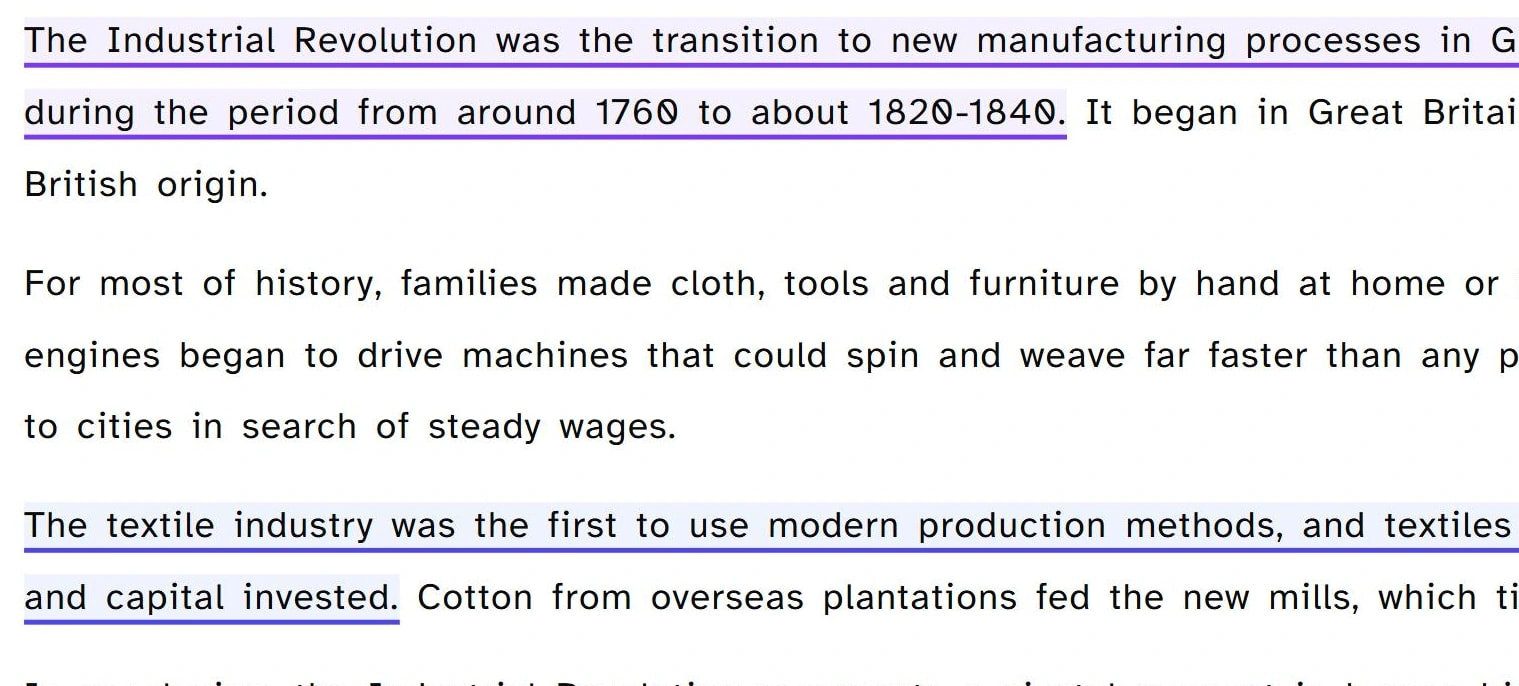
The answers tell you what to do. A properly quoted and cited sentence that is flagged is not a problem. A sentence you know came from a source but was not flagged is a problem the checker missed, so fix it anyway.
Use the checker to learn, not just to pass
If the same kinds of sentences keep getting flagged across your work, such as transitions, openings or factual claims, that tells you something about your writing habits. Over time you get a clearer sense of which parts of your writing are truly yours and which you absorbed from reading.
What to do when your checker flags something
A flag is not a crisis; it is information. Here is how to respond to the most common situations.
| What was flagged | What to do |
|---|---|
| A direct quote that is already cited | Check it has quotation marks and an in-text citation. If it does, the flag is harmless. If the quotation marks are missing, add them. |
| A paraphrase that is already cited | The paraphrase is probably too close to the original. Rewrite it more thoroughly in your own words and keep the citation. |
| A paraphrase with no citation | Add a citation now. This is the most common fixable issue. |
| A standard phrase or technical term | Often a false positive: common phrasing, subject terminology or your institution’s name in a header. Note it as a non-issue. |
| Copied text with no citation | Rewrite it as a cited paraphrase, or quote it with quotation marks and a citation. Do not just delete it; the source still needs acknowledging. |
A note on citing sources properly
One of the most common causes of student plagiarism is not bad intent but not knowing how to cite. Subjects use different styles, and even within one style the rules for books, journal articles, websites and secondary sources all differ slightly.
| Style | Where it is used |
|---|---|
| APA | Psychology, education and social sciences. Author-date in text: (Smith, 2021). |
| MLA | Humanities and literature. Author-page in text: (Smith 47). |
| Chicago | History, arts and some sciences. Notes-bibliography (footnotes) or author-date. |
| Harvard | Similar to APA with formatting differences. Common in UK and Australian universities. |
Getting the style wrong is a formatting issue, not plagiarism. Getting the attribution wrong, by citing the wrong source, misquoting or leaving a source out, is an academic integrity issue. If you are not sure your references are right, our citation generator builds them from a URL, DOI or ISBN.