Chicago citation generator
Format Chicago bibliography entries from a URL, DOI or ISBN, then use the footnote and author-date examples below to get every citation right.
- Free account required
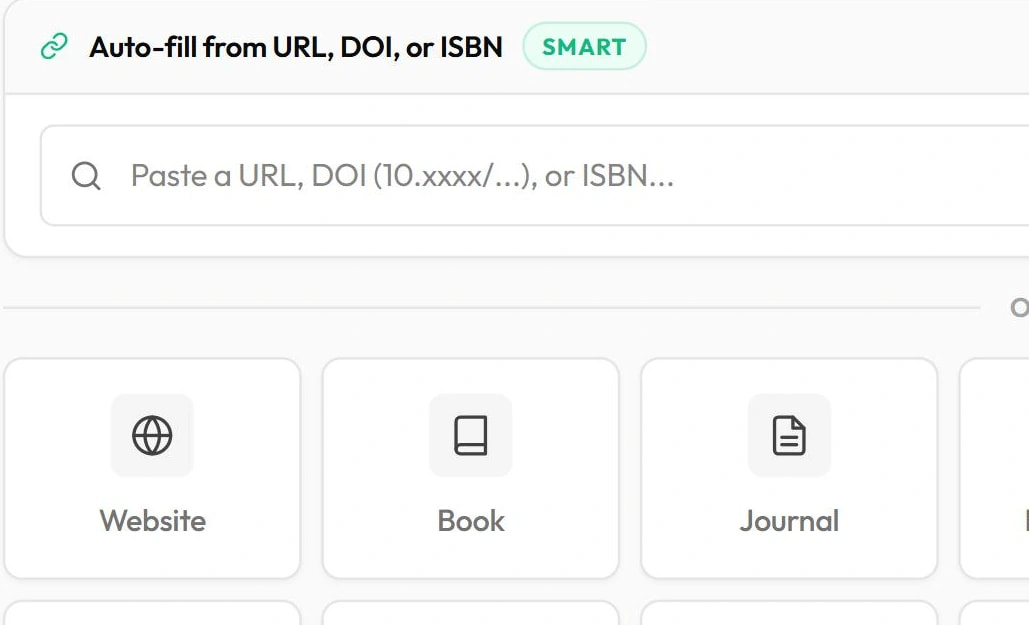
- Auto-fill from URL, DOI or ISBN
- 16 source types
How to cite in Chicago style
Chicago has two systems. Notes-bibliography uses footnotes and suits the humanities. Author-date uses short parenthetical citations and suits the sciences.
Notes and bibliography
- Put a superscript note number at the end of the clause or sentence, after any punctuation except a dash.
- The first note for a source is a full note. Later notes are short: surname, short title (up to four words), page.
- Notes give the author as First Last and separate elements with commas. The bibliography inverts the first author (Last, First) and uses periods.
- Italicize book and journal titles. Put article, chapter and web page titles in “quotation marks”. Use title case for both.
- List the bibliography alphabetically by surname, with a hanging indent.
Author-date
- Cite in the text as (Author Year, page), with no comma between author and year: (Kuhn 1962, 52).
- The reference list puts the year straight after the author’s name, then the title.
- For four or more authors, cite the first author plus “et al.” in the text: (Smith et al. 2020).
- Prefer a DOI, written as https://doi.org/…, over a URL. Add an access date only when a source shows no date.
- Shorten inclusive page numbers the Chicago way: 737–38, not 737–738.
These rules and examples follow the 17th edition (2017), which the app’s Chicago 17 option uses. The 18th edition came out in 2024 and keeps the same core patterns, but check which edition your instructor or publisher wants.
Chicago citation examples
Footnotes, short notes and bibliography entries for the four most common source types, plus the same sources in author-date.
Journal article
Watson and Crick, Nature, 1953
- Footnote
- 1. J. D. Watson and F. H. C. Crick, “Molecular Structure of Nucleic Acids: A Structure for Deoxyribose Nucleic Acid,” Nature 171, no. 4356 (1953): 737, https://doi.org/10.1038/171737a0.
- Short note
- 2. Watson and Crick, “Molecular Structure,” 737.
- Bibliography
- Watson, J. D., and F. H. C. Crick. “Molecular Structure of Nucleic Acids: A Structure for Deoxyribose Nucleic Acid.” Nature 171, no. 4356 (1953): 737–38. https://doi.org/10.1038/171737a0.
Book
Kuhn, 1962
- Footnote
- 1. Thomas S. Kuhn, The Structure of Scientific Revolutions (Chicago: University of Chicago Press, 1962), 52.
- Short note
- 2. Kuhn, Structure of Scientific Revolutions, 52.
- Bibliography
- Kuhn, Thomas S. The Structure of Scientific Revolutions. Chicago: University of Chicago Press, 1962.
Website
Placeholder example
- Footnote
- 1. Jane Doe, “A Short History of the Printing Press,” Example History Hub, March 3, 2024, https://www.example.org/printing-press.
- Short note
- 2. Doe, “Printing Press.”
- Bibliography
- Doe, Jane. “A Short History of the Printing Press.” Example History Hub. March 3, 2024. https://www.example.org/printing-press.
YouTube video
Placeholder example
- Footnote
- 1. Example History Channel, “Why the Printing Press Changed Europe,” March 3, 2024, YouTube video, 8:15, https://www.youtube.com/watch?v=VIDEO_ID.
- Short note
- 2. Example History Channel, “Printing Press Changed Europe.”
- Bibliography
- Example History Channel. “Why the Printing Press Changed Europe.” March 3, 2024. YouTube video, 8:15. https://www.youtube.com/watch?v=VIDEO_ID.
The journal article and book are real sources; page numbers in the notes are sample pinpoints. The website and video use placeholder names and example URLs to show the pattern.
Common Chicago citation mistakes
Mistakes to check for
- Mixing notes-bibliography and author-date in the same paper.
- Inverting the author’s name in a footnote. Only the bibliography starts Last, First.
- Placing the note number before a comma or period instead of after it.
- Italicizing a web page or article title instead of using quotation marks.
- Using “ibid.” for every repeat citation. The 17th edition prefers a short note.
- Ordering the bibliography by first citation instead of alphabetically.
When to use Chicago style
Chicago is the default in many humanities departments and in book publishing. Pick the system your instructor or publisher names. Turabian is the student version of Chicago and uses the same patterns.
- History and art history (notes-bibliography)
- Philosophy, religion and literature courses that ask for footnotes
- Natural and social sciences (author-date)
- Books and university press publishing
Create Chicago citations in three steps
The citation generator lives in the Plagiarism Checker Plus web app. It fills in the source details and formats the entry for you.
Create a free account
Sign up for the web app. The citation generator needs a free account.
Choose Chicago 17
Pick Chicago 17, then paste a URL, DOI or ISBN, or fill in one of 16 source types.
Check and copy
Compare the entry with your source, then copy it into your bibliography.
The app formats the bibliography entry. Write footnotes and author-date citations from the patterns above. The Chrome extension can also cite the page you’re reading in Chicago, APA 7, MLA 9 or Harvard.
Chicago citation questions
Build your Chicago reference list
Sign up free, choose Chicago 17 and add your sources by URL, DOI or ISBN.