IEEE citation generator
Format IEEE references from a URL, DOI or ISBN in the free web app, then check them against the IEEE rules and examples below.
- Free account required
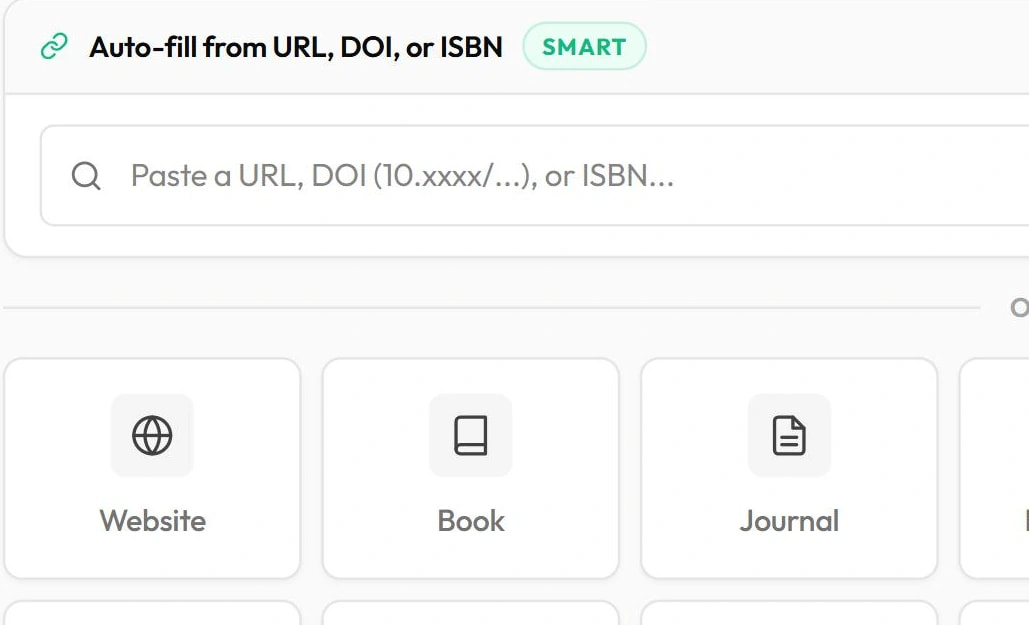
- Auto-fill from URL, DOI or ISBN
- 16 source types
How to cite in IEEE style
IEEE is a numbered style. Each source gets a number in square brackets, in the order you first cite it, and keeps that number throughout.
In the text
- Cite with the reference number in square brackets, inside the sentence punctuation: “… as shown in [1].”
- Number sources in the order they first appear, and reuse the same number for later citations.
- Cite several sources as [1], [3], and a range as [2]–[5].
- Add a page inside the brackets when you need one: [3, p. 12].
- Write “as shown in [2]”, not “as shown in reference [2]”.
In the reference list
- Title the list References and order it by number, not alphabetically. Each number sits in brackets, flush left.
- Write authors with initials first: J. D. Watson. List up to six; for seven or more, give the first author plus “et al.”
- Put article and paper titles in quotation marks, in sentence case. Italicize journal, conference and book titles.
- Abbreviate journal and conference names (Proc., Trans., Conf.) and use vol., no. and pp.
- End with the DOI when there is one, written as doi: 10.xxxx.
Based on the IEEE Reference Guide from the IEEE Author Center, including its 2022 website format. Some IEEE journals and conferences add their own rules, so check their author instructions.
IEEE citation examples
The bracketed in-text citation and the numbered reference entry for four source types engineers cite most.
Journal article
Watson and Crick, Nature, 1953
- In-text
- The double-helix model was first proposed in [1].
- Reference
- [1] J. D. Watson and F. H. C. Crick, “Molecular structure of nucleic acids: A structure for deoxyribose nucleic acid,” Nature, vol. 171, no. 4356, pp. 737–738, Apr. 1953, doi: 10.1038/171737a0.
Book
Kuhn, 1962
- In-text
- Kuhn describes this as a paradigm shift [2, p. 52].
- Reference
- [2] T. S. Kuhn, The Structure of Scientific Revolutions. Chicago, IL, USA: Univ. of Chicago Press, 1962.
Conference paper
He et al., CVPR 2016
- In-text
- Residual networks were introduced in [3].
- Reference
- [3] K. He, X. Zhang, S. Ren, and J. Sun, “Deep residual learning for image recognition,” in Proc. IEEE Conf. Comput. Vis. Pattern Recognit. (CVPR), Las Vegas, NV, USA, 2016, pp. 770–778, doi: 10.1109/CVPR.2016.90.
Website
Placeholder example
- In-text
- A plain-language overview is given in [4].
- Reference
- [4] J. Doe. “How lithium-ion batteries work.” Example Energy Hub. Accessed: Mar. 10, 2026. [Online]. Available: https://www.example.org/battery-basics
The journal article, book and conference paper are real sources; p. 52 is a sample page. The website uses a placeholder name and example URL to show the pattern.
Common IEEE citation mistakes
Mistakes to check for
- Ordering references alphabetically instead of by first citation.
- Giving a source a new number each time it is cited.
- Writing full first names: James Watson instead of J. D. Watson.
- Using title case or italics for article titles.
- Placing the bracket after the period instead of before it.
- Using round brackets or superscript numbers instead of [1].
When to use IEEE style
IEEE style comes from the Institute of Electrical and Electronics Engineers and is the default for its journals and conferences. Engineering and computer science courses use it widely for reports, theses and lab write-ups.
- Electrical and electronic engineering
- Computer science and software engineering
- Telecommunications and signal processing
- IEEE journal articles and conference papers
Create IEEE citations in three steps
The citation generator lives in the Plagiarism Checker Plus web app. It fills in the source details and formats the IEEE reference for you.
Create a free account
Sign up for the web app. The citation generator needs a free account.
Choose IEEE
Pick IEEE, then paste a URL, DOI or ISBN, or fill in one of 16 source types.
Check and copy
Check initials, dates and abbreviations, then copy the entry into your reference list.
The app formats the reference entry; add the bracketed numbers in your text as you write. The Chrome extension only cites in APA 7, MLA 9, Chicago and Harvard, so use the web app for IEEE.
IEEE citation questions
Build your IEEE reference list
Sign up free, choose IEEE and add your sources by URL, DOI or ISBN.