MIT report warns of AI 'cognitive surrender' and advises against relying on AI detectors
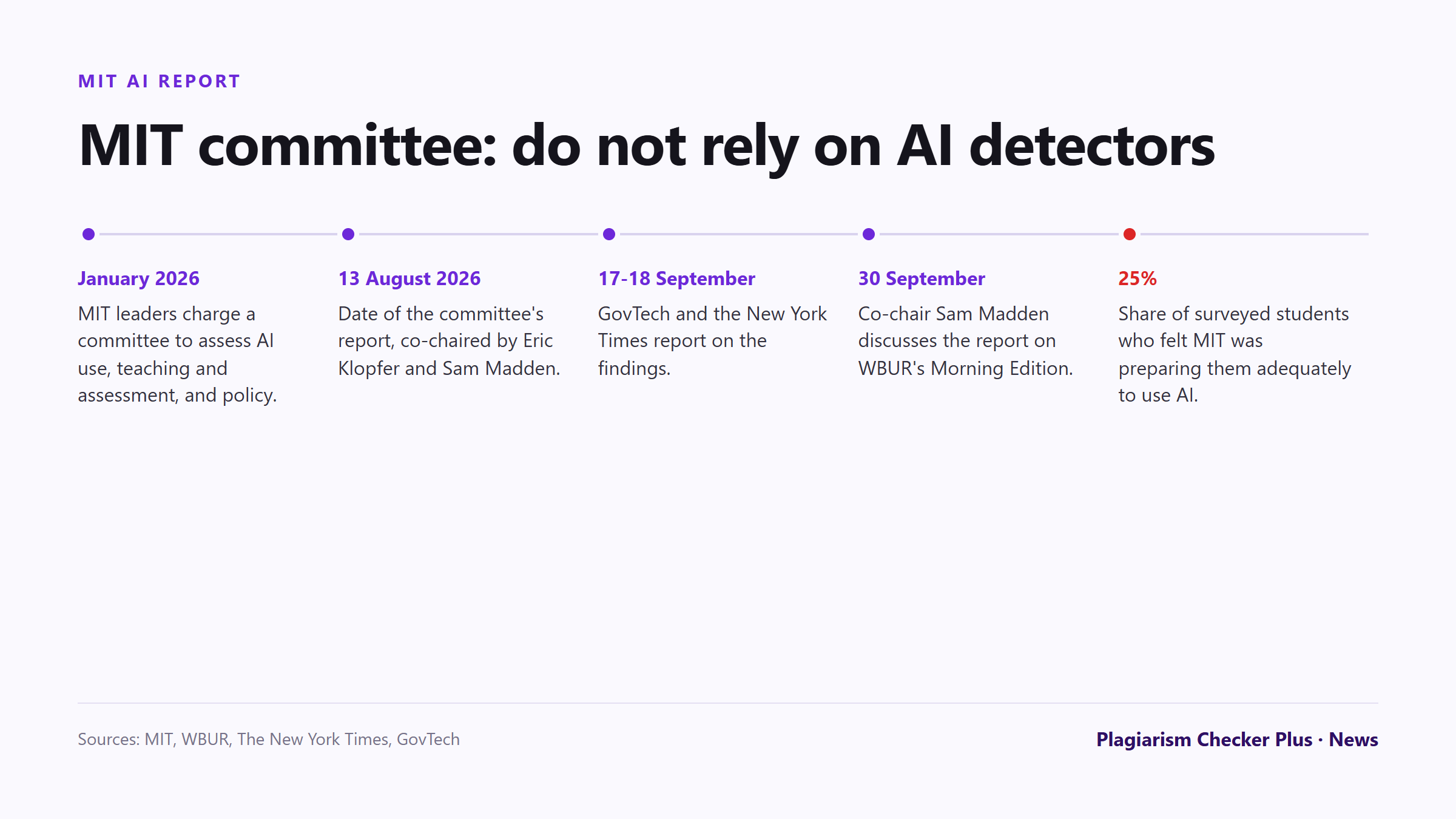
On 30 September 2026 the co-chair of an MIT committee on AI in education went on Boston public radio to discuss the committee's report, the latest stop for a document that has been reported by the New York Times, GovTech and others since mid-September. The report itself is dated 13 August 2026. It argues that AI is weakening some of the ways students learn, and that universities should respond by changing how they teach and assess, not by leaning on detection software. Here is what it says.
Summary
- MIT's Ad Hoc Committee on AI Use in Teaching, Learning, and Research Training published a report dated 13 August 2026; it drew wide press coverage from mid-September and a WBUR radio interview with its co-chair on 30 September.
- The report says students can fall back on AI at the first hint of difficulty, and links AI use to lower attendance at office hours and less group study.
- It advises instructors not to rely on AI detectors and to move towards oral exams, portfolios and in-class work.
Key takeaways
- The report describes AI detection software as unreliable in everyday cases, such as when a student uses AI only for an outline or an edit.
- MIT's Committee on Discipline does not treat an AI detector result alone as sufficient evidence, according to the report.
- The committee rejects a single campus-wide AI rule and asks for a shared framework that departments and instructors apply to their own courses.
Key facts
| Question | Answer |
|---|---|
| Who | MIT's Ad Hoc Committee on AI Use in Teaching, Learning, and Research Training, co-chaired by Eric Klopfer and Sam Madden. Members included undergraduate and graduate students, faculty from every school, and staff. |
| What | A report of principles and recommendations on teaching, assessment, campus life and AI policy at MIT. |
| When | Committee charged in January 2026. Report dated 13 August 2026. Reported by GovTech on 17 September and the New York Times on 18 September. Co-chair interviewed on WBUR on 30 September. |
| Who is affected | MIT students and instructors directly. The recommendations are not yet policy. |
| Where to read it | MIT's AI and Education report page |
A note on timing: this is not a report that came out this week. It is dated August, and the national coverage began about two weeks ago. The most recent development is the WBUR Morning Edition segment with Sam Madden on 30 September.
What the committee found
According to the report, MIT's chancellor, provost and faculty chair asked the committee in January 2026 to assess current AI use, identify new approaches to teaching and assessment, and propose an AI use policy. After five months of meetings, research and outreach, the committee concluded that the questions went deeper than a policy.
The report says current AI tools can already produce credible answers to almost any written assignment in MIT's undergraduate curriculum, including essays, proofs and coding tasks. It links AI use to lower attendance at office hours, less participation in online discussions and, on anecdotal evidence, fewer in-person study groups.
The phrase that made the headlines is "cognitive surrender". The report uses it for the habit of turning to AI at the first hint of struggle, and says a correct answer from a chatbot can create an illusion of learning. It describes the evidence of harm from overreliance as early signals, not settled findings.
It also cites what it calls the fall 2025 Tech Survey, in which more than two-thirds of responding students said AI would matter in their careers, while only 25% felt MIT was preparing them adequately to use it.
What it says about detectors and assessment
The section most relevant to academic integrity is short and direct. The committee accepts that some detection tools are reasonably accurate on text that is purely AI-generated. Its concern is the mixed cases that are more common in practice, where a student uses AI for an outline or to edit one section, which it says the tools are unlikely to catch.
Its conclusion: "we recommend against relying on AI detectors". The reasons given are an arms race with tools that disguise AI text, the risk that detectors mistake the writing of non-native English speakers or neurodivergent students for AI output, and the damage that even a low false positive rate can do to individual students and to trust in the classroom.
- Discipline: the report says MIT's Committee on Discipline does not consider detector output alone sufficient, and asks MIT to clarify what evidence an AI-related integrity case needs.
- Lockdown browsers: the committee suggests MIT study them but calls the current generation buggy and error-prone, and prefers in-person proctored exams for now.
- Assessment: instructors are urged to consider oral exams, semester portfolios, and out-of-class assignments paired with in-class conversations.
- Policy: no single Institute-wide rule. Instead, a shared framework with a common menu of policies, disclosure expectations and accountability standards.
- Instructors' own AI use: staff who use AI for teaching material, grading or feedback are strongly advised to tell students how and why.
How this fits the wider picture
The New York Times report of 18 September, republished by the Philadelphia Inquirer, set the MIT findings against a mixed national picture. It reports that the University of Chicago has banned AI in certain required social sciences courses, while many university leaders are promoting AI with enthusiasm. It also describes the University of Sydney's approach, in which some assessments are done in person under secure conditions and others require AI use.
GovTech's summary on 17 September grouped the recommendations into three areas: adapting teaching and assessment, strengthening in-person community, and setting up structures for experimentation such as a standing committee and department-level AI leads.
One caution: the report is about one highly selective, technical university, and much of its evidence comes from listening sessions and surveys at MIT. It does not measure how common these habits are elsewhere.
What this means for students and teachers
These points follow from the report's recommendations. They are our reading, not rules from MIT.
- Students: expect AI rules to differ by course and department. Check the policy for each assignment and ask when it is unclear.
- Students: the report holds students responsible for everything they submit, including errors or fabricated citations produced by AI.
- Students: keep drafts, notes and version history. If assessment shifts to oral exams and in-class conversations, you will need to explain your own work.
- Teachers: a detector score is not proof. The report's position is that it should not be the only evidence in an integrity case.
- Teachers: state what AI use is allowed and why, and be open about your own use of AI in grading or feedback.
- Teachers: staged deadlines, in-class drafting and progress meetings are the report's suggested alternatives to surveillance tools.
Sources
- MIT Ad Hoc Committee on AI Use in Teaching, Learning, and Research Training, Report: AI and Education, Massachusetts Institute of Technology, 13 August 2026.
- Tiziana Dearing and Rob Lane, MIT professor says 'cognitive surrender' to AI is rampant on college campuses, WBUR, 30 September 2026.
- Mark Arsenault, Dana Goldstein, Alan Blinder and Sarah Mervosh, MIT report warns AI is causing 'cognitive surrender.' Universities are in a bind, The New York Times (via The Philadelphia Inquirer), 18 September 2026.
- News Staff, MIT Report Calls for AI-Aware Redesign of Higher Ed, GovTech, 17 September 2026.
FAQ
What does 'cognitive surrender' mean in the MIT report?
The report uses the term for students falling back on AI at the first hint of struggle instead of working through a problem themselves. It says a correct answer from a chatbot can create an illusion of learning.
Does MIT use AI detectors?
The committee's report advises against relying on them and says MIT's Committee on Discipline does not consider AI detector output alone sufficient. The report is a set of recommendations, not a ban, and it does not describe what individual instructors do.
When was the MIT AI and education report published?
The report is dated 13 August 2026. GovTech reported on it on 17 September and the New York Times on 18 September. Its co-chair Sam Madden discussed it on WBUR's Morning Edition on 30 September 2026.
What does MIT recommend instead of AI detection?
The report urges instructors to consider assessments that are less vulnerable to AI, such as oral exams, semester portfolios, and out-of-class assignments paired with in-class conversations. It prefers in-person proctored exams to lockdown browsers for now.
What happens next
The report is a set of recommendations to MIT, not a policy, so the next step is for MIT's faculty and administration to decide what to adopt. It asks for some changes to start straight away and for others to be studied first, and it proposes a standing committee on AI and education to keep the work going. Other universities are likely to be asked by their own staff and students how their rules compare.
How AI detectors work, and where they fall short
A plain-English guide to what AI detection can and cannot tell you about a piece of writing.