South Korea checks glasses, collars and Wi-Fi before the Suneung after an AI cheating confession
South Korea's College Scholastic Ability Test, known as the Suneung, takes place on Thursday 19 November 2026. In the week before it, the country's AI cheating debate moved from theory to a confession. The top scorer on this year's national tax accountant exam admitted that he had photographed the questions with a miniature camera and used generative AI to get the answers. The government responded within two days with new checks on glasses, clothing, devices and networks at every Suneung test centre, and with proposals for far tougher penalties.
Summary
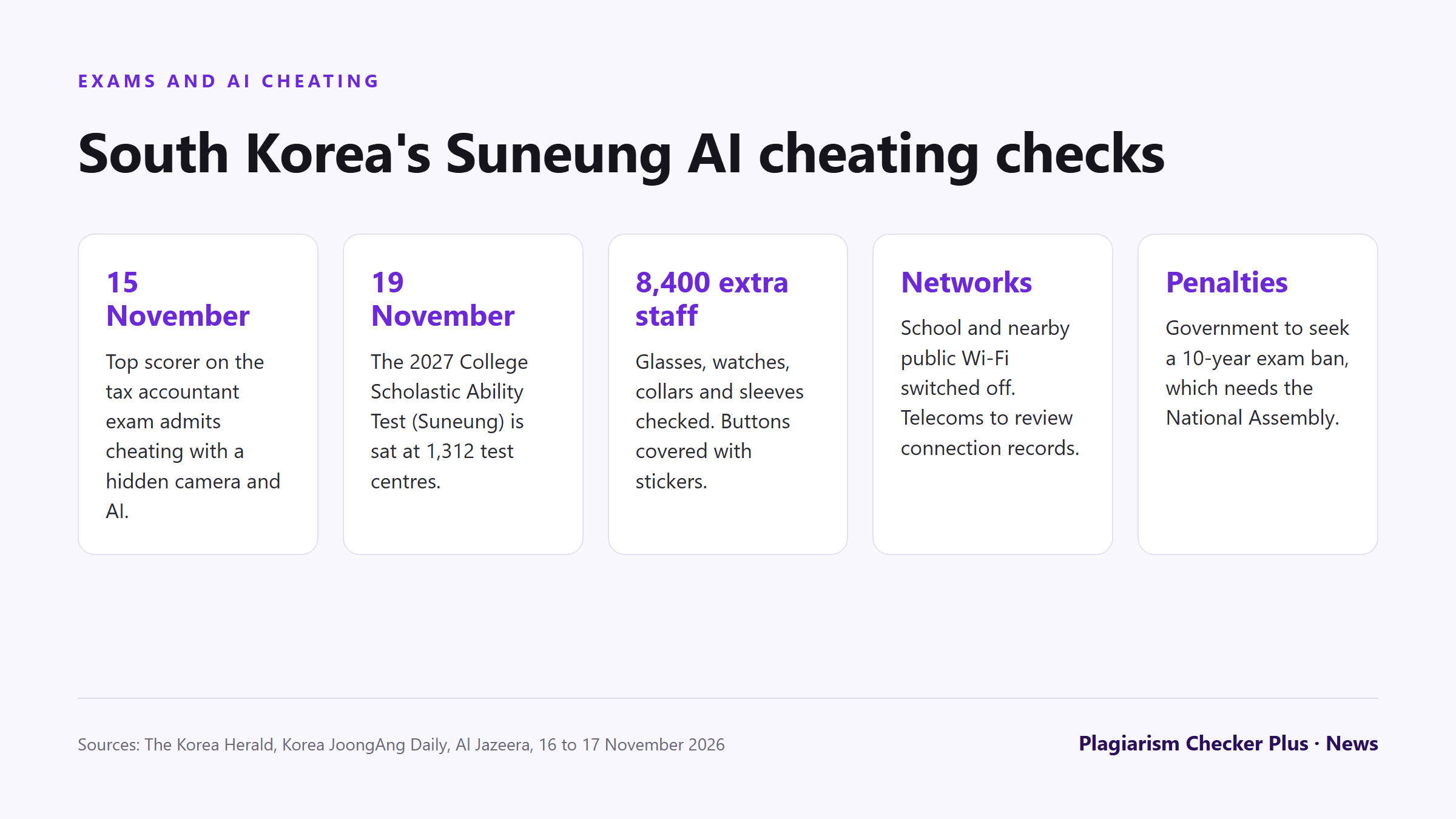
- On 15 November 2026 Han Won-seok, 34, the top scorer on this year's tax accountant exam, admitted in a video that he cheated in both stages of the exam using a miniature camera and generative AI. He appeared for police questioning as a suspect on 17 November.
- For the 19 November Suneung, about 8,400 extra staff will join roughly 75,000 proctors at 1,312 test centres. Glasses, watches, collars and sleeves will be checked, clothing buttons covered with stickers, and school and nearby public Wi-Fi switched off.
- The government said it will seek to extend the Suneung ban for cheaters from one year to 10 years. That needs the National Assembly's cooperation.
Key takeaways
- The confession concerned a professional licensing exam, not the Suneung, but it prompted government-wide measures across state-run exams.
- The new checks target devices and networks in the exam room. Text-based AI detectors play no part, because the answers are written by hand in a supervised hall.
- Teachers' groups question whether proctors recruited days before the exam can spot increasingly small devices.
What happened
According to Al Jazeera, the candidate sat the tax accountant exams in April and July and answered nearly all questions correctly, which prompted investigations. In a video released on Sunday 15 November he said he had used a miniature camera to photograph the questions, sent the images to a generative AI tool and checked the answers on another device. The Korea Herald reports that he did this in both stages of the exam and appeared for police questioning as a suspect on 17 November.
The case landed in a country already worried about wearable AI. Al Jazeera reports that education authorities banned smart glasses from exams in July, and that three students were caught using smart glasses during tests at universities in Seoul in October.
The government's response on 16 and 17 November
On 16 November Prime Minister Han Seong-sook led a meeting of eight ministries and agencies, Korea JoongAng Daily reports. The prime minister ordered officials to begin proceedings to void the tax accountant's results and bar him from that exam for five years. The Education Ministry was put in charge of a government-wide emergency response team for the Suneung, and a separate task force will look at smart-device cheating across all state-run exams. The Employment and Labor Ministry and the Human Resources Development Service of Korea will review how national certification exams are run, including screening gates at test venues.
On 17 November the government set out the detailed Suneung measures. The Korea Herald reports that the prime minister called AI-assisted cheating a "social evil" and promised zero tolerance.
| Area | What was announced for the 19 November Suneung |
|---|---|
| Staff | About 8,400 extra staff join roughly 75,000 proctors at 1,312 test centres. About 1,800 will check for smart devices and about 6,600 will work as hallway proctors. |
| Glasses and clothing | Candidates remove their glasses for a check before the first period, and glasses are checked again before each period. Watches, collars and sleeves are inspected, and clothing buttons are covered with stickers. |
| Devices | Phones and other electronic devices are switched off and handed in. Keeping a prohibited device counts as cheating even if it is not used. Bags stay in hallways, and an emergency alert is sent before the exam to help find phones that were not handed in. |
| Networks | School Wi-Fi and nearby public networks are switched off, and proctors check for portable routers. Mobile data stays on. Telecom companies will help review connection records from exam hours. |
| Searches | Metal detectors may be used where there is reason to suspect a hidden device. The Education Ministry says there is no legal basis for blanket searches without consent. |
| After the exam | Results will be checked for irregularities such as implausibly high scores. A reporting centre takes tips and works with police, and the government says global tech companies have offered to help with investigations. It has not named them. |
Proposed penalties
- Longer exam bans. The government said it will seek to extend the Suneung ban for cheaters from one year to 10 years and apply it to this year's exam. The Korea Herald notes this needs the National Assembly's cooperation. The ruling Democratic Party said it would draft a special law to that effect, and the opposition People Power Party also plans legislation on cheating penalties.
- Criminal complaints. Cheaters will face complaints for obstruction of official duties by fraudulent means, which carries up to five years in prison, according to The Korea Herald.
- University places. The government consulted the Korean Council for University Education on revoking admissions for students found to have cheated, and on expelling enrolled students.
- Sellers. Authorities said they will investigate businesses selling cheating devices such as miniature cameras.
Criticism of the measures
The Korean Federation of Teachers' Associations questioned whether proctors recruited just before the exam could detect sophisticated AI cheating, and warned that physical checks could lead to complaints of inappropriate contact. The Korean Teachers and Education Workers Union said the late recruitment of hallway proctors would disrupt schools. The opposition criticised the government for failing to catch the tax exam cheating and said it plans motions recommending the dismissal of the prime minister and the education minister.
South Korea is not alone. Al Jazeera reports that National Taiwan University disqualified a medical school applicant in June for allegedly using AI smart glasses, and that China is installing security gates at gaokao test sites to detect smart glasses and other devices.
What this means for students and teachers
- Supervised exams are not automatically AI-proof. Many universities and regulators are moving back to in-person assessment because coursework is easy to complete with AI. This case shows that exam halls need their own device rules, too.
- Students: expect stricter rules on glasses, watches and any connected device in exams. In South Korea, simply keeping a prohibited device without handing it in now counts as cheating.
- Teachers and exam officers: this kind of cheating is caught through invigilation, device checks and unusual results, not by running answers through a text detector.
- For written work: an AI detector score is a likelihood, not proof. It is one piece of evidence to weigh alongside drafts, version history and a conversation with the student.
Sources
- Lee Seung-ku, Buttons get stickers, Big Tech gets a call in Suneung cheating crackdown, The Korea Herald, 17 November 2026.
- Lee Seung-ku, Govt. to ban smart devices, monitor Wi-Fi to curb AI cheating on Suneung, The Korea Herald, 17 November 2026.
- Korea JoongAng Daily, Gov't weighs Wi-Fi outage as part of enhanced screening for AI cheating on CSAT, 16 November 2026.
- Shola Lawal, South Korea cheating scandal: Are AI smart glasses a threat to exams?, Al Jazeera, 17 November 2026.
FAQ
Why is South Korea checking students' glasses at the Suneung?
Because AI-enabled smart glasses and miniature cameras can be used to photograph questions and receive answers from AI tools. After the top scorer on the 2026 tax accountant exam admitted cheating this way, the government ordered glasses checks before each Suneung testing period.
When is the 2027 Suneung?
The 2027 College Scholastic Ability Test is on Thursday 19 November 2026, at 1,312 test centres across South Korea.
What is the penalty for cheating on the Suneung?
Penalties include voiding results, a ban on sitting the exam and referral to police. The government said on 17 November 2026 that it will seek to extend the ban from one year to 10 years, which requires cooperation from the National Assembly.
Can AI detectors catch this kind of exam cheating?
No. Text-based AI detectors estimate whether typed text is likely to be AI-generated. In a handwritten, supervised exam the risk is a hidden device, so the checks focus on invigilation, device searches, networks and unusual results.
What happens next
The Suneung goes ahead on 19 November under the tightest device rules South Korea has used. Whether the checks catch anyone, and whether the 10-year ban becomes law, will be clearer in the coming weeks. We will update this article when the government reports on the exam.
AI cheating and plagiarism statistics
What the published data says about AI misuse and plagiarism in schools and universities, with sources.