Harvard report: AI suspicion is eroding student-teacher trust
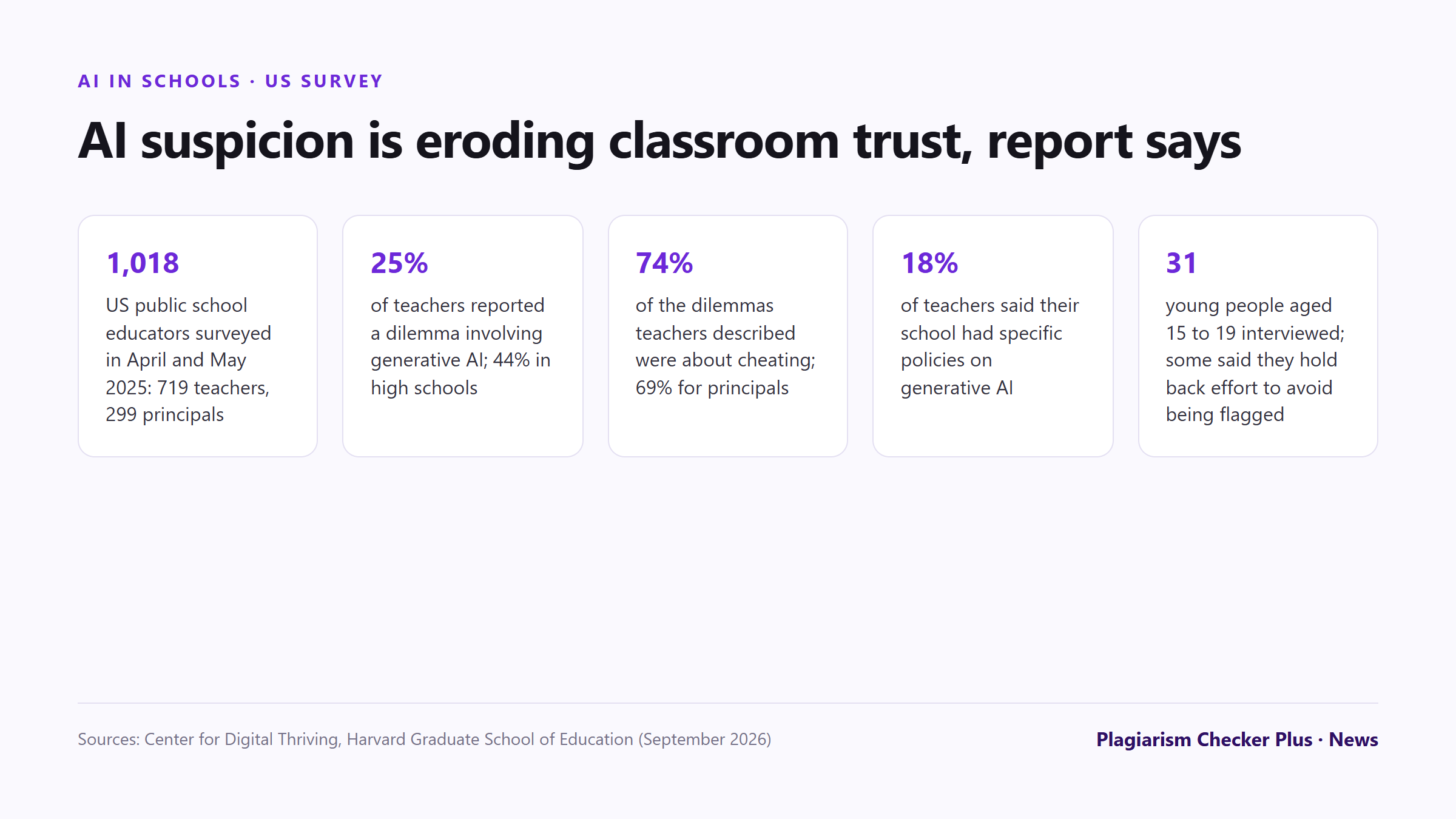
A report from the Center for Digital Thriving, a research centre at the Harvard Graduate School of Education, argues that schools' focus on catching AI cheating is doing a different kind of damage: teachers and students have stopped trusting each other. The report, An AI Policy Isn't a Playbook, is dated September 2026 and was covered by Education Week and ABC News on 30 September. It draws on a nationally representative survey of 1,018 US public school teachers and principals and on interviews with 31 young people. Among its findings is that some students say they deliberately write worse so their work is not flagged as AI.
Summary
- The Center for Digital Thriving surveyed 719 teachers and 299 principals in US public schools in April and May 2025, and interviewed 31 young people aged 15 to 19 between April and June 2026.
- A quarter of teachers said they had faced a dilemma involving generative AI. Of the situations teachers went on to describe, 74% were about cheating.
- The report says tools marketed to detect AI cheating have been shown to be unreliable, and that some students now cap their effort to avoid being flagged.
Key takeaways
- The report names the problem "two-way suspicion": teachers cannot prove AI use, and students cannot disprove it.
- Only 18% of teachers and 24% of principals said their school had specific policies on generative AI when surveyed in spring 2025.
- The survey is from spring 2025 and the student interviews are a small, non-representative sample, so the two parts of the evidence carry different weight.
What the report is and who wrote it
An AI Policy Isn't a Playbook: Educators Need Agency, Not Just New Rules was written by Beck Tench, Emily Weinstein and Carrie James, with Allison Starks and Sara Konrath. The report states that it was published by the Center for Digital Thriving in September 2026. The centre is based at Project Zero at the Harvard Graduate School of Education. The work was funded by a grant from the John Templeton Foundation, with further support from the Susan Crown Exchange and Pivotal Ventures.
The evidence comes from three places, and it helps to keep them apart.
| Source | Who | When |
|---|---|---|
| National survey | 719 teachers and 299 principals in US K-12 public schools, drawn from RAND's American Educator Panels and weighted to be nationally representative | Invitations sent 21 and 28 April 2025; closed 19 and 27 May 2025 |
| Educator interviews | 12 survey participants (4 teachers and 8 principals) | July and August 2025 |
| Youth interviews | 31 young people aged 15 to 19, recruited through a youth nonprofit and a network of US schools | April to June 2026 |
The methods section of the report gives completion rates of 51.7% for teachers and 30.2% for principals. The percentages below are from the survey unless stated otherwise.
What the survey found
Teachers and principals were asked whether they had experienced any dilemmas or difficult decisions related to generative AI in their school or classroom. According to the report, 25% of teachers and 29% of principals who answered said yes. The share rose with the age of the students.
| Finding | Figure |
|---|---|
| Teachers who reported an AI dilemma | 25% |
| Elementary school teachers | 11% |
| Middle school teachers | 29% |
| High school teachers | 44% |
| Principals who reported an AI dilemma | 29% |
| Teacher descriptions of a dilemma that were about cheating (171 descriptions) | 74% |
| Principal descriptions that were about cheating (85 descriptions) | 69% |
| Teachers who said their school had specific generative AI policies | 18% |
| Principals who said the same | 24% |
The 74% and 69% figures are sometimes reported as shares of all teachers. They are not. They are shares of the written descriptions given by the educators who had said yes to the dilemma question. The report notes that elementary teachers make up about half of US public school teachers, which pulls the overall 25% figure down.
One methodological detail is worth knowing. The report says the 256 written descriptions were coded by one human and two AI models, and that the three agreed on 93% of them.
Detection, proof and students who hold back
The report's sharpest section is about proof. It says tools marketed to detect cheating "have been shown to be unreliable", which leaves teachers who suspect a student with no reliable way to show it. The authors coin the word "AI-dar" for a teacher's hunch that a piece of work was not written by the student.
A seventh grade English teacher quoted in the report put it this way: "When a student digs in and says they didn't use it, there's no actual proof." A ninth grade English teacher described running a suspicious piece through a detector, getting a result that it was written by a human, and still not believing it.
Students described the same problem from the other side. The report says the researchers heard many stories from young people about being falsely accused, and from some who now limit their effort on purpose. One 15-year-old said: "We can't make ourselves sound too smart anymore, we cannot give our full effort anymore, because then we're at the risk of being detected for AI." An 18-year-old college student described putting a group paper through four detectors and finding that one of them flagged all of the student's own writing.
The report calls the result "two-way suspicion", defined as two parties suspecting each other of using AI, which erodes trust whether or not AI was used. A 16-year-old quoted in the report described it as "kind of like a hellscape for both students and teachers".
What this means for students and teachers
- Students: if you are worried about being flagged, keep your drafts, notes and version history. They are evidence of how a piece was written, and they are more useful than writing below your ability.
- Students: ask each teacher what AI use is allowed on each assignment. The survey suggests most schools had no specific policy in spring 2025, so the answer may differ from class to class.
- Teachers: a detector result and a hunch are both starting points for a conversation. The report's accounts show the harm done when an accusation comes with no discussion.
- Teachers: say in advance what you will do if you suspect AI use, including whether the student will get a chance to explain or to show their process.
- School leaders: fewer than a quarter of principals reported a specific generative AI policy. Teachers quoted in the report describe being left to decide alone.
Sources
- Beck Tench, Emily Weinstein and Carrie James, with Allison Starks and Sara Konrath, An AI Policy Isn't a Playbook: Educators Need Agency, Not Just New Rules, Center for Digital Thriving, Harvard Graduate School of Education, September 2026 (report page and full PDF).
- Arianna Prothero, How AI Suspicions Are Undermining Student-Teacher Relationships, Education Week, 30 September 2026.
- Shafiq Najib, New report looks at how AI is impacting trust between students and teachers, ABC News, 30 September 2026.
- Cory Smith, AI fuels cheating concerns in schools, mistrust between teachers and students: report, The National News Desk, 30 September 2026.
FAQ
What is the Harvard report on AI and student-teacher trust?
It is An AI Policy Isn't a Playbook, published in September 2026 by the Center for Digital Thriving at the Harvard Graduate School of Education. It combines a nationally representative survey of 1,018 US public school teachers and principals from spring 2025 with interviews with educators and 31 young people.
Did the report find that 74% of teachers think students cheat with AI?
No. A quarter of teachers said they had faced a dilemma involving generative AI. Of the situations those teachers then described, 74% were coded as being about cheating. For principals the figure was 69%.
Do students really write worse on purpose to avoid AI detectors?
Some of the young people interviewed said they do. The report quotes a 15-year-old who said students cannot give their full effort because of the risk of being detected for AI. The interviews involved 31 people and were not a representative sample, so the report does not say how widespread this is.
What does the report say about AI detectors?
It says tools marketed to detect cheating have been shown to be unreliable, leaving teachers with no reliable way to prove AI use. It also quotes a student whose own writing was flagged by one of four detectors she tried.
What does the report recommend?
It recommends conversation over policing. It offers five free classroom activities and asks teachers to move from assuming how students use AI to asking them, and from an us-versus-them stance to a shared one.
What happens next
The report's survey data is now more than a year old, and the authors describe their youth interview project as ongoing. The useful part for schools this term is the description of the mechanism: suspicion without proof on one side, and no way to prove innocence on the other. We will update this article if the centre publishes newer survey figures.
How teachers check for AI writing
A plain guide to the methods teachers use, what a detector score does and does not show, and what counts as supporting evidence.